
- Pricing & Availability
- What comes in the box?
- Design & Construction
- Size & Measurements
- User Interface
- The App
- Emitter & Beam
- Mode Chart
- Runtime
- Driver & Regulation
- Batteries & Charging
- Switch
- Carry & Ergonomics
- Competition
- Conclusion
Pricing & Availability
FlashlightGo.com sent me this light in exchange for an honest review. Here is the product page on their site where you can see current pricing.
What comes in the box?
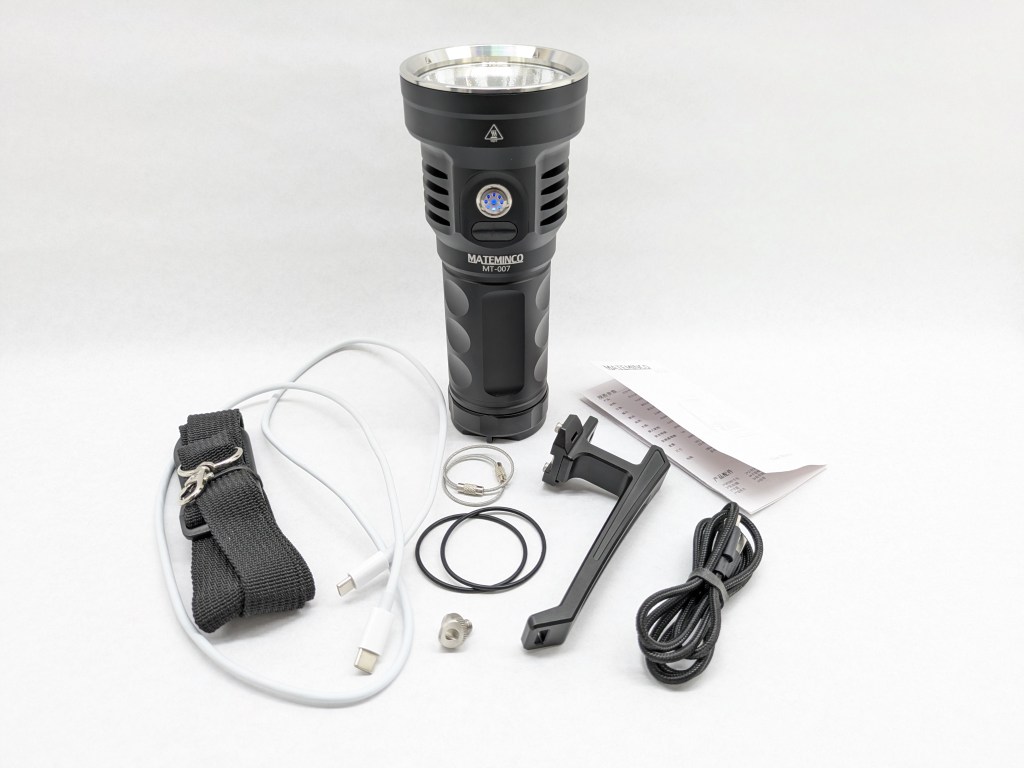
The box is nice with a magnetic closure and foam insert. Inside is:
- The light itself
- Battery (inside the light)
- User manual
- USB A-to-C charging cable & USB C-to-C charging cable
- Spare o-rings
- Shoulder strap with flexible ring loops
- Handle & hardware

Design & Construction


Build quality is hit or miss. The body of the light is nicely made, but the switch and handle leave a lot to be desired. It’s worth noting the IP rating is IP66, not IP67-68 like most lights.
Size & Measurements
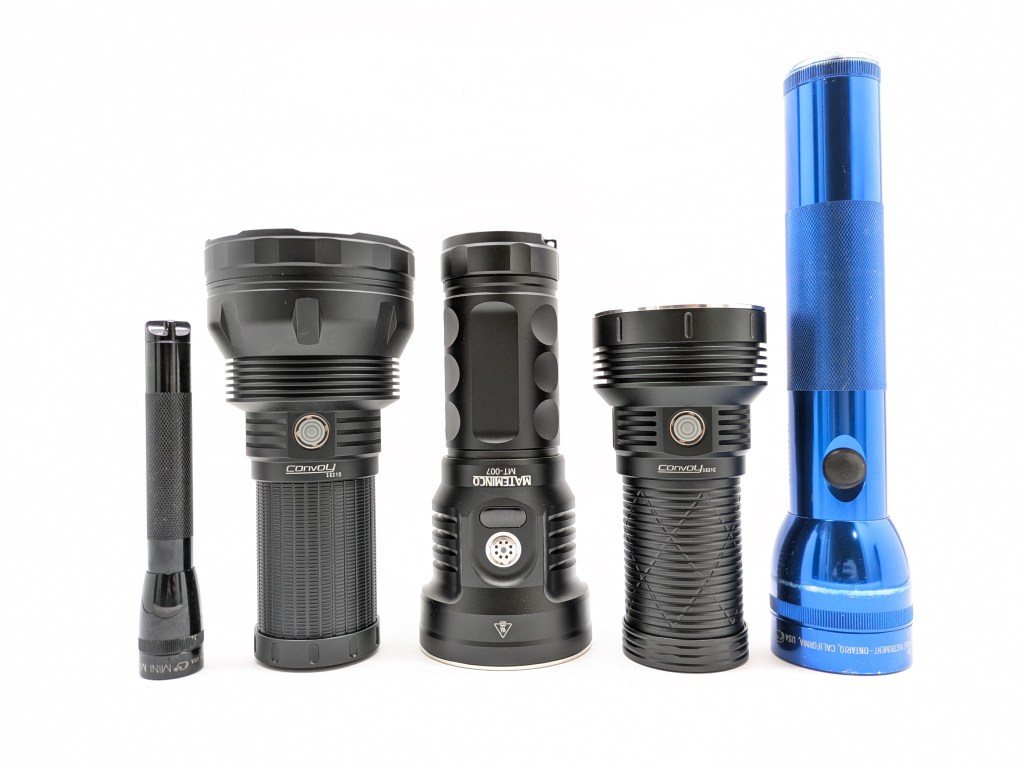
Mini Maglite | Convoy 3X21D | Mateminco MT-007 | Convoy 3X21C | Maglite 2X
| Measurement | Measured (mm) |
|---|---|
| Bezel Diameter | 79.2 |
| Maximum Head Diameter | 79.2 |
| Length | 184 |
| Switch Diameter | 10.8 |
| Body Tube Diameter | 53.0 |
| Tailcap Diameter | 54.9 |
| Tailcap Length | 18.8 |
| Driver Diameter | ~45 |
| Included Battery Length | 97.4 |
| Weight with included battery (g) | 1037 |
User Interface
This UI lacks most of the features I expect in an E-switch UI. I wouldn’t want to use it every day for daily carry, but for occasional use it’s fine.
The actions are # of presses followed by a hold (H) or a release (C). So, “1C” is one click and release. “2H” is two clicks but you hold down the last one.
| State | Action | Result |
|---|---|---|
| Off | 1C | On (mode memory) |
| Off | 1H | No result |
| Off | 4C | Voltage readout |
| Off | 5C | Lockout |
| Off | 6C | Enable/disable always-on switch LED |
| On | 1H | Adjust brightness |
| On | 1C | Off (except Turbo and Strobe sometimes) |
| Any | 2C | Turbo (not memorized) |
| Any | 3C | Strobe (not memorized) |
| Lockout | 5C | Low (bottom of ramp) |
Basic E-switch UI Checklist: 6/12
- 1C on/off❌
- 1C from Turbo/Strobe goes to the previous state, which may not be off, and that’s inconsistent. 1C in momentary mode does not turn it off, for obvious reasons. Otherwise it’s 1C on/off.
- 1H to change brightness✅
- Stepped levels❌
- Smooth ramping only.
- Main rotation is Low-Med-High❌
- Lowest-mode shortcut: 1H from off❌
- Low shortcut: 1H from Moonlight✅
- There are no discrete levels. If you go to the lowest level and hold the button, it will increase in brightness, so I’m giving it a point here.
- Turbo shortcut: 2C from anywhere✅
- Strobe shortcut: 3C from anywhere✅
- Note: Strobe is constant-frequency
- Mode memory for Low, Medium, and High❌
- No mode memory for Moonlight, Turbo, and Strobe✅
- 4C to lock/unlock❌
- Electronic lockout is activated/deactivated by 5C from off.
- Does something when you click the switch in Lockout mode✅
The App
According to the user manual, this model has Bluetooth and a corresponding phone app to control it remotely. Unfortunately, it’s Android only and isn’t hosted in the Play store. The only way to get it is to download the APK by scanning a QR code in the user manual. Then you have to go into your phone’s settings to let you install apps from unknown sources. That’s highly suspicious so I did not download or install it for testing. I hope Mateminco goes through the hoops to host their app on the Play store. Or better yet, just abandon the whole idea of app control for a flashlight because it’s a gimmick.
Emitter & Beam
MT007 has seven SFH55.2 LEDs that sit inside a custom orange-peel reflector. These LEDs produce a lot of brightness and throw, but don’t have great color properties. I tried everything short of a lens filter wrench to unscrew the bezel and it wouldn’t budge.
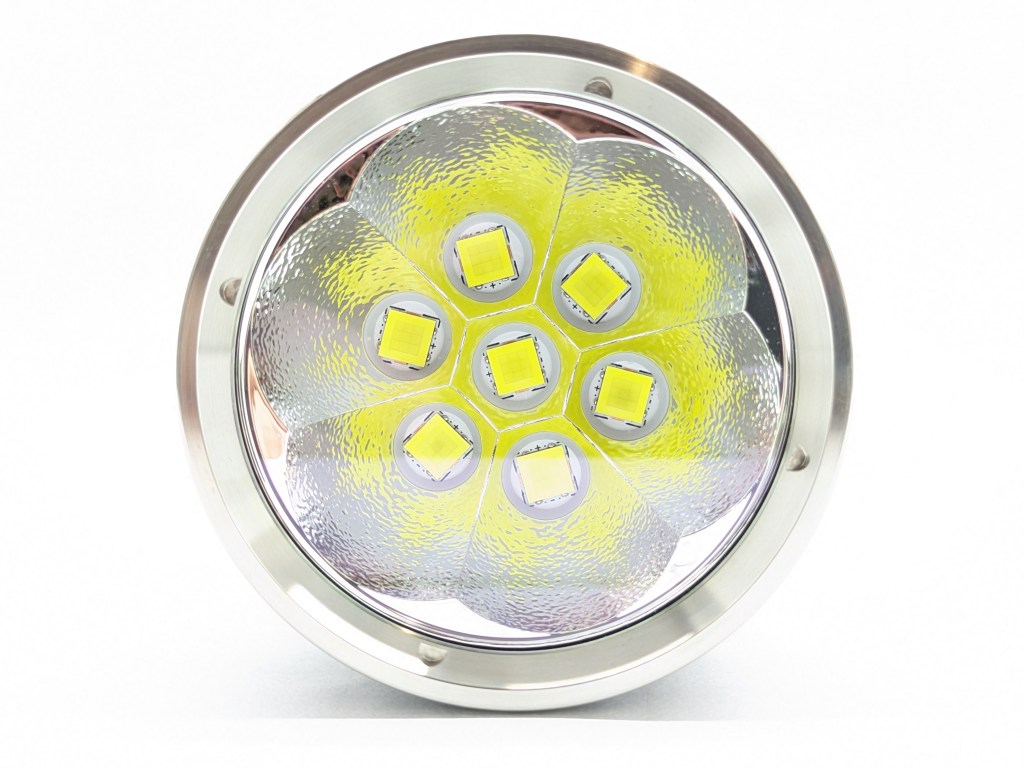
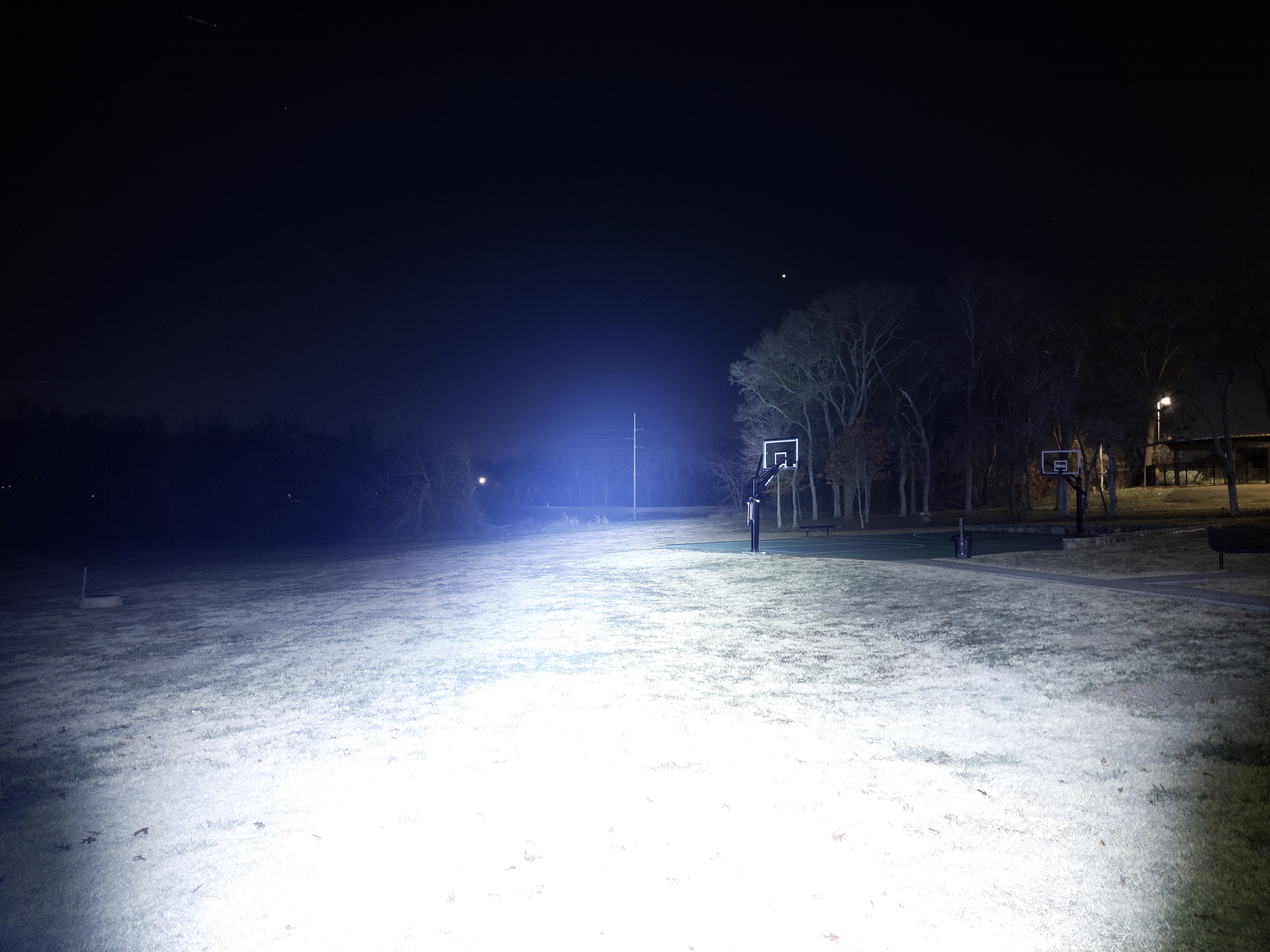
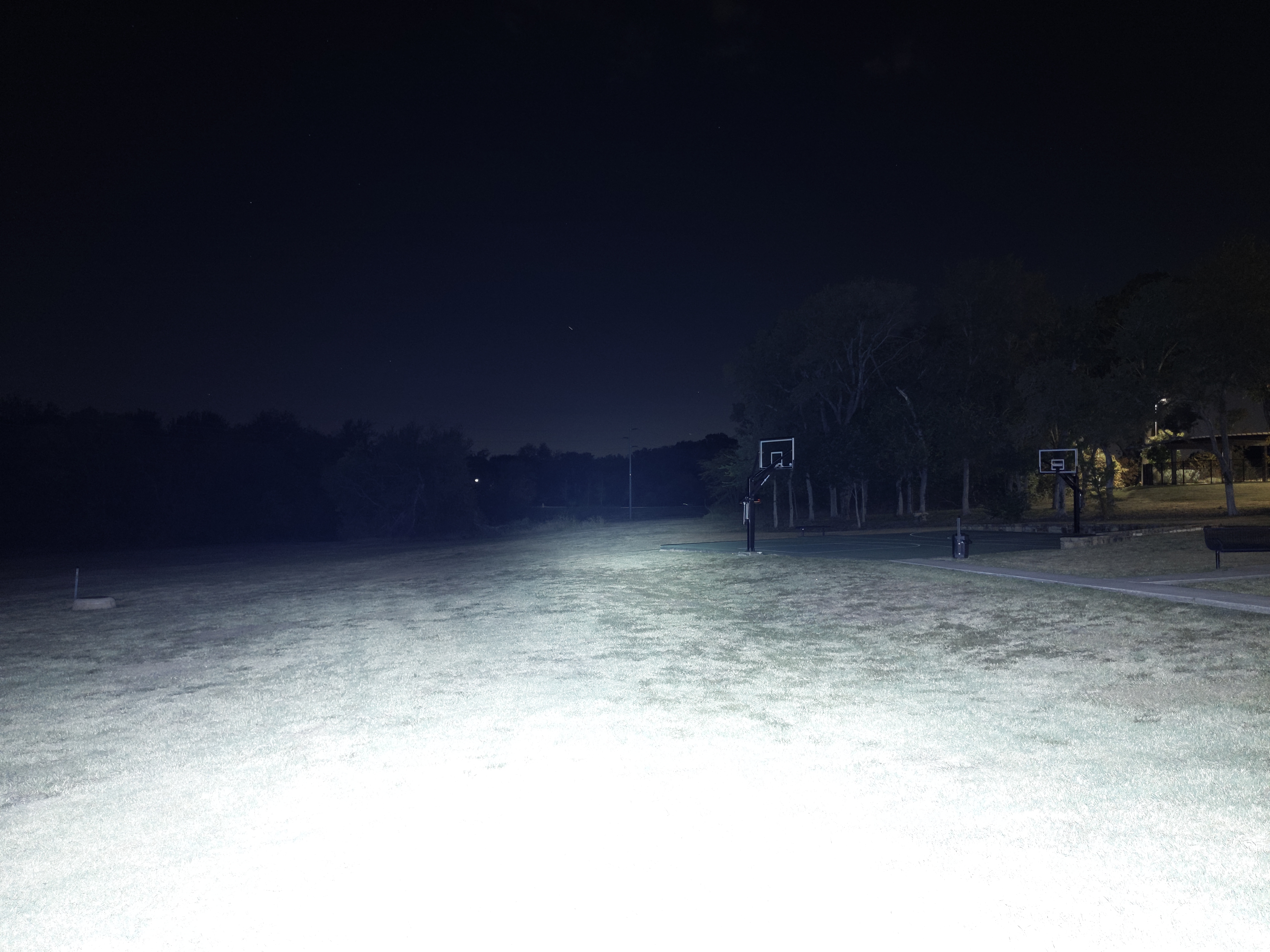
The beam has noticeable rings and flower petals throughout the spill. It’s not particularly clean, but it’s not problematic either. It’s fairly balance between flood and throw.
In the beamshots below, camera settings are fixed and the wall is 2.8M away.

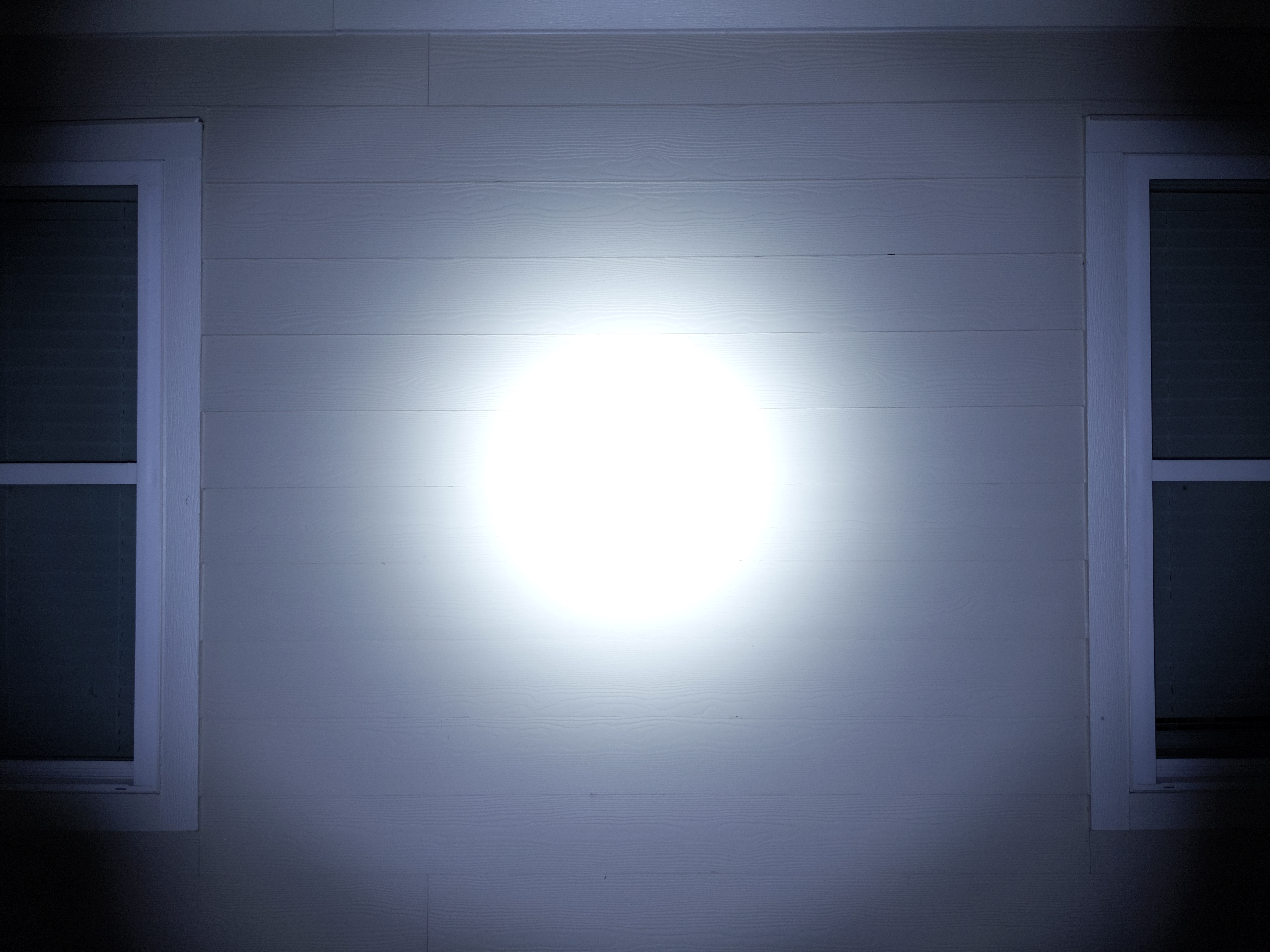

In the beamshots below, camera settings are fixed, the basketball goal to the right of the hotspot is 39M away, and the power pole in the center is 185M away.

Mode Chart
Disclaimer: All of my measurements are taken at turn-on. Lumen measurements were taken on a Texas Ace 3.5″ Lumen Tube. A candela measurement was taken at 10 meters with an Opple Light Master III on the highest brightness, and other candela figures were calculated relative to that. CRI, CCT, & DUV data were taken for each mode from a few feet away at the center of the hotspot with the Opple Light Master and Waveform DUV Calculator. Runtime tests were performed with the Ceilingbounce app on my smartphone. These tests were performed with a fully charged included battery unless otherwise specified. I cannot measure moonlight directly, so moonlight readings are calculated based on the brightness relative to the next-lowest mode. None of this is professional equipment, so take these measurements with a grain of salt.

The official specs are above, followed by my own measurements below. The brightness adjustment is smooth, so I only list measurements for the highest and lowest levels.
| Level | Lumens | Candela | Throw (Meters) | CRI (Ra) | Color Temp. (K) | DUV (Tint) |
| Turbo | 15500 | 95000 | 620 | 63 | 5660 | 0.0113 |
| High (top of ramp) | 9800 | 60000 | 490 | 61 | 5620 | 0.0129 |
| Low (bottom of ramp) | 100 | 610 | 50 | 58 | 5440 | 0.0163 |
This light fell significantly short of the advertised 21,000lm, which is disappointing. 15,000lm is still impressive nonetheless.
Runtime

Performance: Initial Turbo brightness is lower than advertised, but sustained output is excellent at ~3000lm. That’s better than any other light I’ve tested in this class (~$100-150 soda can flooders).
Thermal regulation: My Turbo and Turbo Cooled tests are virtually identical except for a spike at 6 minutes. It’s effectively a timed stepdown only as far as I’m concerned. I would expect a much larger difference if it had active thermal regulation.
LVP (Low Voltage Protection) is present and works well. When the battery is effectively empty, the light will shut itself off. It doesn’t rely on the battery’s protection circuit and the light can be re-activated in an emergency.
Driver & Regulation

The driver can supposedly deliver up to 65 amps, according to the user manual. I don’t know exactly what kind of driver it is (FET, Linear, Buck, or Boost). I had suspected FET, but the lack of any PWM and high sustained output makes me think it might be Linear or Buck.

Regulation performance is good/average. It maintains most of the Turbo brightness down to ~25% charge. The lowest mode is perfectly regulated (it’s the same brightness regardless of battery level). I didn’t realize High mode (top of ramp) was different than Turbo until after I had done the regulation test, so that’s why only Turbo appears in the chart above.
PWM: I couldn’t detect any PWM with my eyes, ears, camera, or Opple Light Master.
Parasitic Drain: 16.2 milliamps with the switch LED on. That will take 82 days to drain the included battery. If you turn the switch LED off, it goes down to 67 microamps, which will take 54 years to drain the included battery.
Batteries & Charging


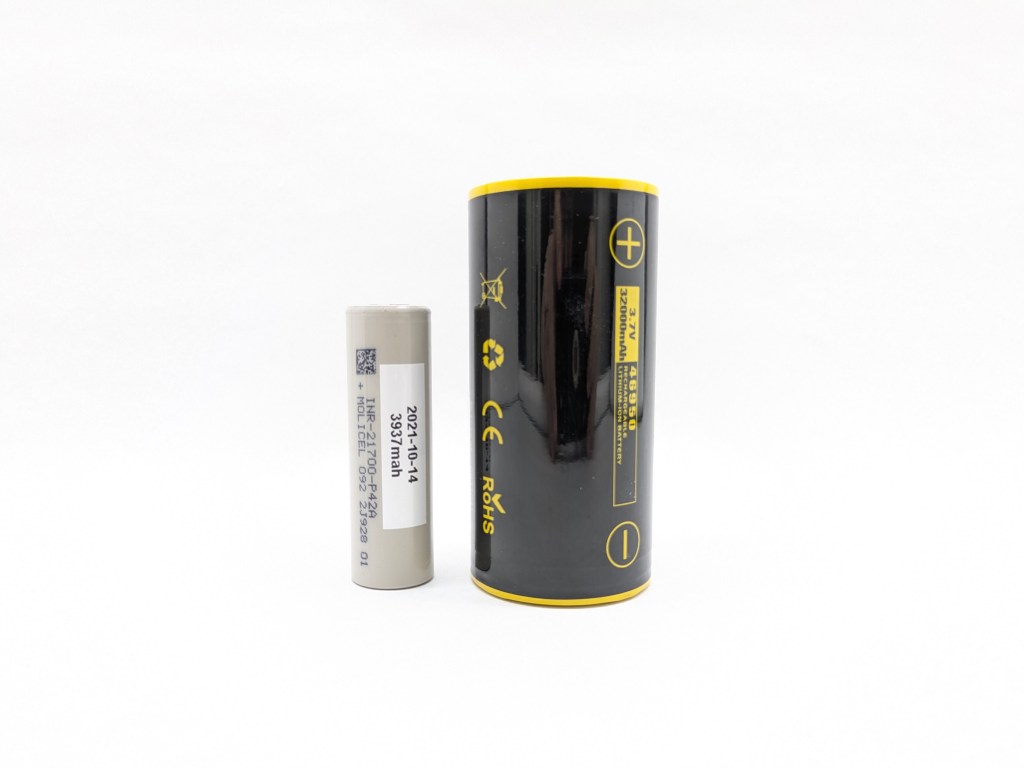
The battery included is a GIGANTIC 46950 cell. It’s a single 32000mAh cell. That’s 2-3x the capacity possible in similar-size lights using 18650 or 21700 cells.

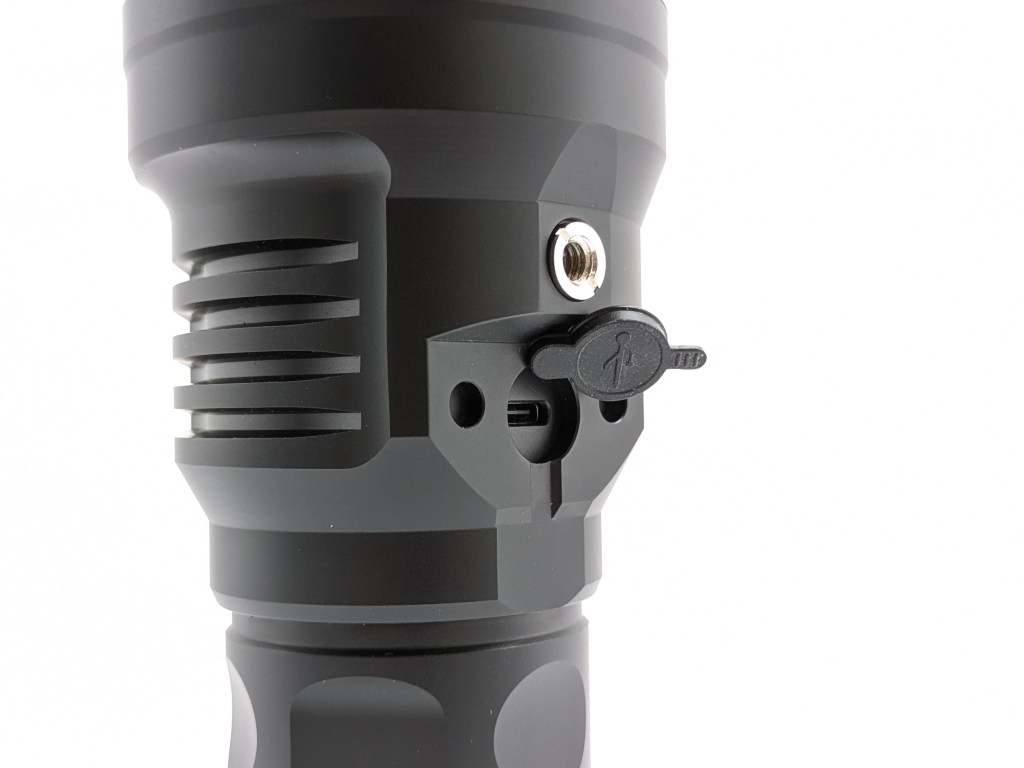
Charging is facilitated by a USB-C port on the side of the light under a silicone port cover. Charging is sloooow because the battery is so huge, and takes over 8 hours using an 18W adapter. It works when plugged in, but brightness is limited if you have the battery disconnected. With such a large battery I’m glad there’s a powerbank function. It’s rated up to 18W output, which is good.
The battery indicator is located under the switch and is lit constantly unless you turn it off. I wish it just activated for a few seconds after pressing the switch like most other lights. I don’t find this color system intuitive. I think red (low battery / charging) and green (high/full battery) would be better.
| State | Color/Pattern | Meaning |
| Charging | Solid Blue | Fully Charged |
| Charging | Solid Green | Charging |
| Unplugged | Solid Blue | >3.6V |
| Unplugged | Solid Green | 3.0-3.6V |
| Unplugged | Blinking Green | <3.0V |
Switch

This switch is not great. It’s a metal e-switch located on the side of the head. It’s a little bit loose and it rattles when you shake the light or touch the switch. The click is audible but not tactile at all, so it can be hard to tell when it clicks. As you press the switch, the metal boot rubs against the retaining ring and makes an audible scraping sound that’s not pleasant. I find that I miss-click much more frequently on this switch than most. The switch backlight is a battery indicator and it’s either on or off. It’s not like most lights where you click the switch and the indicator comes on for a few seconds and then turns off (that’s what I prefer).
Carry & Ergonomics
Ergonomics are fine. The button is well-placed and it balances in my hand well. It’s large and heavy with almost no texturing, so it often feels unwieldy in the hand. It works best in a forward grip but a neck grip is usable too.


The handle solution is very disappointing. It’s directly opposite from the button (not good, but normal). It covers the charging port, and that’s the only way to charge the light since the battery is a weird size. The included thumb screw is too short and barely bites into the threaded hole on the light, making me feel like it’s going to loosen and drop the light at any moment. That threaded hole on the light is a weird size so it actually has a separate steel insert (which can unscrew and become loose) to make it a standard tripod thread. Despite being a standard tripod thread, the bezel sticks out past that spot so you can’t actually mount the light to flat tripod plate. Overall it seems like an afterthought feature slapped on at the last minute.

Competition
Here are some lights in the same class and how they compare.
- less expensive
- a bit brighter
- significantly smaller
- no handle included
- can be tripod mounted
- better (and more complicated) Anduril 2 user interface
- better switch
- takes three 21700 batteries (less than half the capacity)
- lower sustained output and runtime
- less expensive
- almost as bright
- similar beam shape
- shorter and lighter weight, easier to handle
- marginally better handle
- no powerbank function
- different but not better or worse UI
- better switch
- no battery indicator in the switch (except while charging)
- lower sustained output and runtime
This section is not comprehensive. If I didn’t include a particular light here, it doesn’t mean it’s bad or doesn’t deserve to be here. I simply cannot list every possible competitor.
Conclusion
Mateminco MT-007 packs a LOT of performance for the price. 15,000lm turbo with best in class sustained brightness and runtime. The driver quality is excellent as well. I don’t think anything else competes with it at those metrics alone. However, the rest of the light feels under-developed like a prototype. Its unwieldy to hold and the included handle isn’t a good solution. Charging is slow and the battery indicator system is confusing. The UI is lacking a number of standard features, making it cumbersome to use at times. I like the concept of a large flooder with this huge 46950 battery, but this execution leaves a lot to be desired. If you’re wanting a well-polished light with a great user experience, you might want to consider other options. If you want the best performance you can get for the money and nothing else matters, this is a great option.
Thanks to FlashlightGo for sending me this light for review. They have a huge selection including most of my favorite lights!

 Grizzly's Reviews