
- Pricing & Availability
- What comes in the box?
- Design & Construction
- Size & Measurements
- User Interface
- Emitter & Beam
- Mode Chart
- Runtime
- Driver & Regulation
- Batteries & Charging
- Switch
- Carry & Ergonomics
- OLED Display
- Competition
- Conclusion
Pricing & Availability
Nitecore sent me this light in exchange for an honest review. Here is the official product page where you can see current pricing. At the time of writing it’s $150 USD.
What comes in the box?
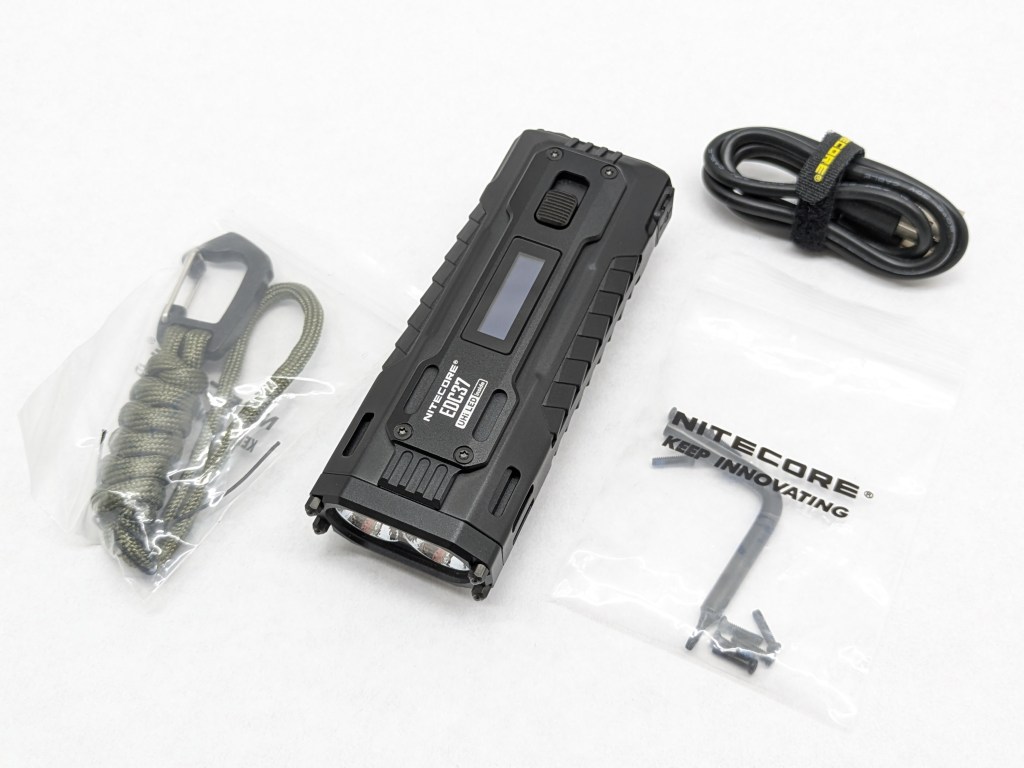
Mine is a pre-release sample and did not come with a retail box. It did include:
- The light itself
- USB A-to-C charging cable
- Paracord lanyard
- Disassembly tool & screws (optional replacements for the glass breakers)
Design & Construction
EDC37 has a great tacti-cool aesthetic, but it’s got chamfers in all the right places to not be bulky. I don’t care for the glass breakers, so I’m glad you can replace them with regular screws (included) using the included tool.
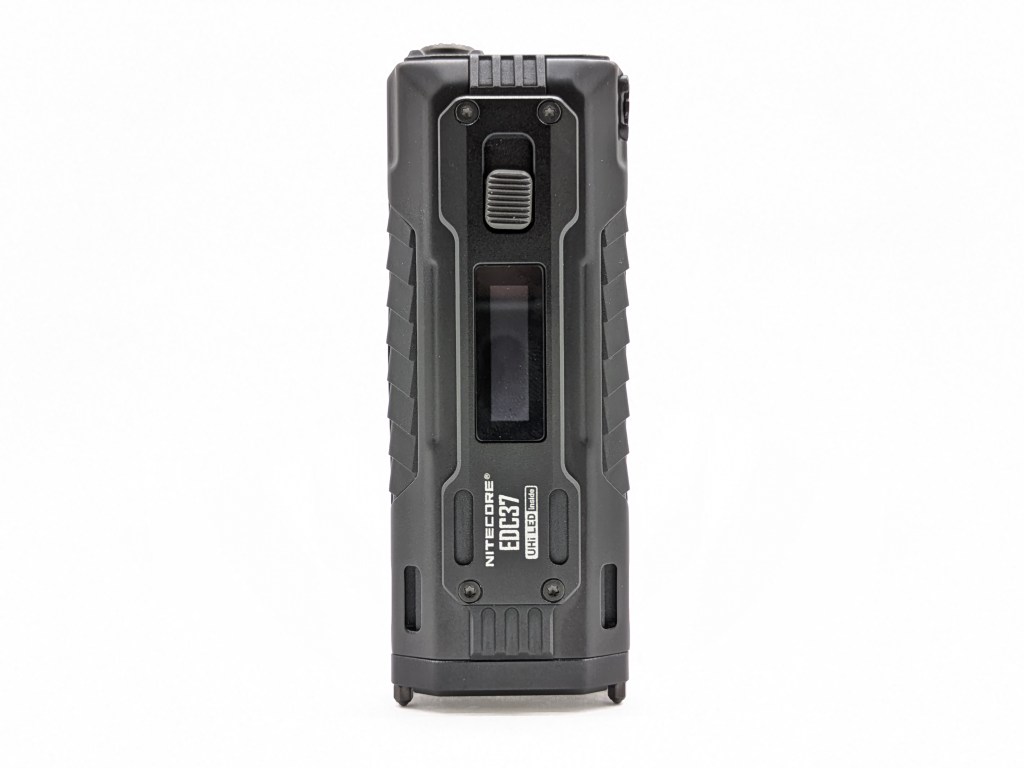
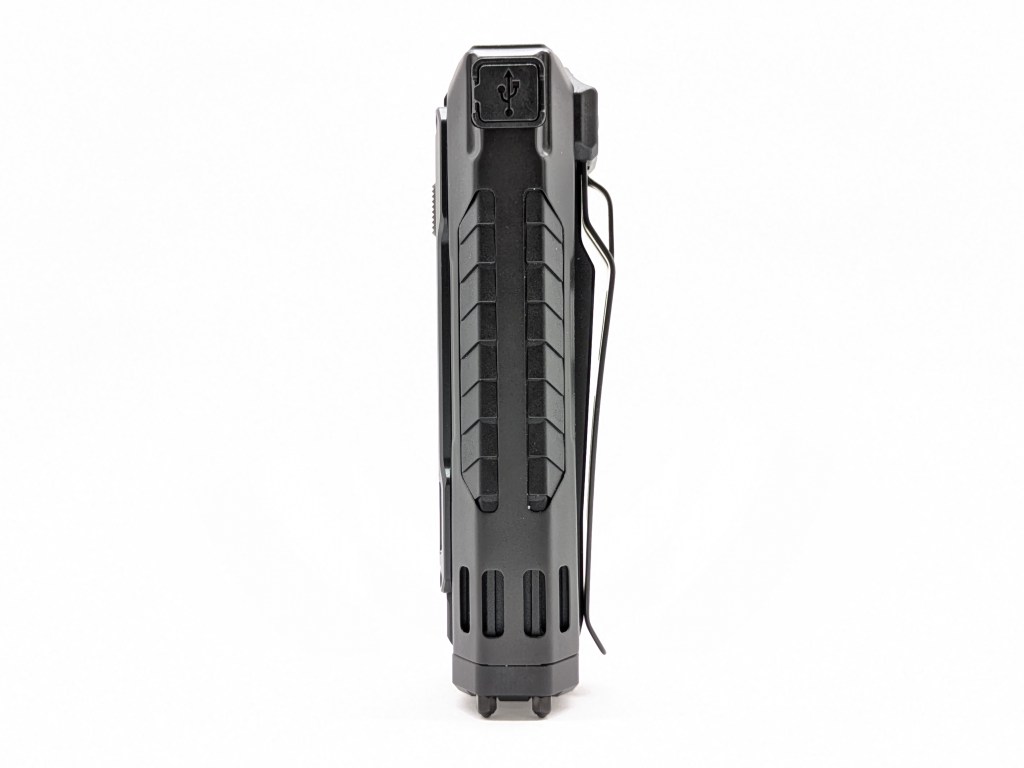

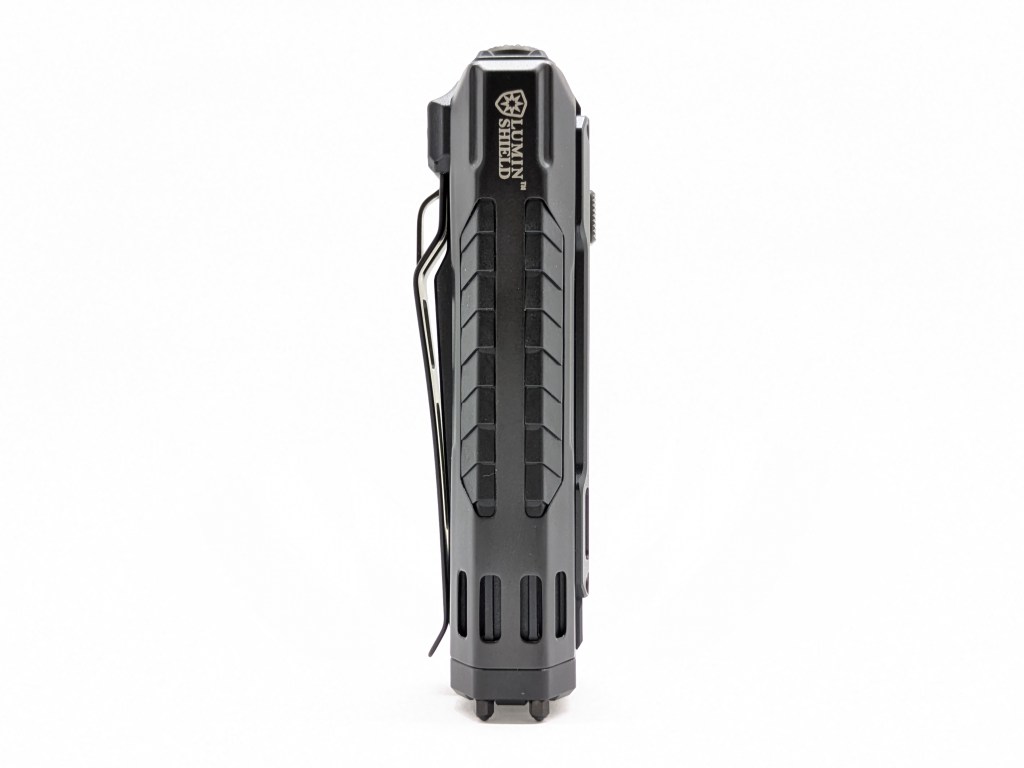
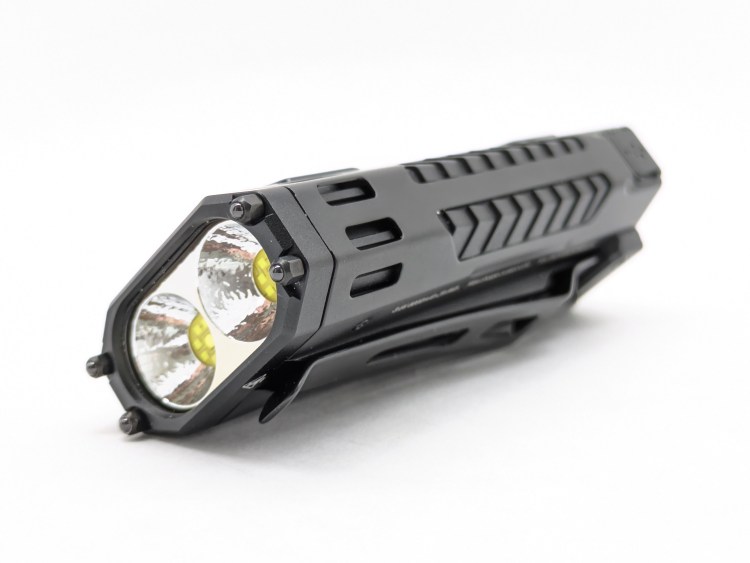

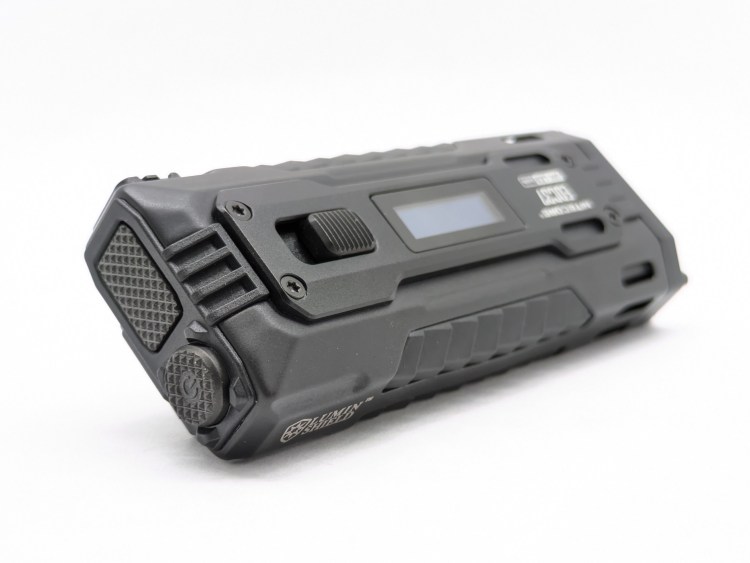
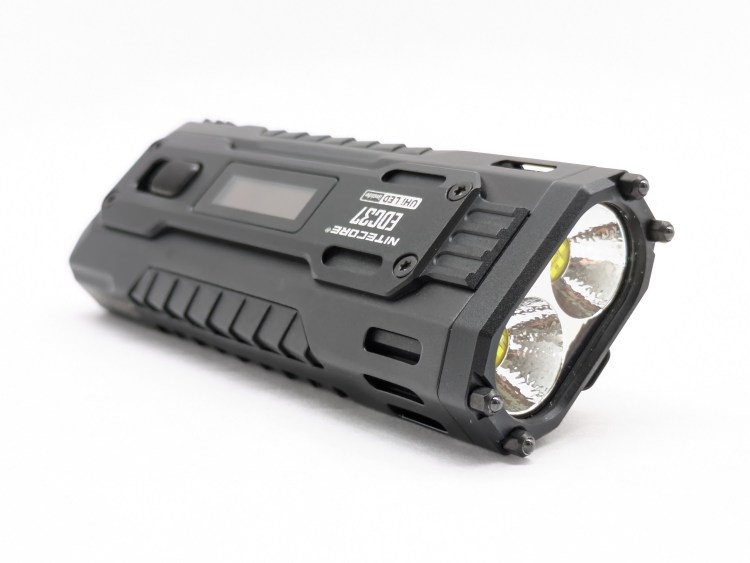
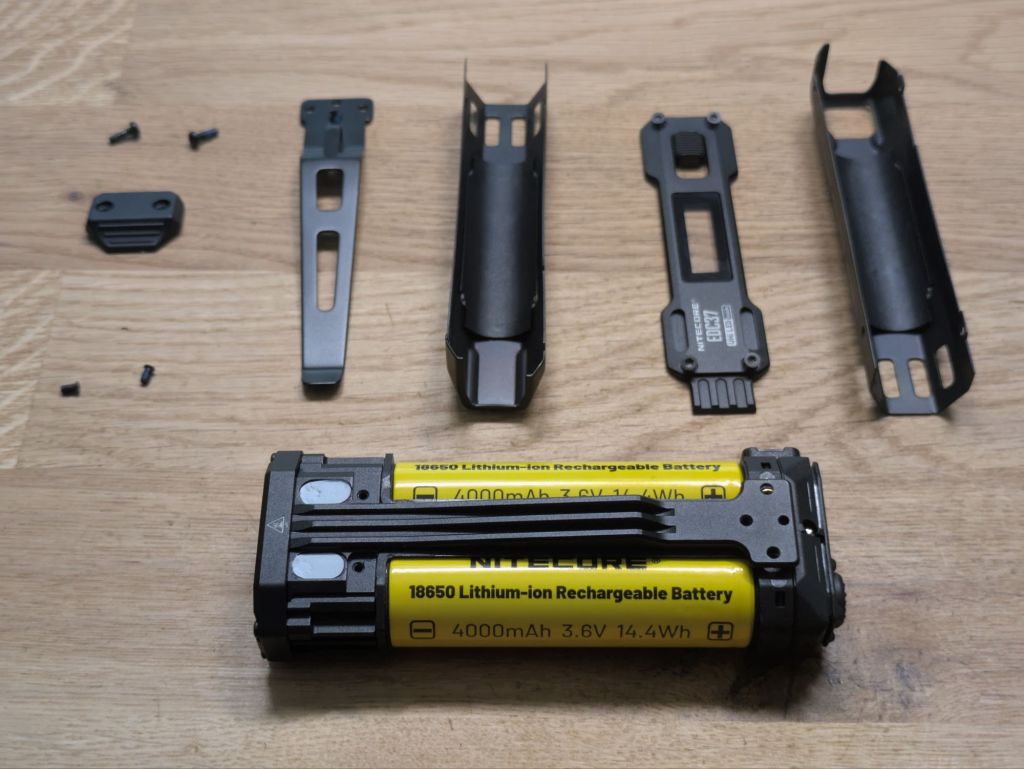
Build quality is good. It’s constructed with a plastic and aluminum frame and two steel side panels. It screws together and can be partially disassembled, but it doesn’t give you access to anything critical. For full disassembly I think you’d need a soldering iron. The batteries are not user replaceable.
Water resistance: It’s worth noting this light is IP54 rated, not the IP67-IP68 typically found in quality flashlights. If you plan to use the light around water, that may be a deciding factor for you.
Size & Measurements
Mini Maglite | Nitecore MT2C Pro | Nitecore EDC37 | Skilhunt M200 V4 | Surefire G2X Pro
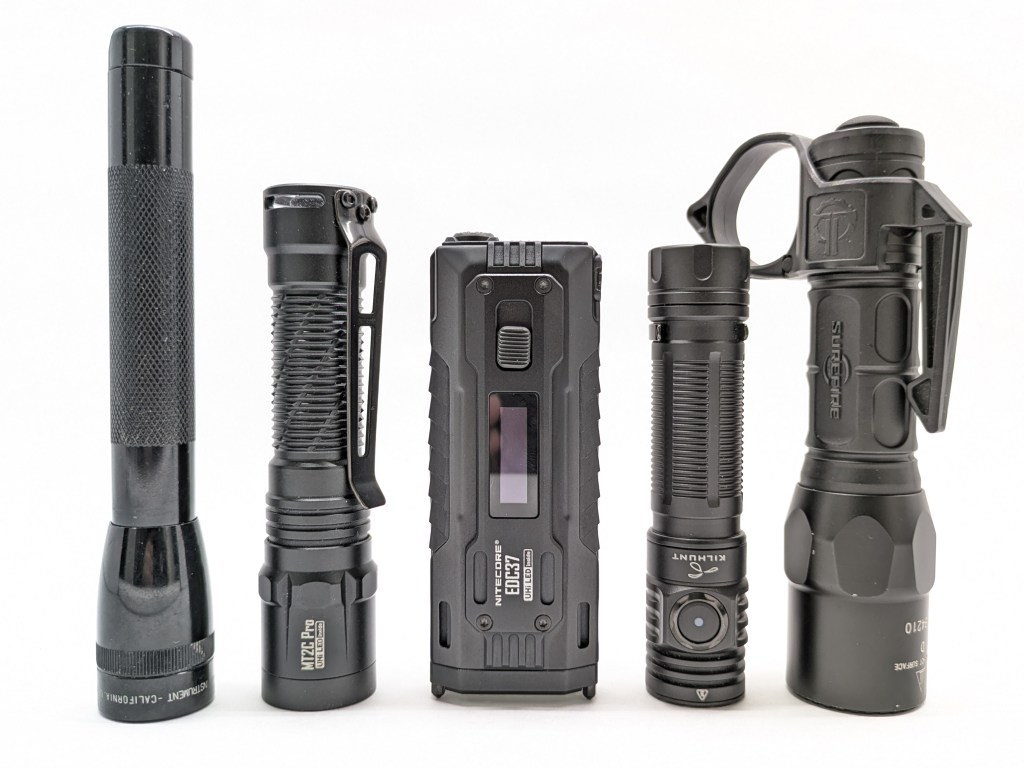
| Measurement | Measured (mm) |
|---|---|
| Length (without glass breakers) | 105.3 |
| Width | 39.3 |
| Thickness (including clip) | 20.7-29.7 |
| Pocket Clip Screw Spacing | 13 |
| Weight (g) | 199 |
User Interface
This is largely the same UI Nitecore uses on their other flat EDC-series lights and it works well.
This light has two two-stage switches on the tail. One has a power icon, so I’ll call it the “power” switch. The other is the Turbo/Strobe switch, which I’ll call “T/S”. There’s also a slider switch on the side for lockout.
| State | Switch | Action | Result |
|---|---|---|---|
| Off | Power | Full-Press | On |
| Off | Power | Half-press | Turn on display |
| Off | Power | Half-Press and hold | Momentary “Ultra-low” |
| Display only | Power | Half-press | Change mode while off |
| On | Power | Half-Press | Cycle mode (“Ultralow”-Low-Med-High) |
| Any (except full lockout) | T/S | Half-Press and hold | Momentary Turbo |
| Any (except full lockout) | T/S | Full-Press and hold | Momentary Luminshield |
| Turbo/Strobe/Luminshield | Power | Full-Press | Switch between Turbo, Luminshield and Strobe groups |
What they got right:
- There’s a dedicated Turbo/Luminshield/Strobe button. I love being able to quickly, instantly, and momentarily access Turbo without needing a specific series of clicks. It’s a great feature. I love that I can choose among Turbo+LumenShield, Turbo+Strobe, or Turbo only.
- There’s a dedicated lockout switch. It’s easier and faster to use than a bunch of clicks, a long hold, or loosening a tailcap.
- Turbo, Luminshield, and Strobe are not memorized. They have a dedicated switch, so you can access them quickly without overriding your memorized mode.
- There’s a shortcut to the lowest mode. Half-pressing the power switch will momentarily activate the lowest mode. That’s great for situations where you don’t want to cycle through High to get down to “Ultralow”.
- You can change the brightness while the light is off and that’s pretty cool. Half-pressing and releasing the power switch while it’s off will light up the display and let you select the brightness level before turning on the light.
What they got wrong:
- Nothing worth mentioning here.
Notes:
- Half lockout: They appear to have removed the goofy half-lockout mode found on previous models. That’s a minor but nice improvement.
- Ultralow: I’m glad there’s momentary direct access to “ultralow” by holding a half-press, and I’m glad that I can cycle to ultra-low before turning the light on. I think it would be better to be able to half-press into momentary ultralow and then full-press for constant ultralow, instead of having to look at the screen. It’s a minor thing, but it’d be nice.
- Ultralow isn’t that low, it’s 14lm. Not a big deal, just don’t expect a proper moonlight mode.
Emitter & Beam
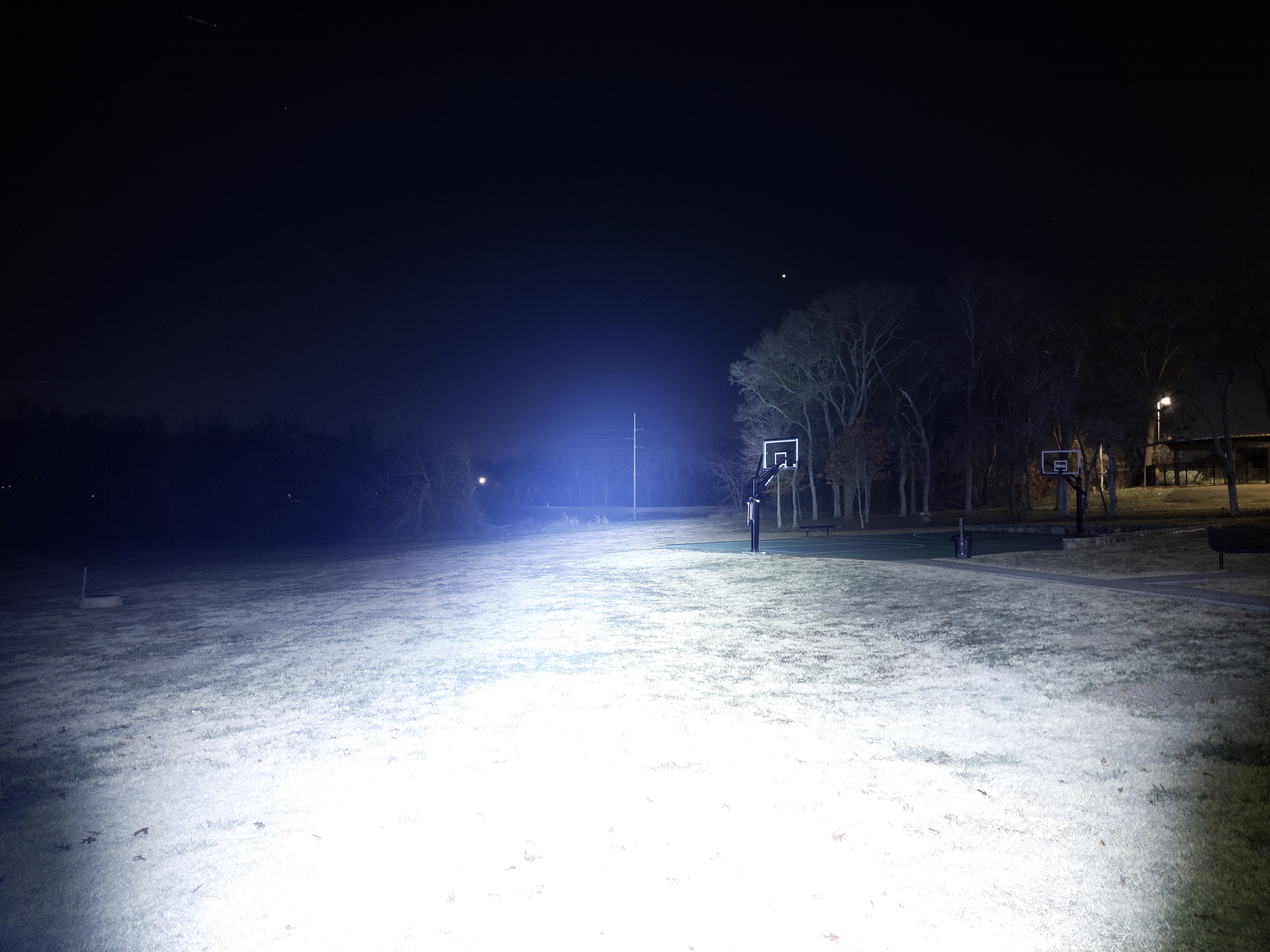
One of the big features of EDC37 is the two NiteLab UHi-20 MAX LEDs with a total of eighteen dies between them. They produce 7,700 lumens at turn on in my testing, the most brightness I’ve seen from a light this size. It’s only for a few seconds at a time but it’s jaw-dropping. They also are segmented, so all the dies turn on in Med, High, and Turbo, but only the center dies turn on in “Ultralow”, Low, and Turbo. That lets you vary how bright you need the spill to be. There is no proximity sensor on this model so it will not automatically dim if there’s an obstruction in front of the light. Be careful and use the lockout switch when it’s in a bag or pocket.

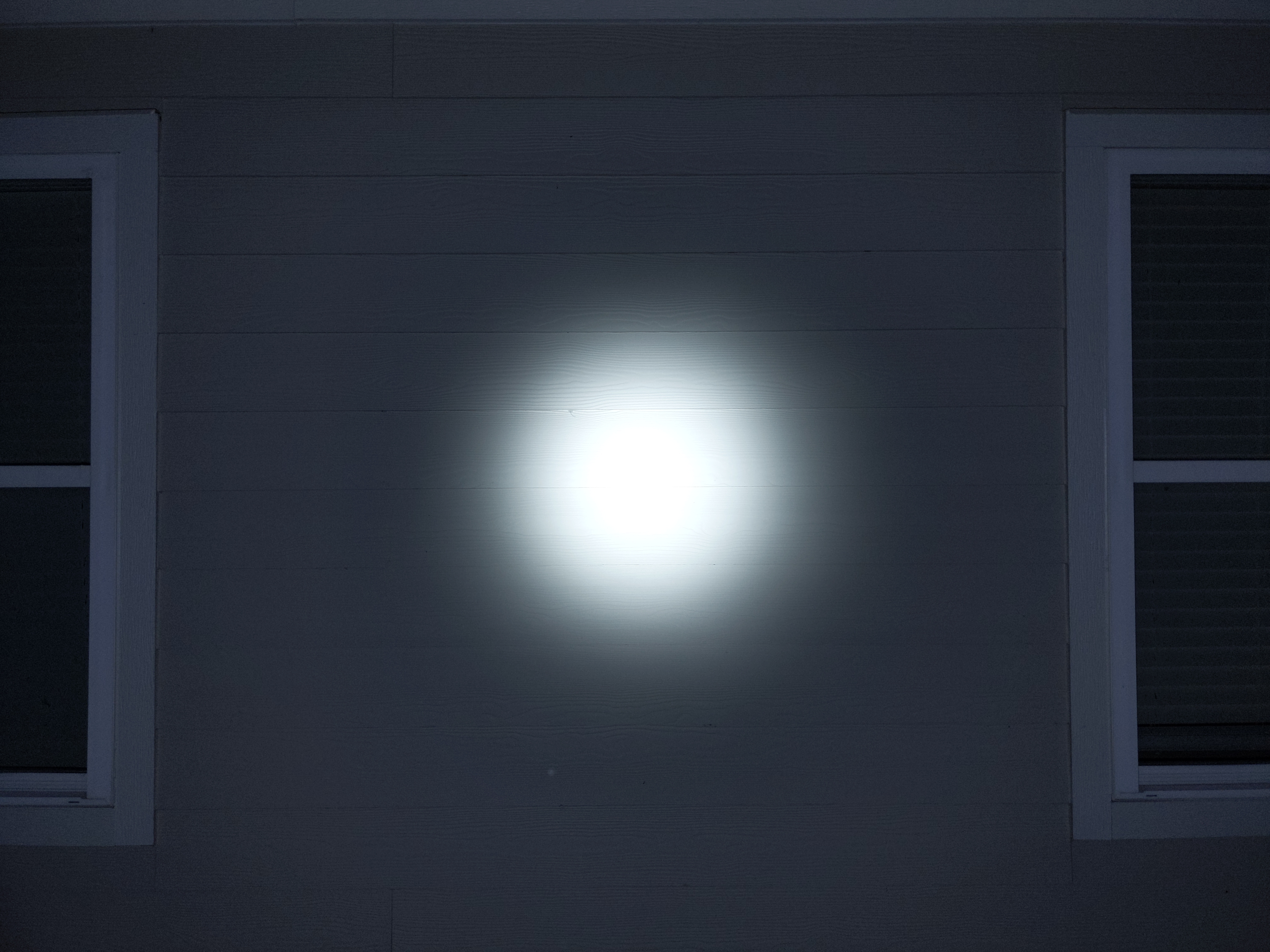
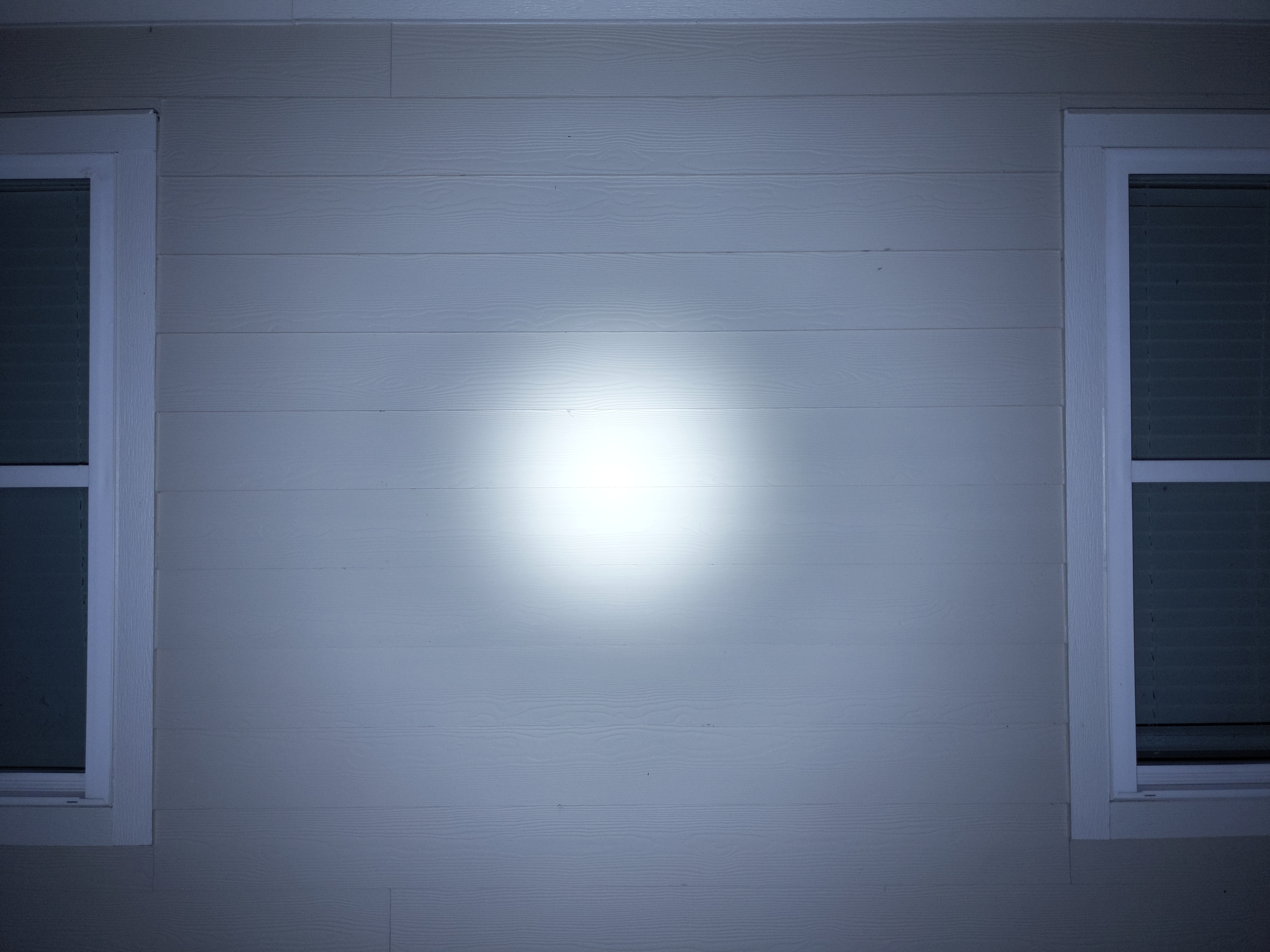
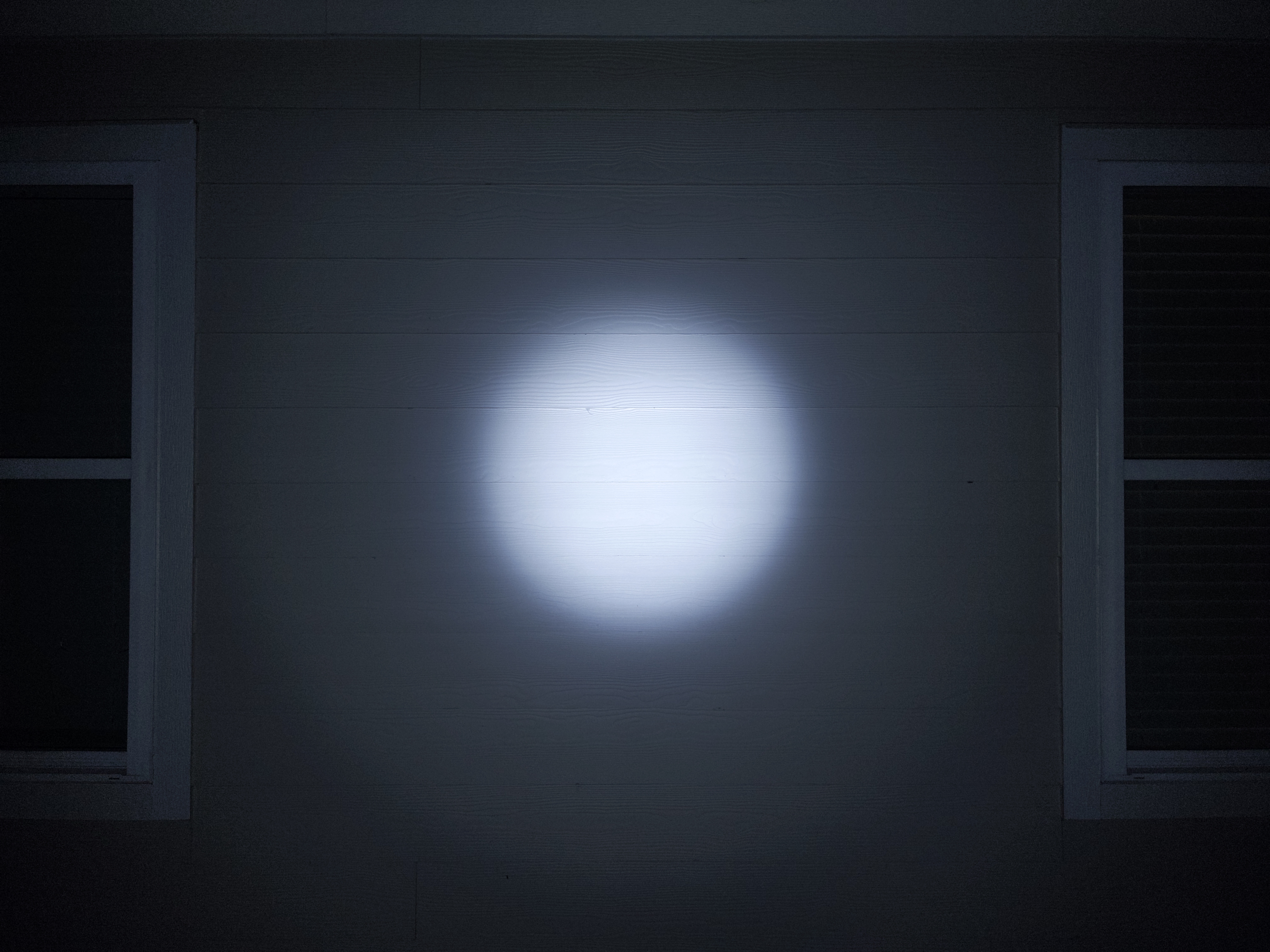
The beam with just the center dies is surprisingly throwy (17.9 CD/LM). With all dies activated, the spill gets much brighter and becomes a floodlight (5.2 CD/LM). The spill has the same minor flat spots as the other flat EDC lights from Nitecore, caused by the bezel.
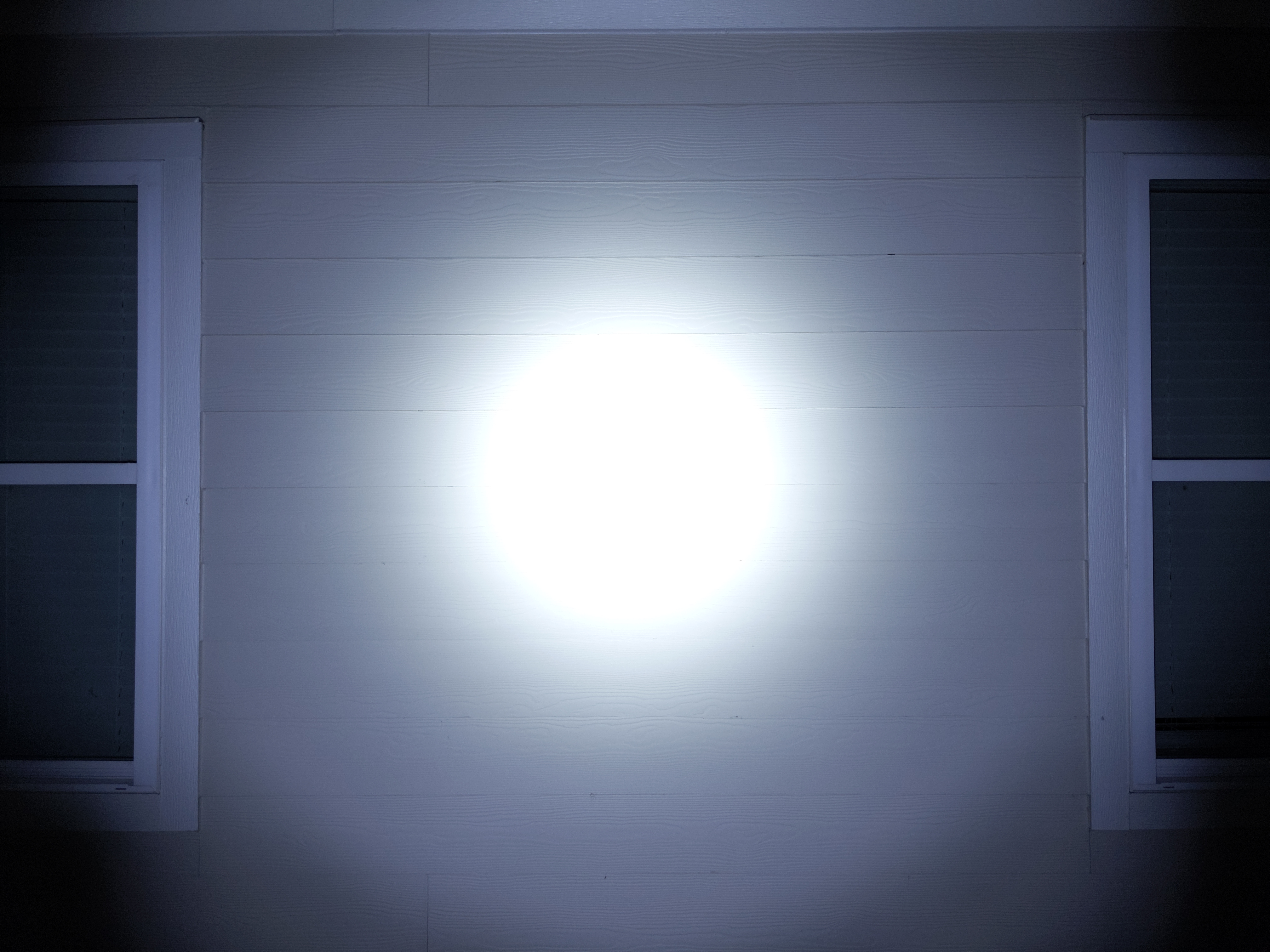
In the beamshots below, camera settings are fixed and the wall is 2.8M away.
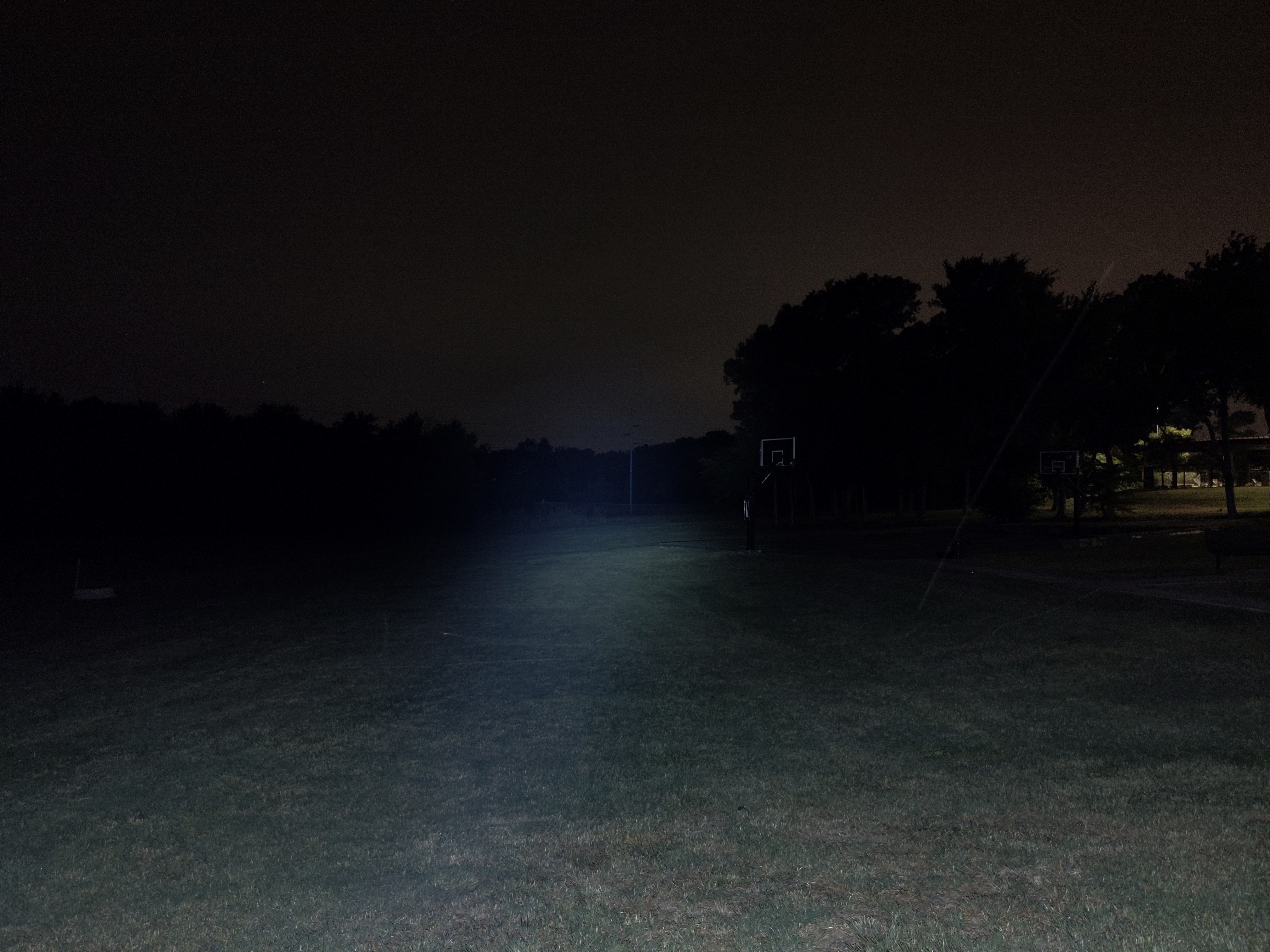
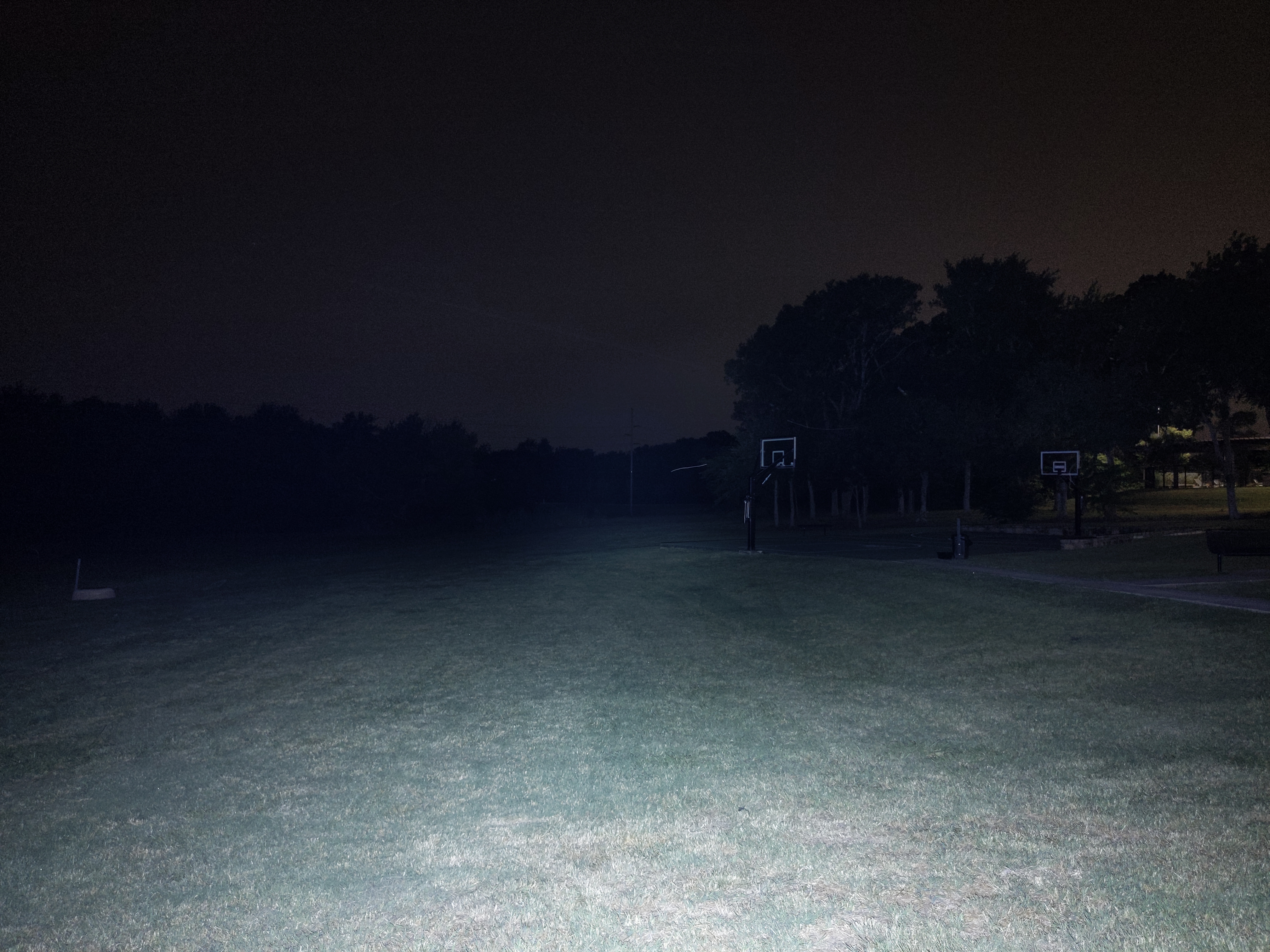
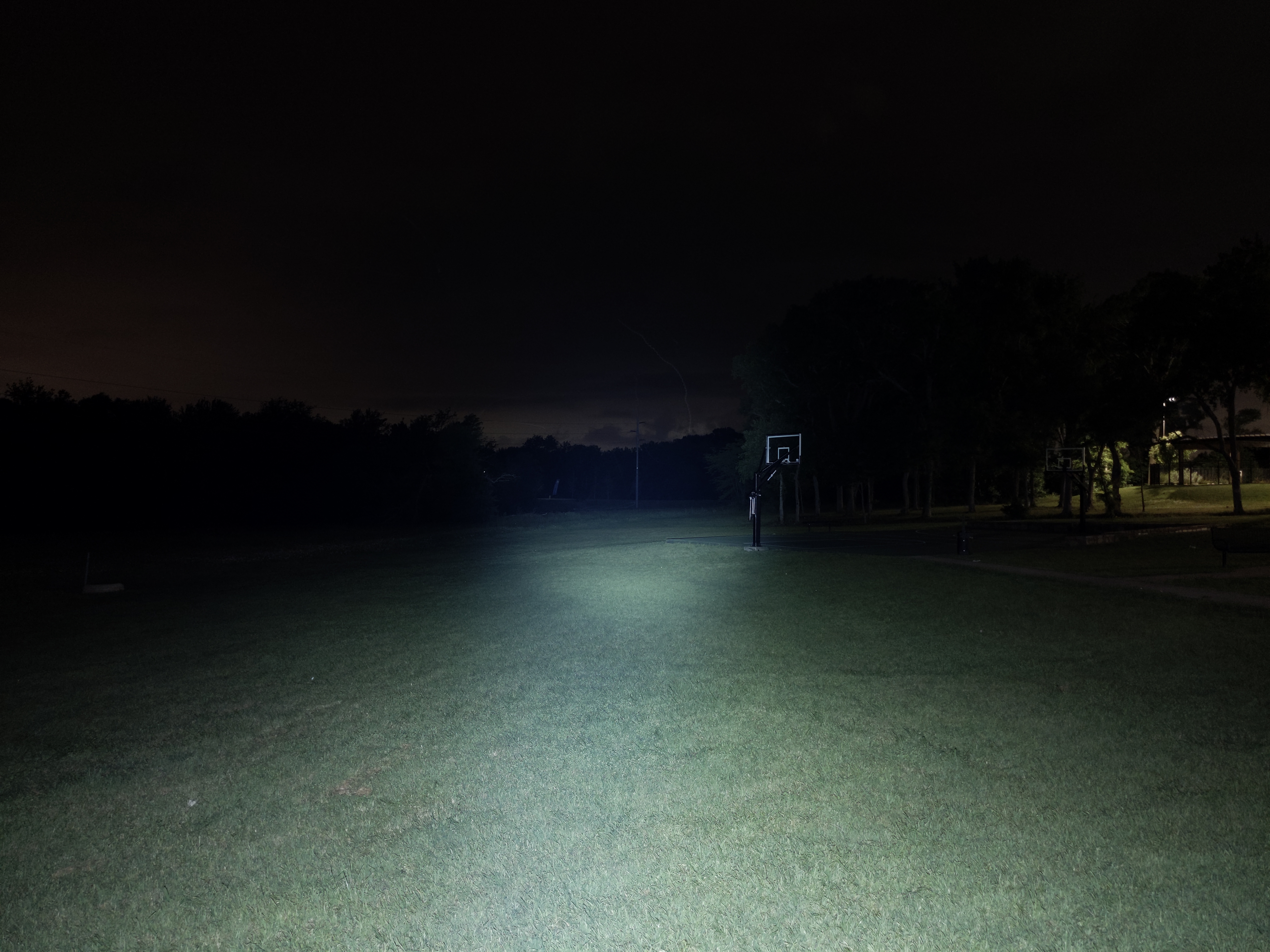
In the beamshots below, camera settings are fixed, the basketball goal to the right of the hotspot is 39M away, and the power pole in the center is 185M away.
Mode Chart
Disclaimer: All of my measurements are taken at turn-on. Lumen measurements were taken on a Texas Ace 3.5″ Lumen Tube. A candela measurement was taken at 10 meters with an Opple Light Master III on the highest brightness, and other candela figures were calculated relative to that. CRI, CCT, & DUV data were taken for each mode from a few feet away at the center of the hotspot with the Opple Light Master and Waveform DUV Calculator. Runtime tests were performed with the Ceilingbounce app on my smartphone. These tests were performed with a fully charged included battery unless otherwise specified. I cannot measure moonlight directly, so moonlight readings are calculated based on the brightness relative to the next-lowest mode. None of this is professional equipment, so take these measurements with a grain of salt.
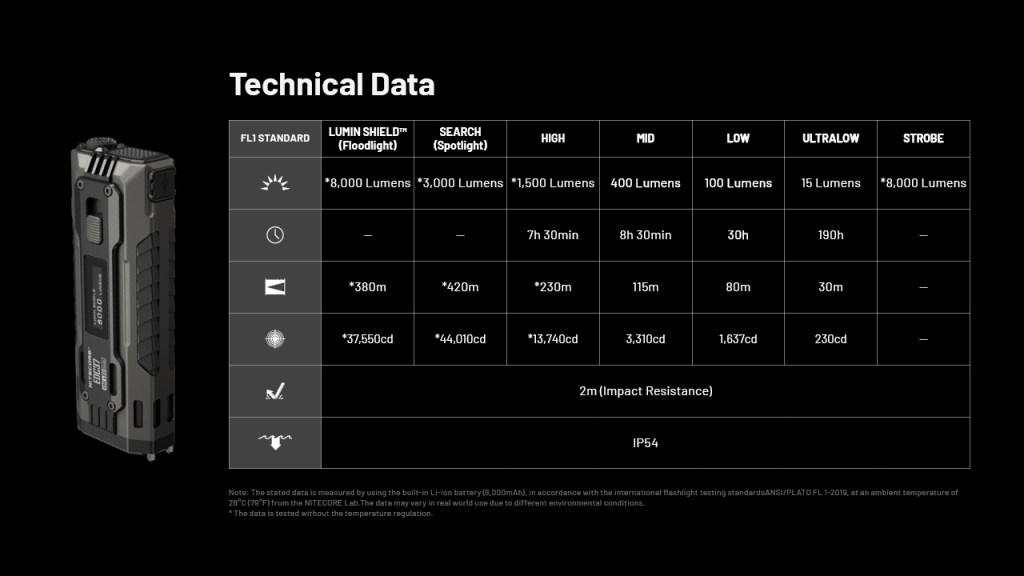
The official specs are above, followed by my own measurements below.
| Level | Lumens | Candela | Throw (Meters) | CRI (Ra) | Color Temp. (K) | DUV (Tint) |
| Luminshield | 7700 | 40000 | 400 | 68 | 6050 | 0.0062 |
| Turbo | 2800 | 50000 | 447 | 68 | 6000 | 0.0057 |
| High | 1400 | 7300 | 170 | 64 | 5570 | 0.0105 |
| Medium | 390 | 2000 | 89 | 62 | 5500 | 0.0124 |
| Low | 110 | 2000 | 89 | 63 | 5380 | 0.0122 |
| Moonlight | 14 | 250 | 32 | 61 | 5310 | 0.0140 |
Note: Low, Moonlight, and Turbo only use the center dies. Medium, High, and Luminshield use all the dies. That’s how Low and Medium have such a large lumen difference but the same throw distance.
Runtime
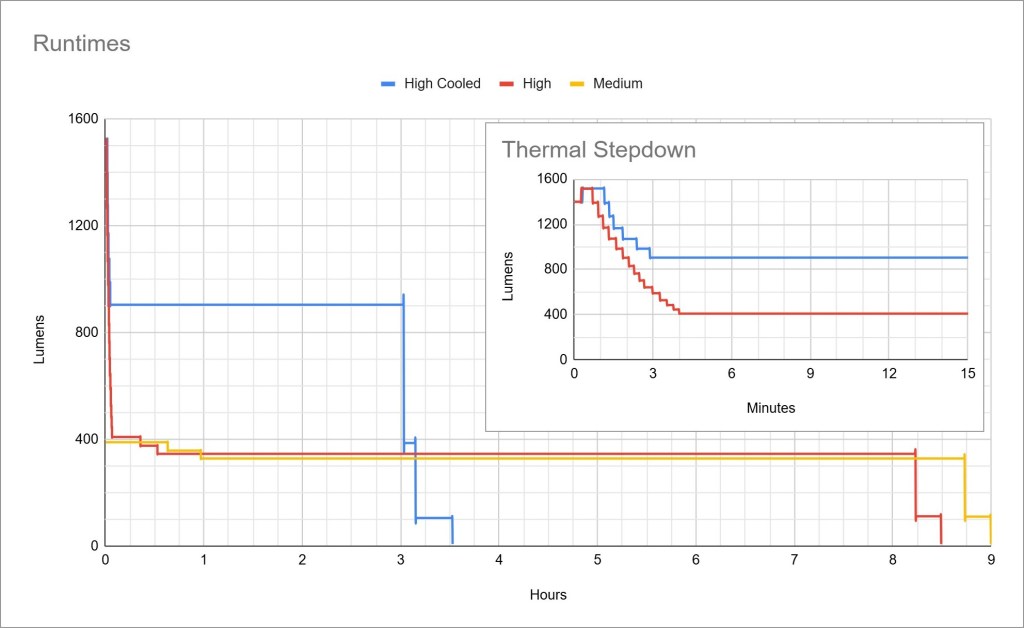
Turbo and LumenShield aren’t graphed because they’re momentary only and step down after 15 seconds and 10 seconds, respectively.
Performance: Sustained output is quite poor for a light this size (I would expect more like 1000lm) but total runtime is excellent.
Thermal regulation: My Turbo Cooled test shows a significant increase in sustained brightness, meaning this light has active thermal regulation that will adjust brightness to give you maximum performance without overheating.
LVP (Low Voltage Protection): May or may not be present. In each of my runtime tests I let the light run for several hours after it had dropped to a very low brightness (a few lumens), but it never shut off before I ended the tests.
Driver & Regulation
Driver: I don’t have any details about the driver. My guess is it’s a FET, but I don’t really know.

Regulation performance is great. It maintains most of the Luminshield and Turbo brightness down to ~30% charge. Normally I qualify that as “good” but the staggering brightness here makes that very impressive.
PWM: No PWM is visible to my eyes or camera, nor audible to my ears. My Opple detected some kind of flickering on Med and High modes, but it’s not PWM.
Parasitic Drain: I can’t measure the parasitic drain because the battery is built in.
Batteries & Charging
The battery included is a built-in 8000mAh 3.6v pack rated at 22A max discharge and 4.8A max charging current. It’s two 4000mAh 18650 cells in parallel and you can see the cells by taking the side panels off, but they appear to be soldered or spot welded in place so you can’t replace them.
That sucks that you can’t replace the batteries. As you can see, the batteries are right there and they’re standard 18650 cells. This isn’t a special li-po pouch cell like their other flat-lights. They should have added springs and made the light 3mm longer so the user can replace the batteries when they wear out instead of having to replace the entire light. All of the competitors I list in the competition section have a user-replaceable battery or batteries.
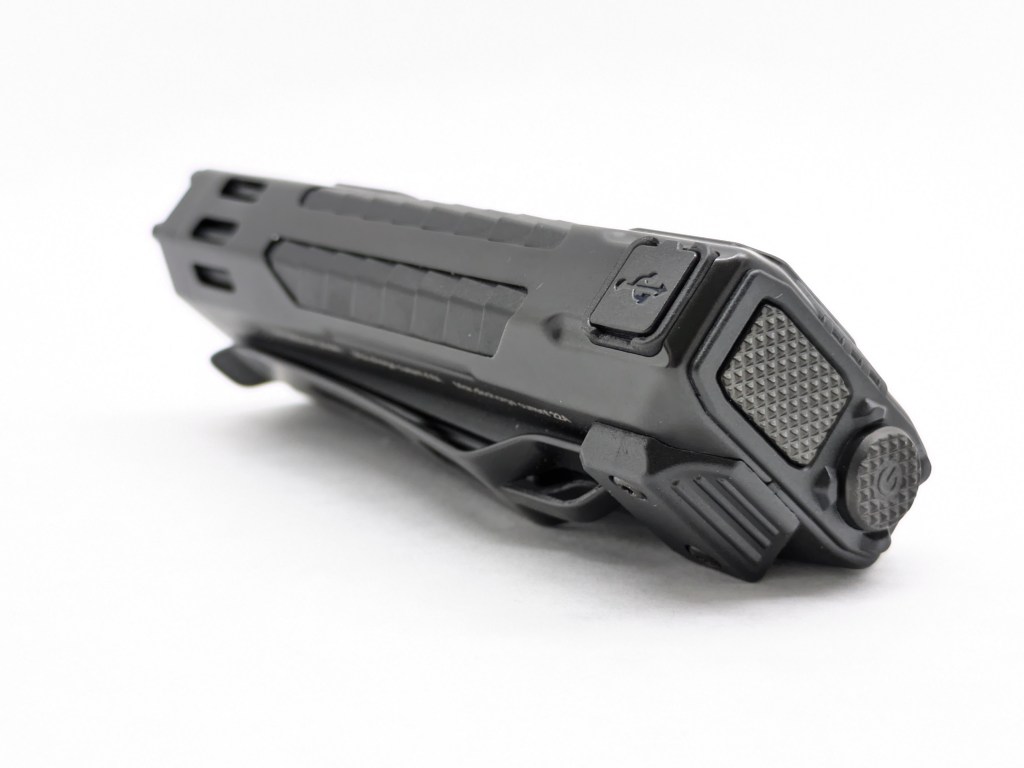
Charging is facilitated by a USB-C port on the side near the tail. It’s covered by a plastic and rubber port cover. Both A-to-C and C-to-C charging work fine. Charging takes just under three hours. The battery is large enough that it should have a powerbank function, but it doesn’t. The light works while charging except for Turbo and Strobe.
The battery indicator is a percentage number and progress par on the display. Not only that, but it also gives you estimated time remaining after the light has been on for a few seconds. Simple indicator LEDs work just as well for me, but the display is a neat gimmick.
Switch
EDC37 has three awesome switches.
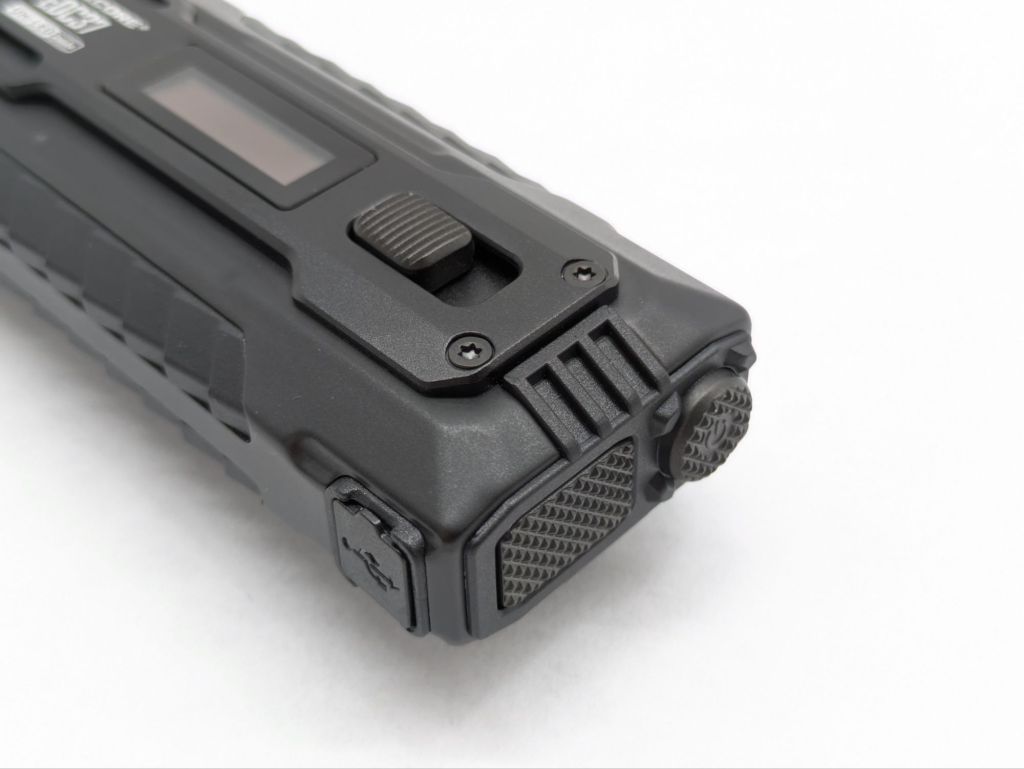
The main power switch is circular and proud. It controls on/off and mode selection. It’s two-stage, so a full-press turns on/off, and a half-press changes modes. You can even change modes while it’s off. Very nice!
The flat rectangular switch is the instant Turbo/Strobe/Luminshield switch. It’s momentary only, so releasing it will turn the light off. It’s two-stage, so a half press activates Turbo and a full press activates Strobe or Luminshield. I love having a dedicated Turbo switch that makes it instantly accessible. I also love that I can choose between Turbo+LumenShield, Turbo+Strobe, or just Turbo.
The toggle switch on the side is for Lockout. I like it because it’s dramatically easier to use than a long hold, series of clicks, or loosening a tailcap. This is a light where lockout might be necessary because both of the main switches are sensitive, it’s freaking bright, and does not have a proximity sensor. My only gripe is that the switch seems backward to me. I wish it unlocked when I push it toward the tail, because my thumb will already be moving that direction when I go to turn it on.
Even though the switches aren’t even, the light will tailstand. It’s just a little crooked and can fall over easily if jostled.
Carry & Ergonomics
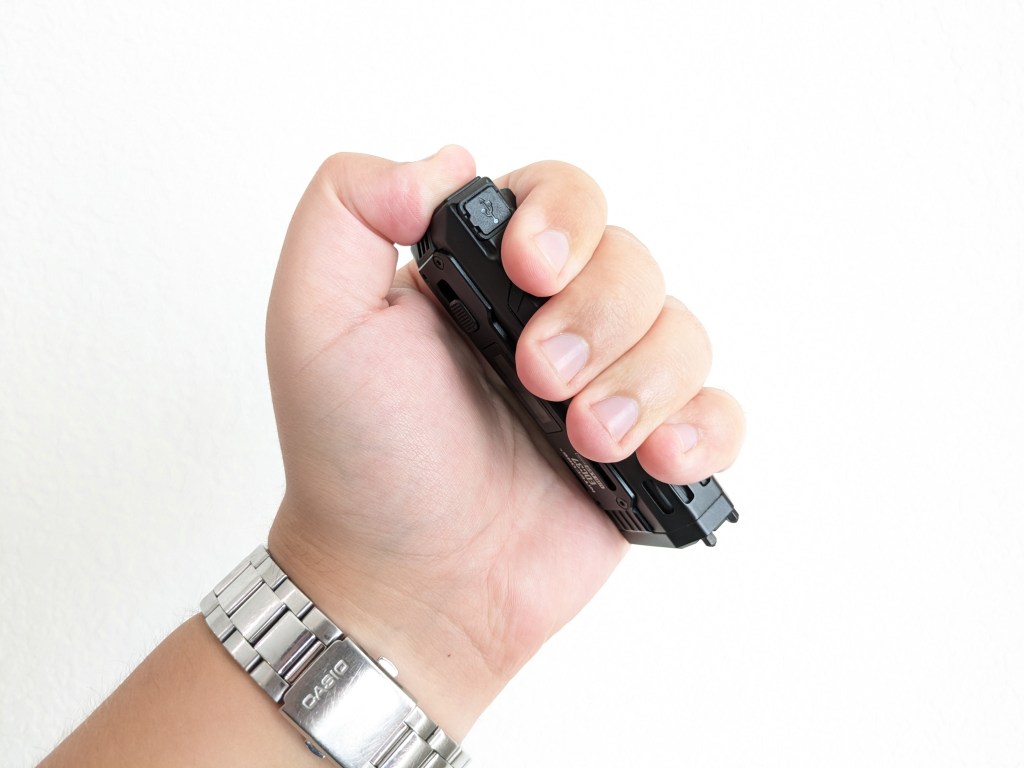
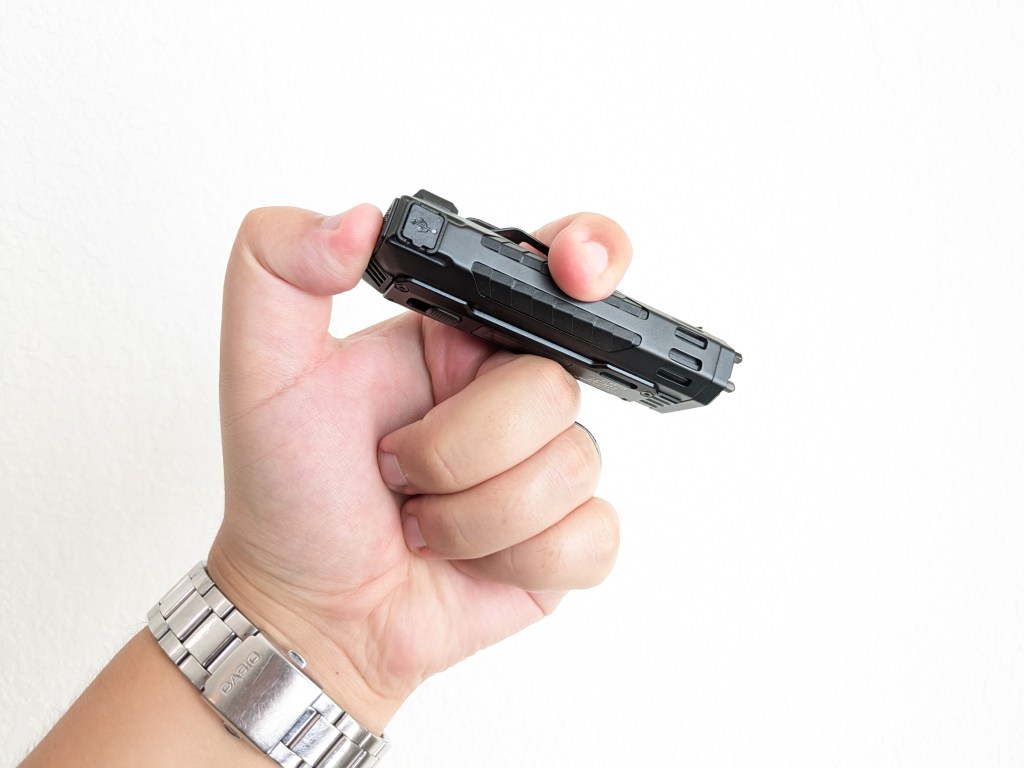
Ergonomics are ok. I hold it in a reverse grip, but cock it sideways to be able to access both switches. It’s not the most ergonomic thing but it’s not bad either.
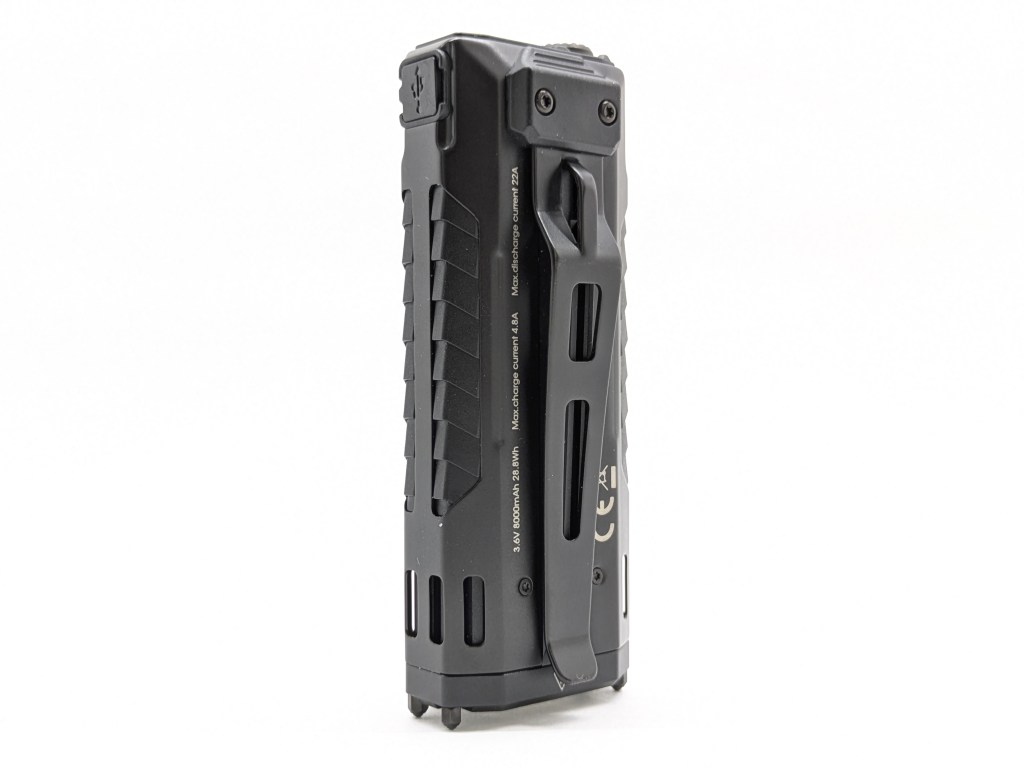
Clip score: 6/8
- Attachment doesn’t pop off or rotate accidentally✅
- User serviceable✅
- Mounts near the tailcap✅
- Deep carry for EDC, shallow-carry for duty/tactical❌
- It’s an EDC light (literally in its name) but carries shallow. A loop-over deep carry clip would be much better.
- Landing location is smooth, not on the charging port, and away from the bezel❌
- It lands almost flush with the bezel, making it fiddly to pocket, sometimes requiring two hands.
- Mouth/ramp and loop(s) are wide enough for pants material✅
- No bidirectional clips if the light is too big or heavy to clip to a hat✅
- Finish is durable✅
I wish Nitecore had included a second, deep-carry clip option in the box. It’s already got the wide hole spacing necessary for a deep carry loop-over clip, and that would make it much easier to carry.
OLED Display
A unique feature of most of Nitecore’s flat lights is the small OLED display. It displays battery voltage, brightness level, remaining runtime at that brightness level, and lockout status. The display turns on for a few seconds after you press a switch. You can turn it on to check battery status or adjust brightness while the light is off by half-pressing the main switch. Half-pressing again will cycle the brightness level so you can turn the light on in any mode you want.
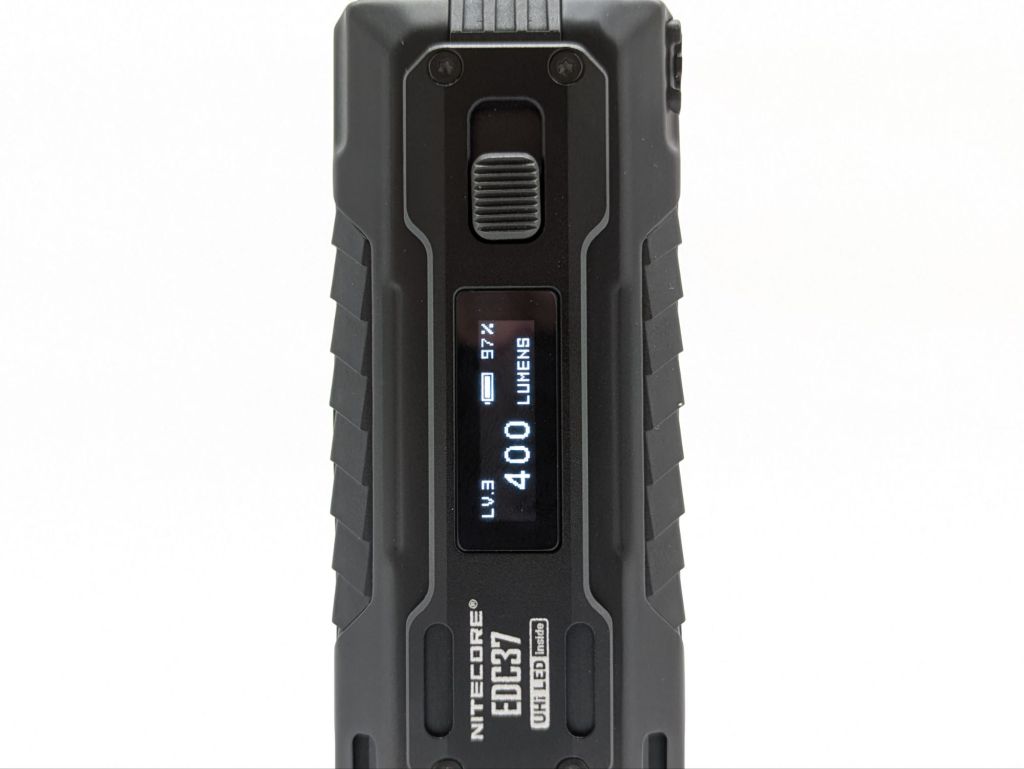
It’s neat at first, but ultimately I think it’s an unnecessary gimmick. I prefer more intuitive and glanceable LED indicators like the ones on Nitecore EDC25.
Competition
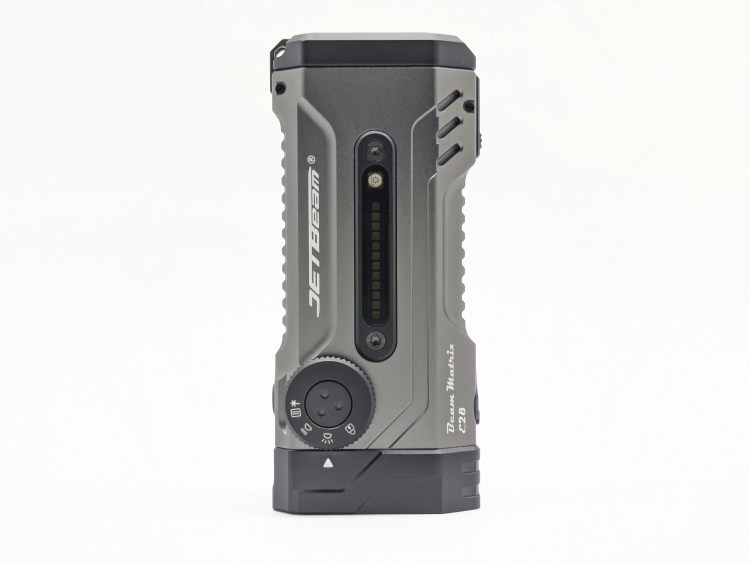
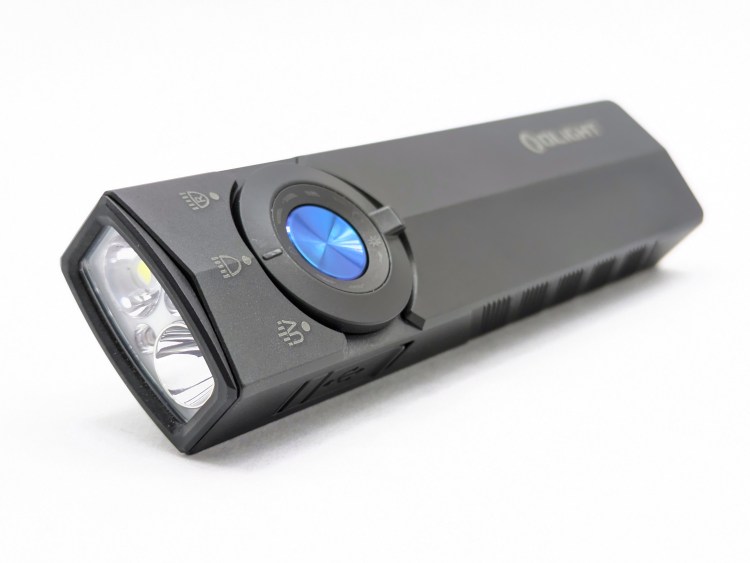
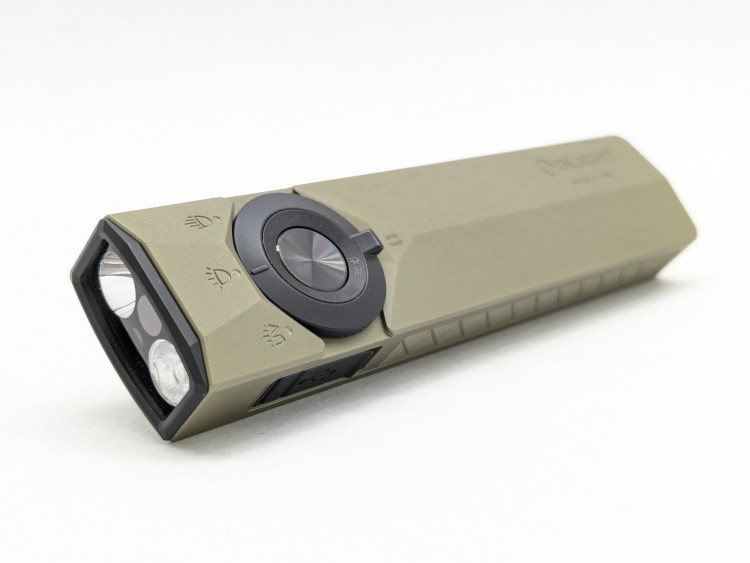
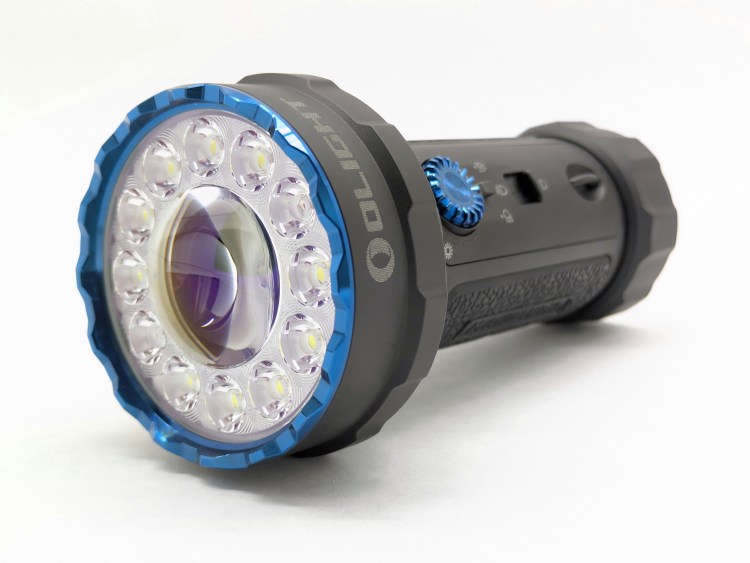
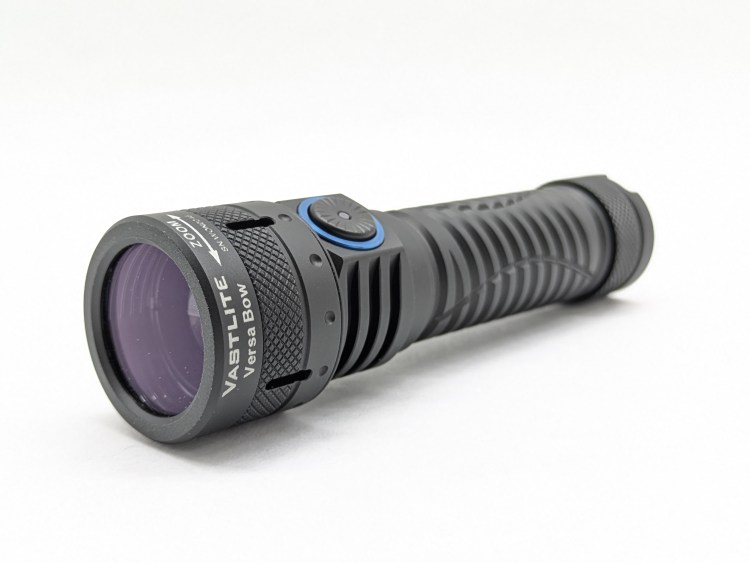
Here are some lights in the same class and how they compare.
- similar price, size, shape, and aesthetic
- dedicated flood beam and dedicated spot beam
- not nearly as bright, but can throw further
- also has limited RGB functionality
- no OLED display
- single user-replaceable 18650 battery
- larger and heavier
- no clip
- similar price
- three bright, floody XHP70 LEDs
- integrated cooling fan
- marginally higher peak brightness and significantly higher sustained brightness
- less throw
- user-replaceable 21700 batteries (may void warranty)
- single side switch
- similar price, size, shape, and aesthetic
- dedicated flood beam, dedicated spot beam, and a side RGBW light
- performance
- two user-replaceable 18650 batteries
- powerbank function
- not as bright, similar throw
- two LED options (SST25 and 519A)
- rotary side switch
This section is not comprehensive. If I didn’t include a particular light here, it doesn’t mean it’s bad or doesn’t deserve to be here. I simply cannot list every possible competitor.
Conclusion
The brightness is jaw-dropping. I cannot understate how impressive this light is outside in the dark. It heats up and steps down very quickly though. The build quality, brightness, beam shape, and throw are excellent. Regulation is great. The UI, switches are good. The price is high but understandable. The clip and sustained brightness is mediocre. The built in batteries are a shame. If you want the absolute brightest thing you can reasonably put in your pocket and carry around, this is it.
Thanks to Nitecore for sending me this light for review!

 Grizzly's Reviews
You say the SK05 Pro doesn’t throw as far as the EDC37. I recommend you check out the reviews of 1lumen and Zeroair. Both say the SK05 Pro throws around 450 meters, like the Nitecore…
LikeLike
Can confirm this throws farther than the SK05 Pro as I have both, I know what other reviews have stated but the drivers in this just outperform it. An insane light that would have been nice to have replaceable batteries. Wuben did it with their X4, Nitecore could have done it with this model. As stated though, if that’s the deal-breaker, the form factor isn’t going to be your go-to anyway. Honestly, if you don’t need the glass breaker, the edc29 is still probably the smart buy. Unless you want extended runtime at the expense of a larger form-factor.
LikeLike