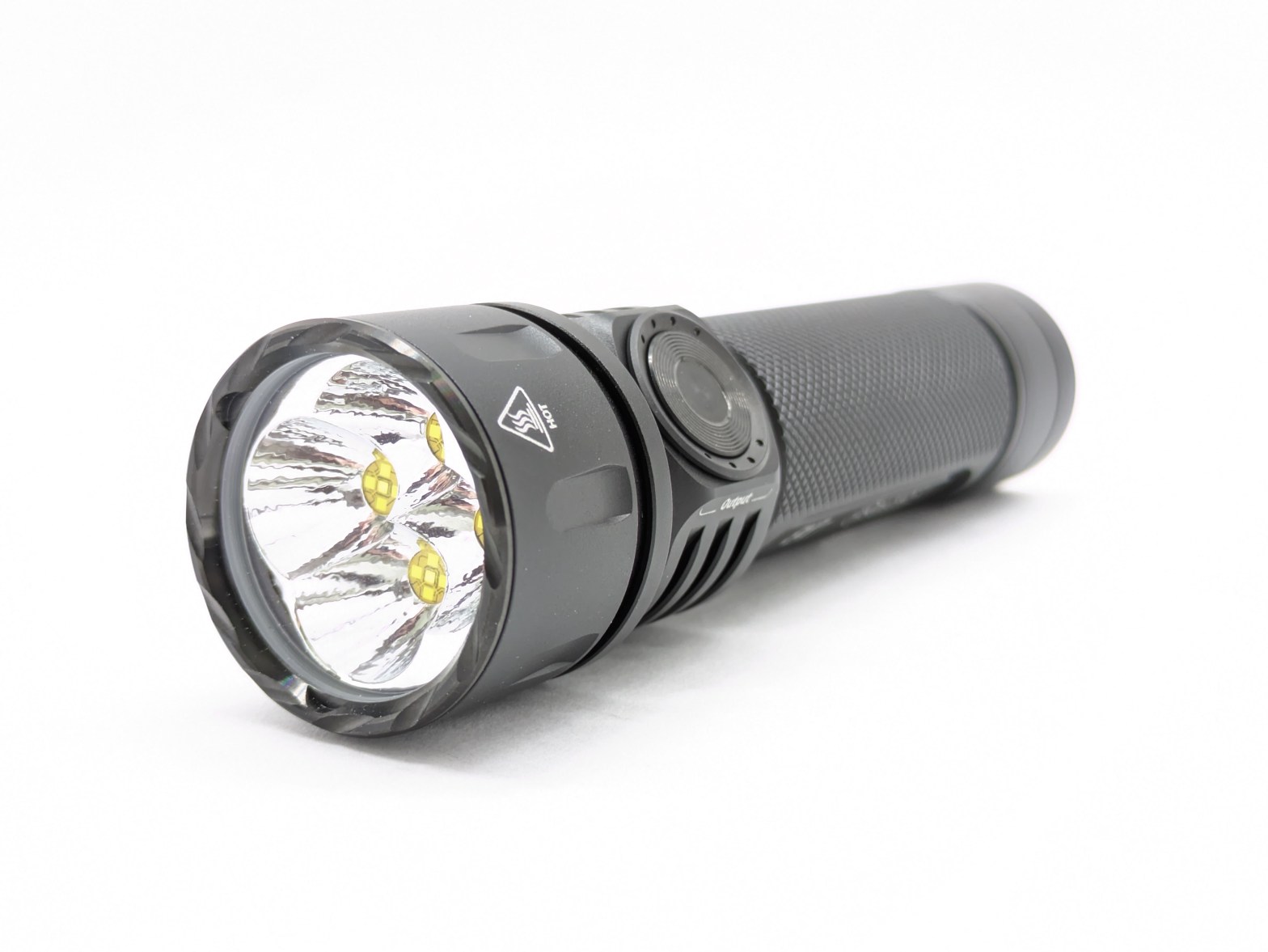
- Pricing & Availability
- What comes in the box?
- Design & Construction
- Size & Measurements
- User Interface
- Emitter & Beam
- Mode Chart
- Runtime
- Driver & Regulation
- Batteries & Charging
- Switch
- Carry & Ergonomics
- Competition
- Conclusion
Pricing & Availability
Flashlightgo.com sent me this light in exchange for an honest review. Here is the product page on their website where you can see current pricing. At the time of writing it’s $100 USD with a battery.
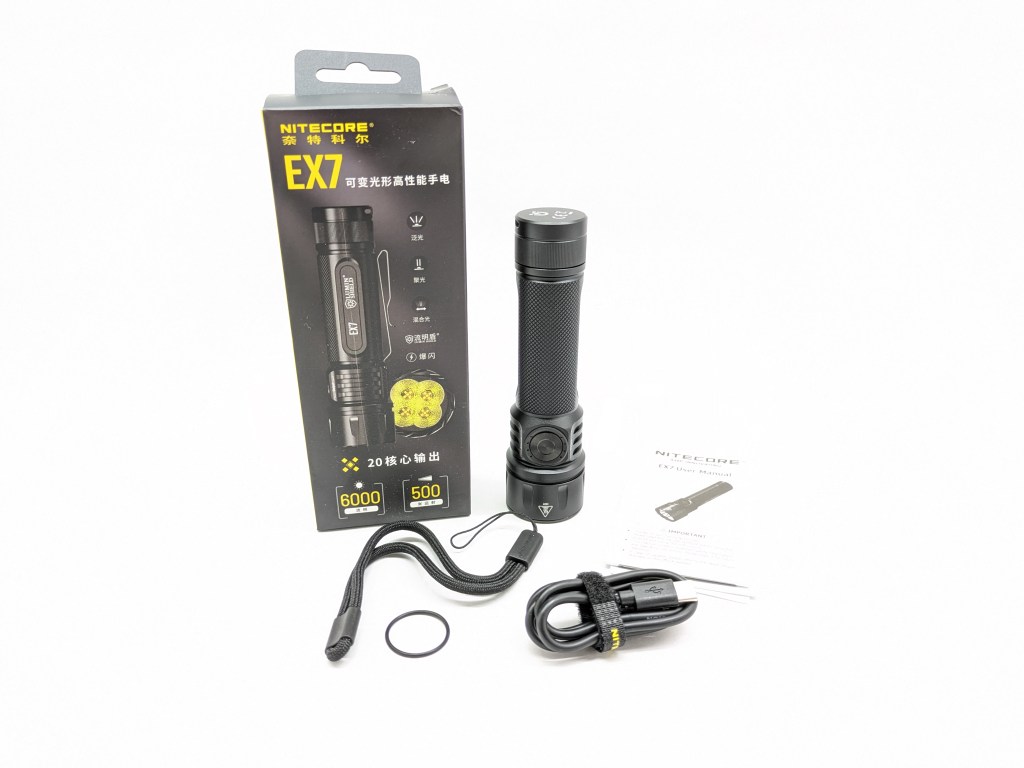
What comes in the box?
EX7 comes in a basic retail box with a vacuum-formed insert. Inside is:
- The light itself
- Battery (inside the light)
- User manual
- USB A-to-C charging cable
- Wrist lanyard
- Spare O-ring
Design & Construction
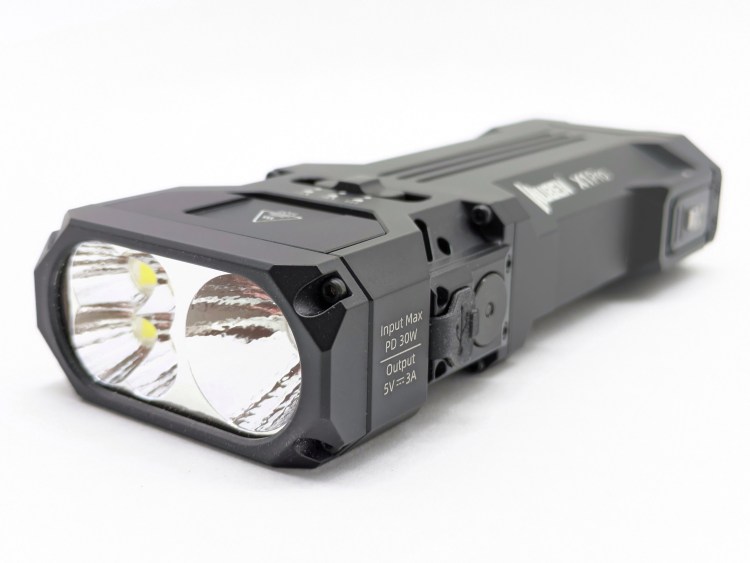
This design is very familiar. It looks remarkably like the Acebeam E75 and Olight Seeker 4 series.
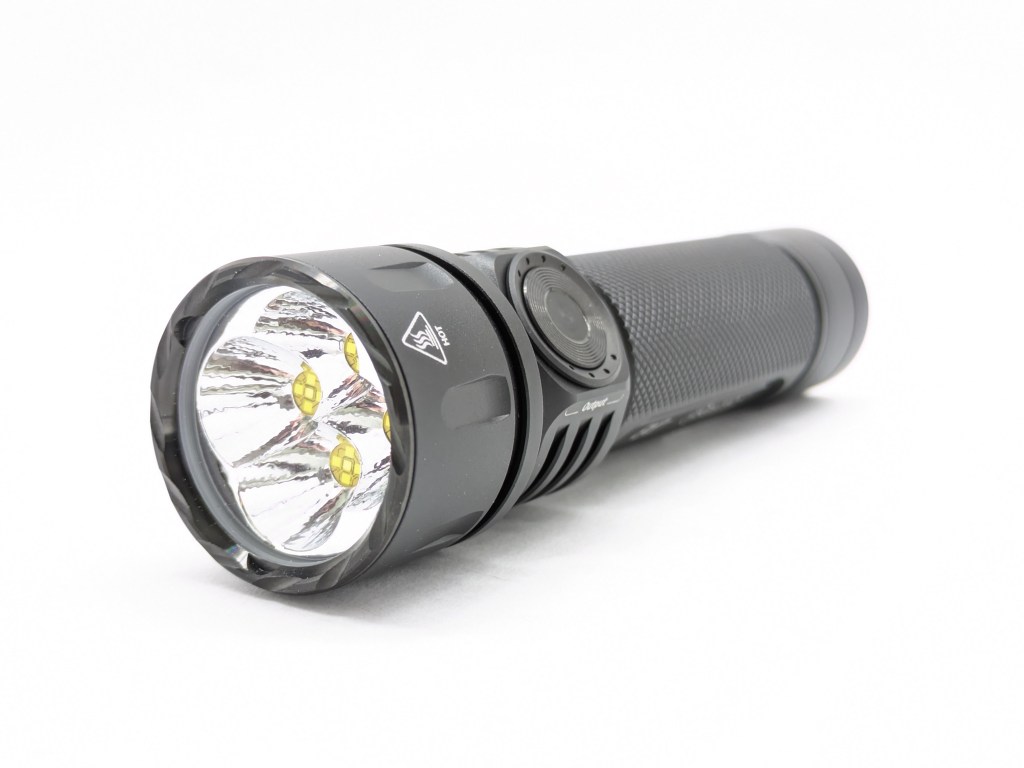
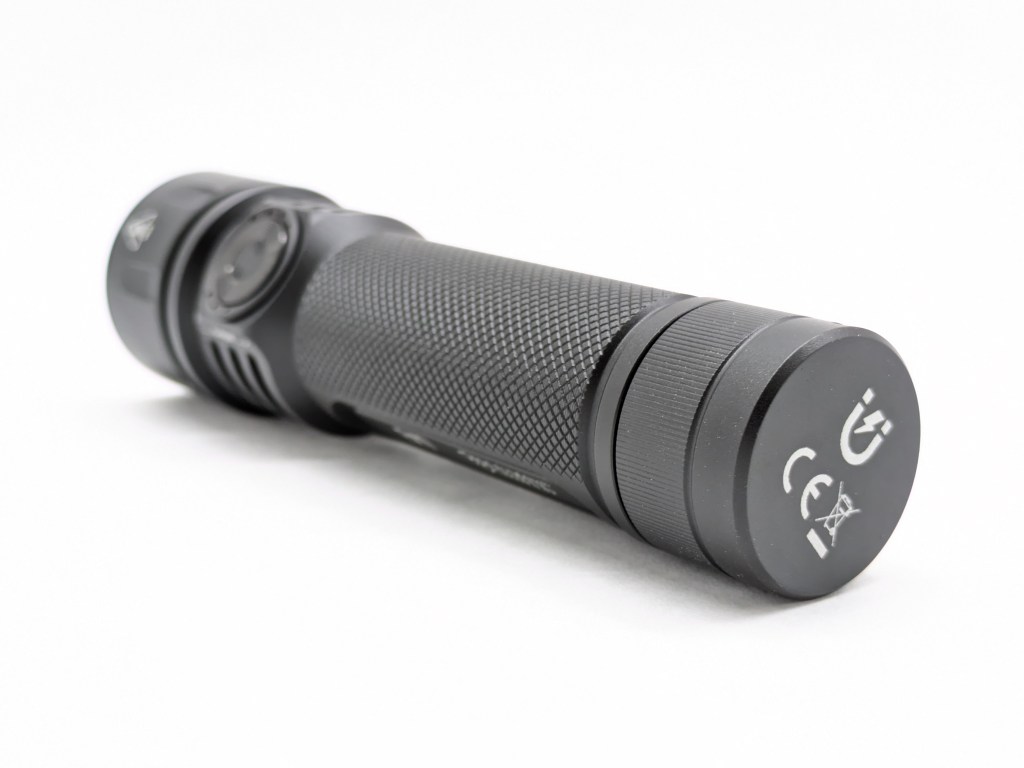
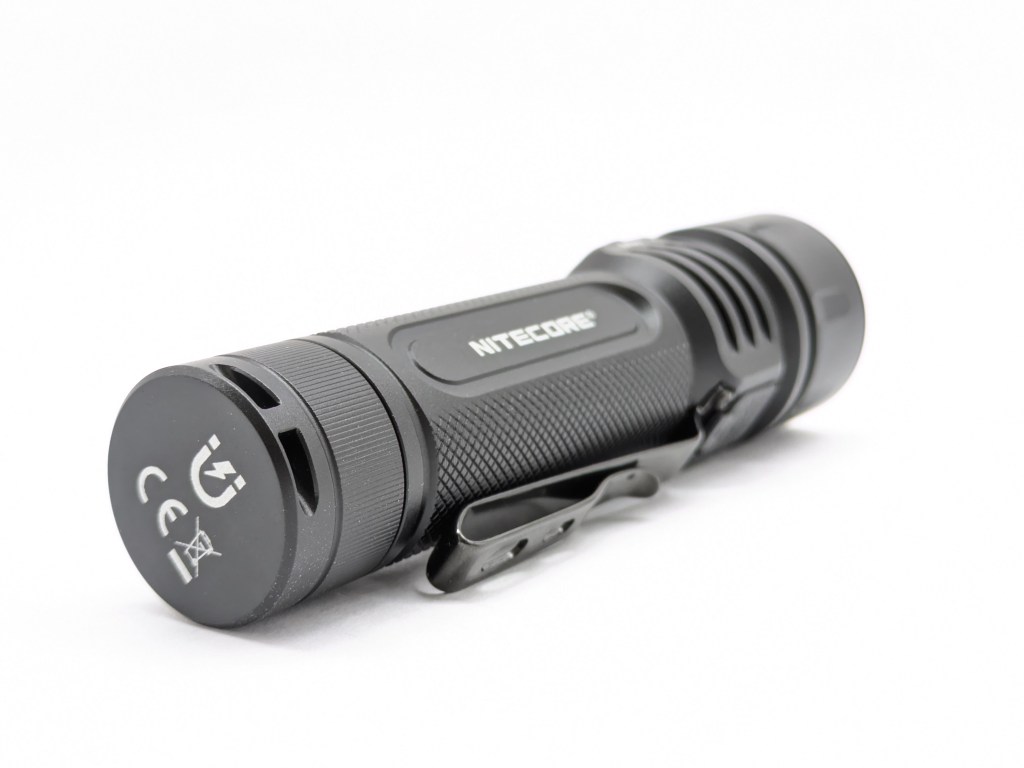
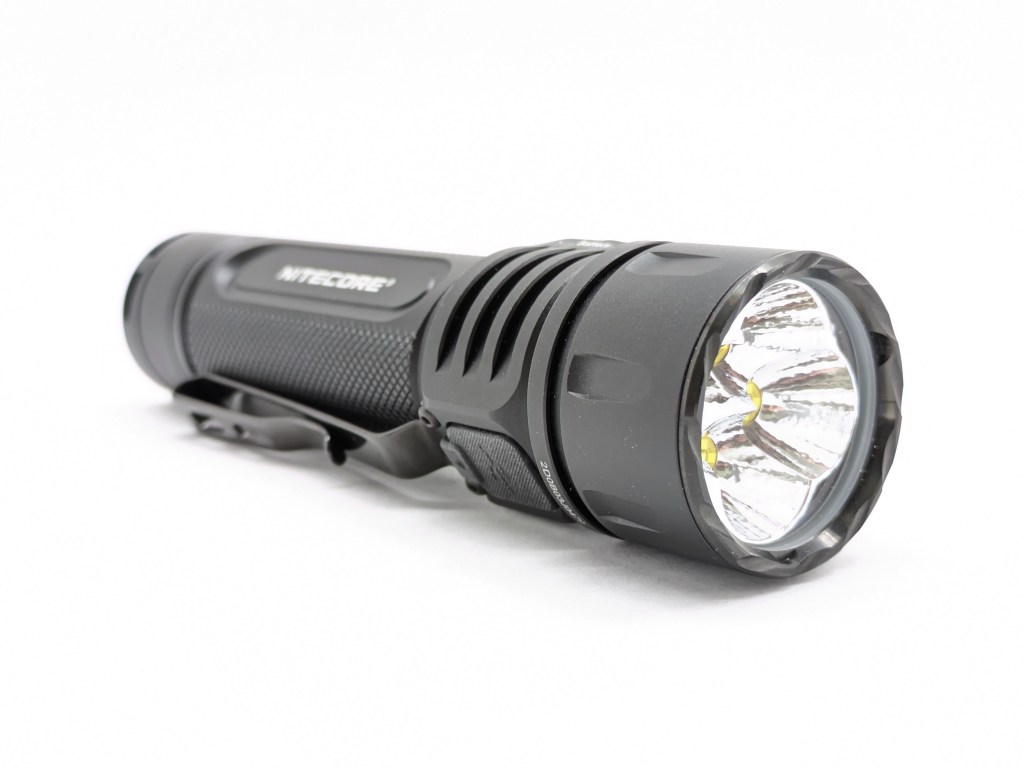
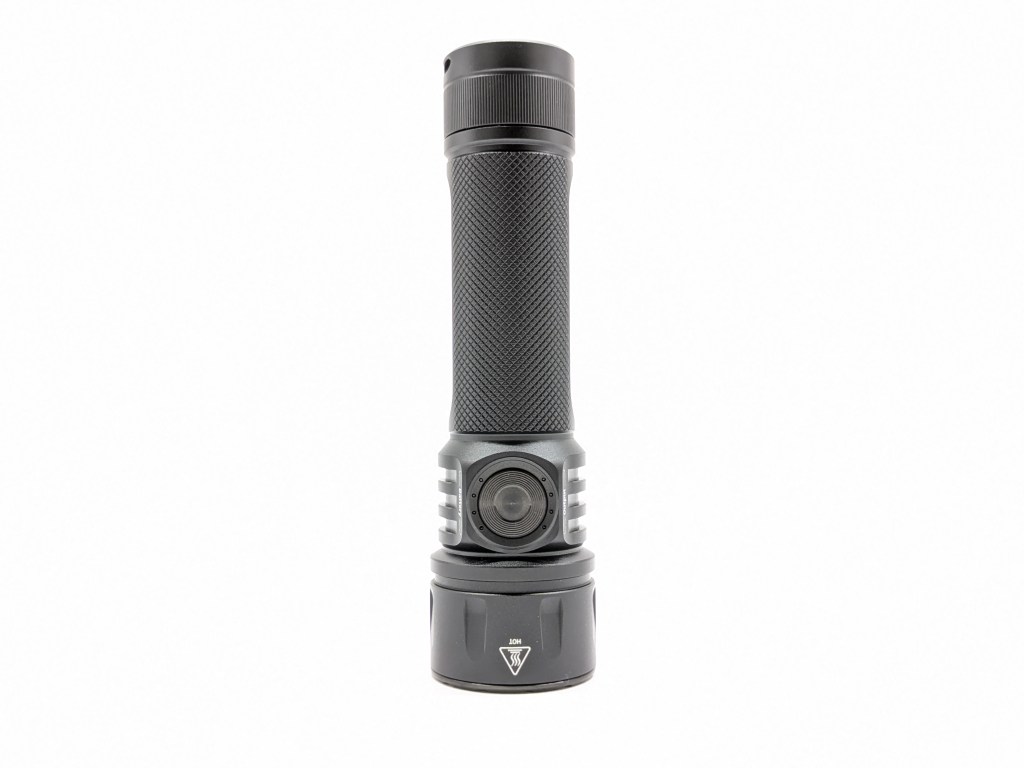
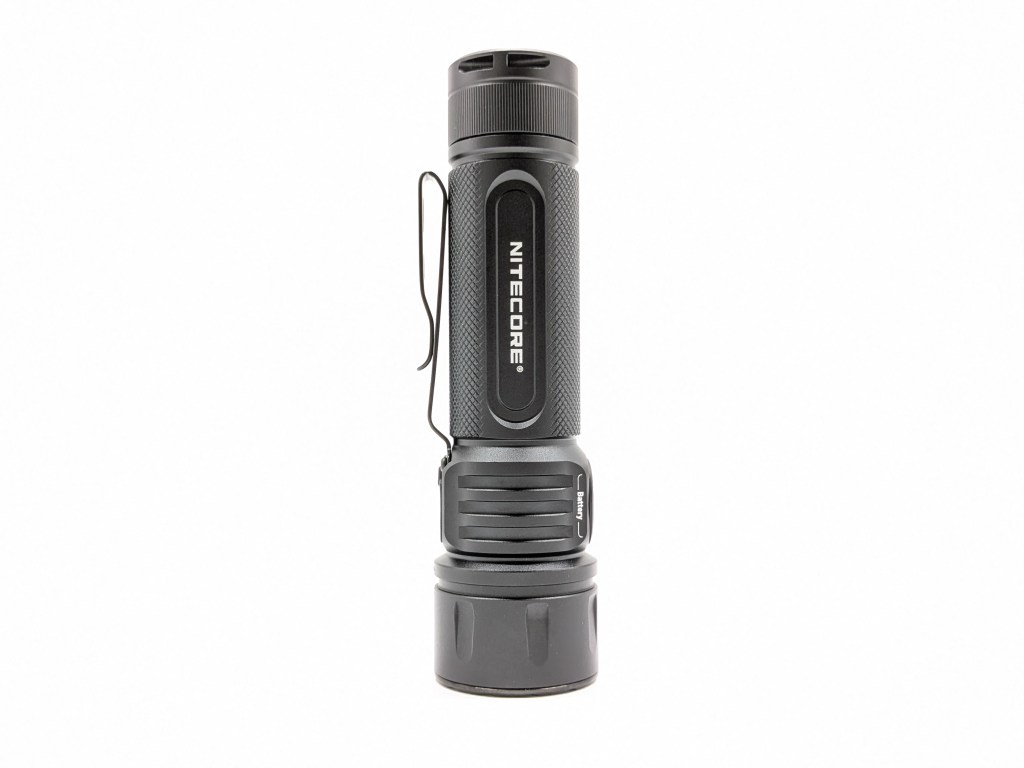
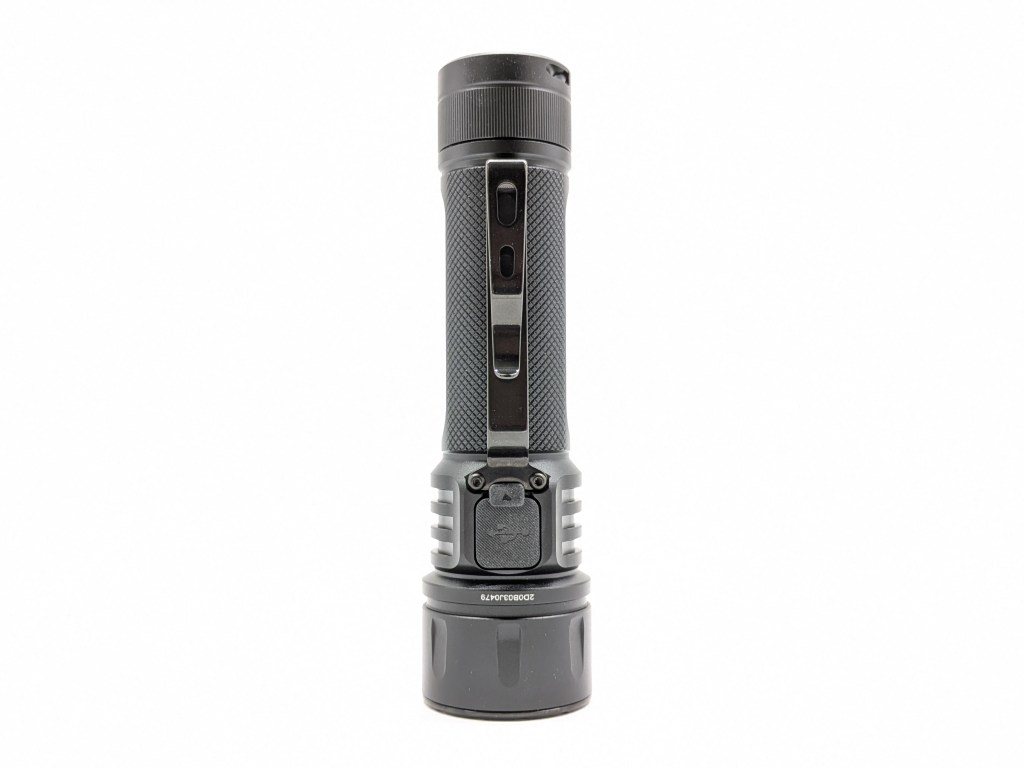
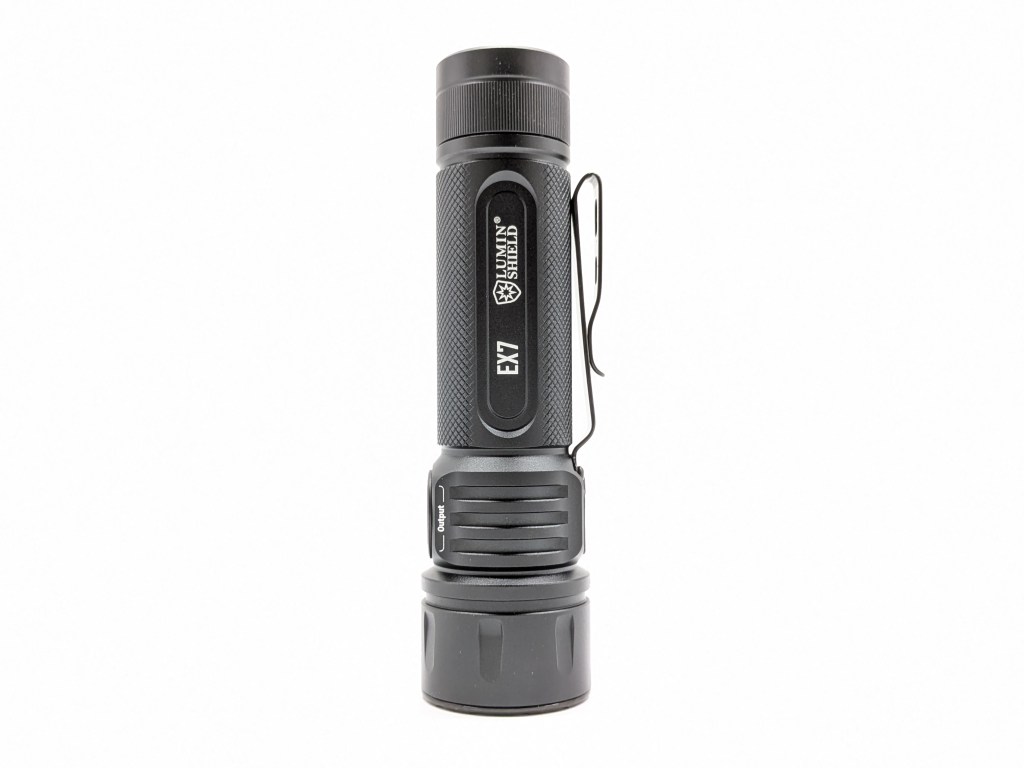
Build quality is fantastic. It feels dense and well made. The finishing is excellent and the threads are smooth.
Size & Measurements
Skilhunt MiX-7 G2+ | Nitecore EDC37 | Nitecore EX7 | Olight Warrior 3S | Mini Maglite
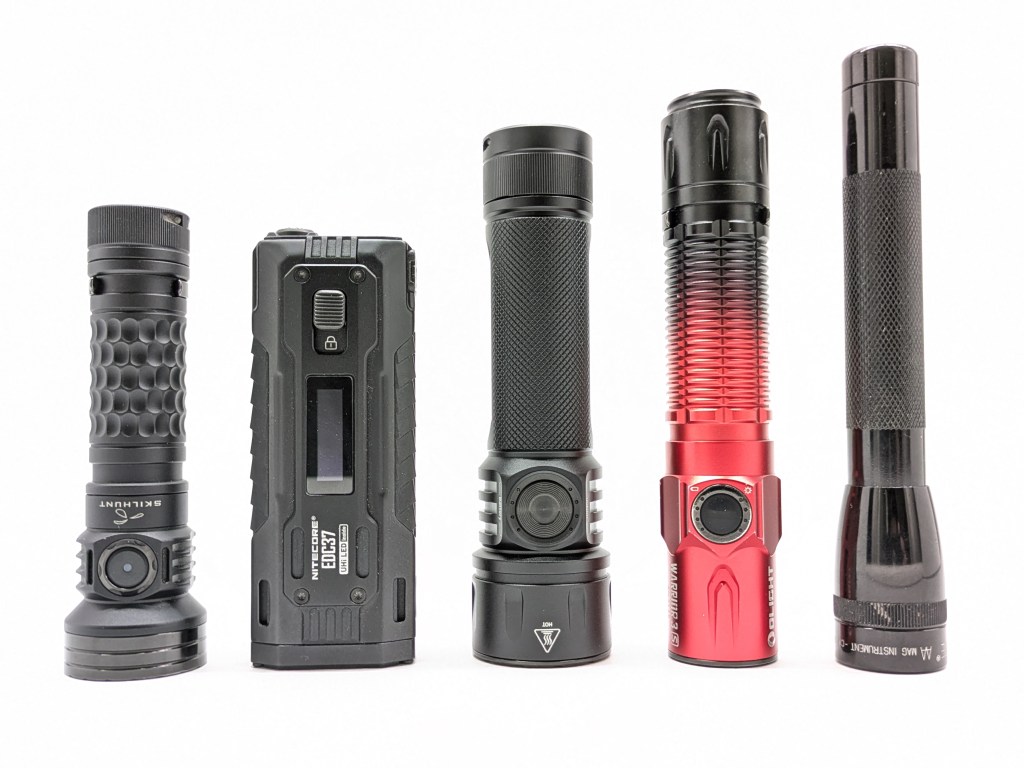
| Measurement | Measured (mm) |
|---|---|
| Head Diameter | 35.0 |
| Length | 130.0 |
| Switch Diameter | 13.5 |
| Body Tube Diameter | 28.0 |
| Tailcap Diameter | 28.0 |
| Tailcap Length | 17.4 |
| Included Battery Length | 75.2 |
| Weight with included battery (g) | 217 |
User Interface
This UI is intolerable and largely ruins the light.
Basic E-switch UI Checklist: 6/12
- 1C on/off❌
- 1C turns it on, but then you have to wait ~2 seconds before clicking again to turn it off. If you don’t wait before clicking it will get brighter instead of turning off.
- 1H to change brightness❌
- It’s 1C to change brightness, but only if you turned it on in the last ~2 seconds. If it’s been more than ~2 seconds then 1C will turn it off instead of making it brighter.
- 1H is reserved for cycling between throw, combined, and flood beams.
- If you 1H for just a moment, not quite long enough to get it to change beam, then you can release and 1C and it will increase brightness. What a strange, bandaid solution.
- Stepped levels✅
- Main rotation is Low-Med-High❌
- There are four modes in the main rotation, not three.
- Moonlight shortcut: 1H from off✅
- Low shortcut: 1H from Moonlight❌
- There is a Moonlight to Low shortcut, but it’s 1C, and that’s only if you’ve turned it on in the last ~2 seconds.
- Brightest mode shortcut: 2C from anywhere✅
- Strobe shortcut: 3C from anywhere✅
- Mode memory for Low, Medium, and High❌
- It always starts on low.
- No mode memory for Moonlight, Turbo, and Strobe✅
- 4C or separate switch to lock/unlock❌
- Lockout is entered by a looooong 1H. Lockout is exited by a looooong 2H
- Mechanical lockout works great by loosening the tailcap a bit.
- Does something when you click the switch in Lockout mode✅
Notes:
- Nitecore ruined the UI by reserving 1H for beam cycling. This should have been an industry standard E-switch UI, plus a 2H action to cycle the beam shape. Then it would have been excellent.
Emitter & Beam
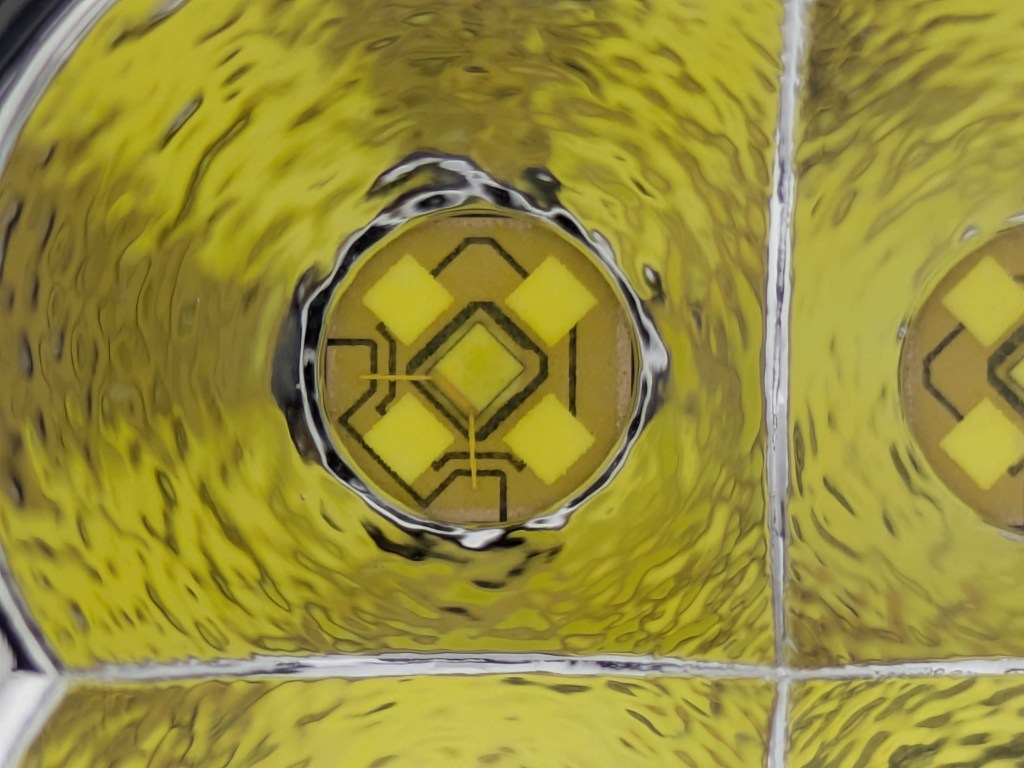
EX7 feature’s Nitecore’s new “M515S” LED, with 5 dies in an X shape. The center die can be turned on separately from the four outer dies. That gives you the ability to have a spot beam (center dies only) or a flood beam (all dies) without having to have separate reflectors/optics for each beam. There’s also a combined beam option, but it’s similar enough to the flood beam that it’s superfluous.
It’s odd that Nitecore chose to debut this LED in a quad-reflector light. Switching different dies on/off to control beam profile doesn’t work as well as just having separate LEDs with separate reflectors/optics. They could have put spot LEDs in two of EX7s reflectors and flood LEDs in the other two. That would likely have achieved cleaner beams.
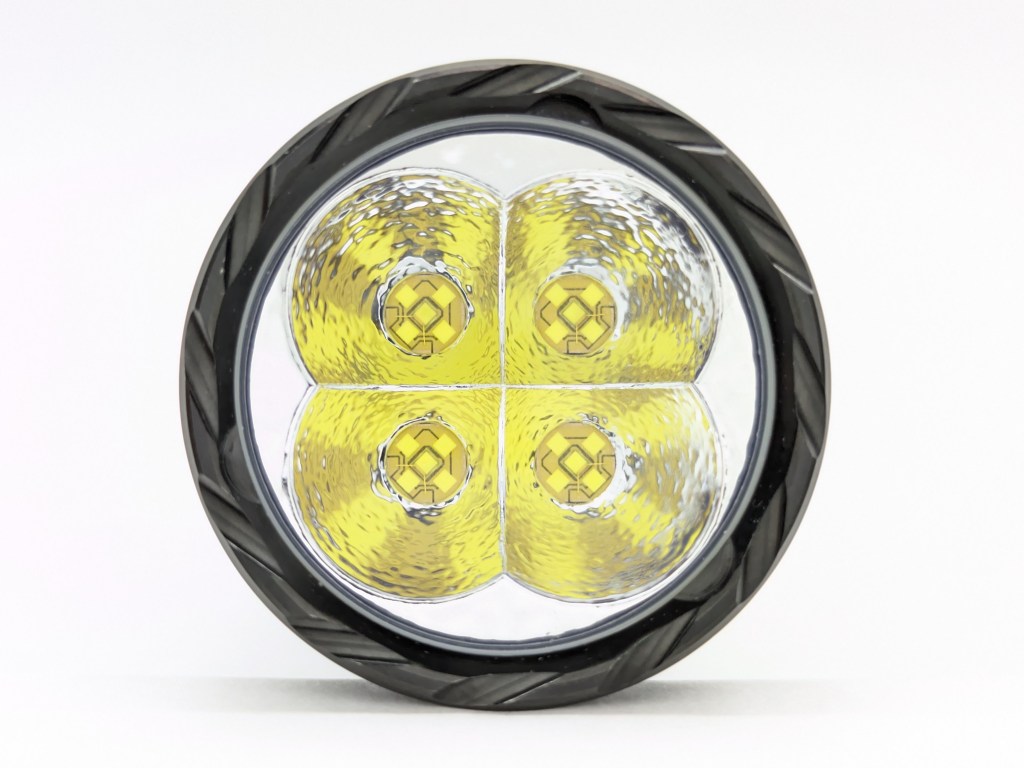
This M515S LED seems best-suited for a small, single-reflector light without room for multiple optics.
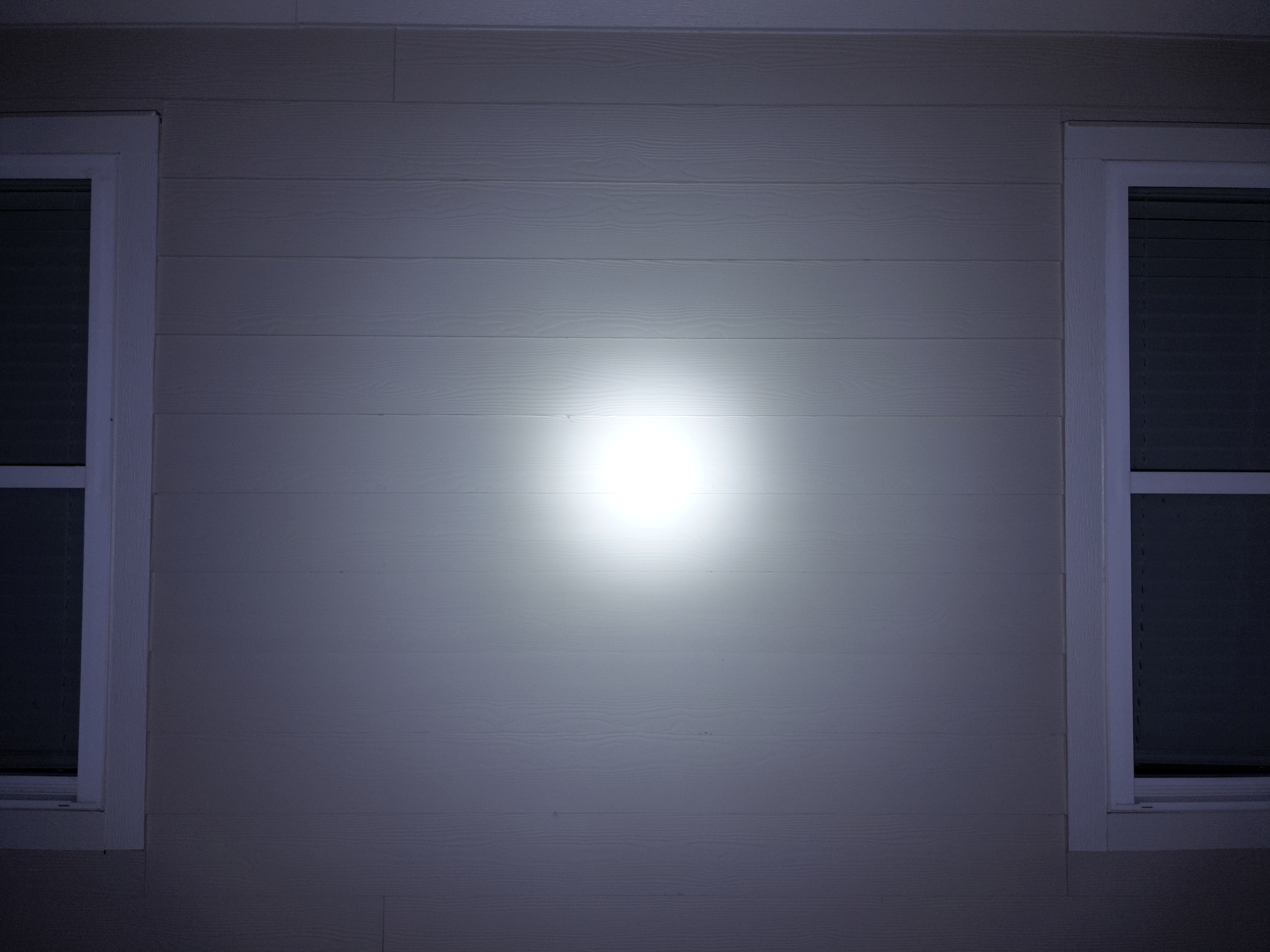
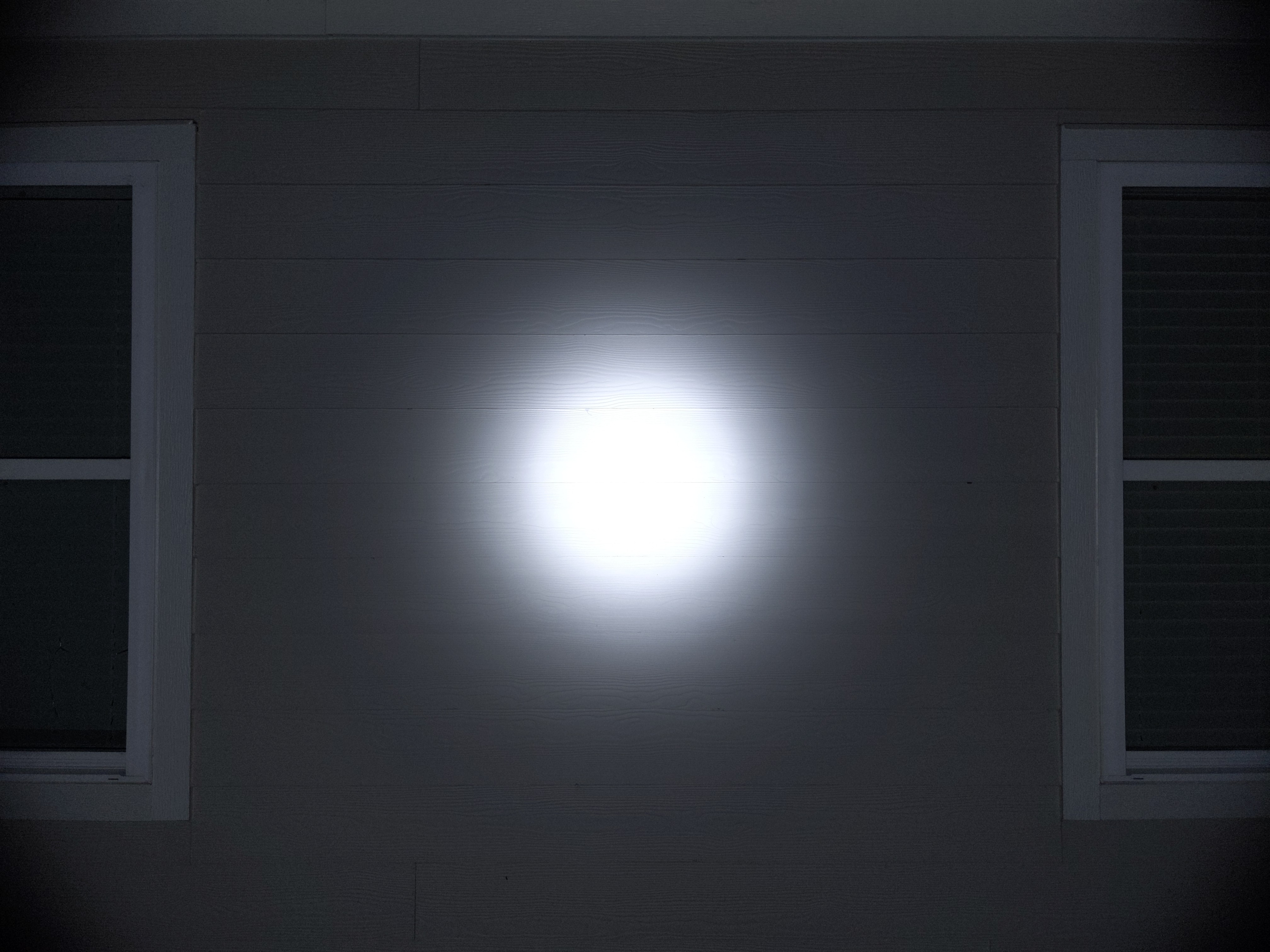
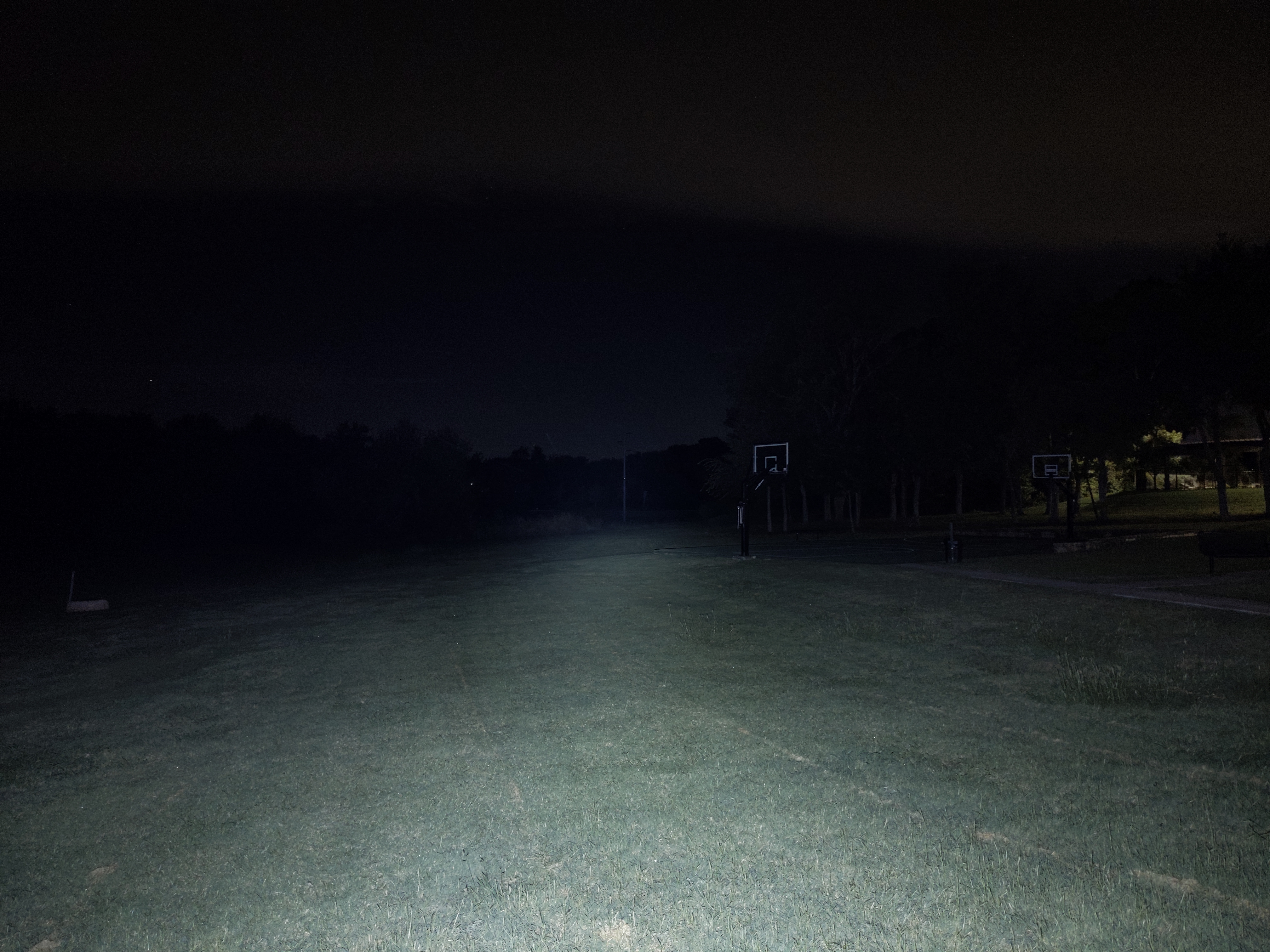
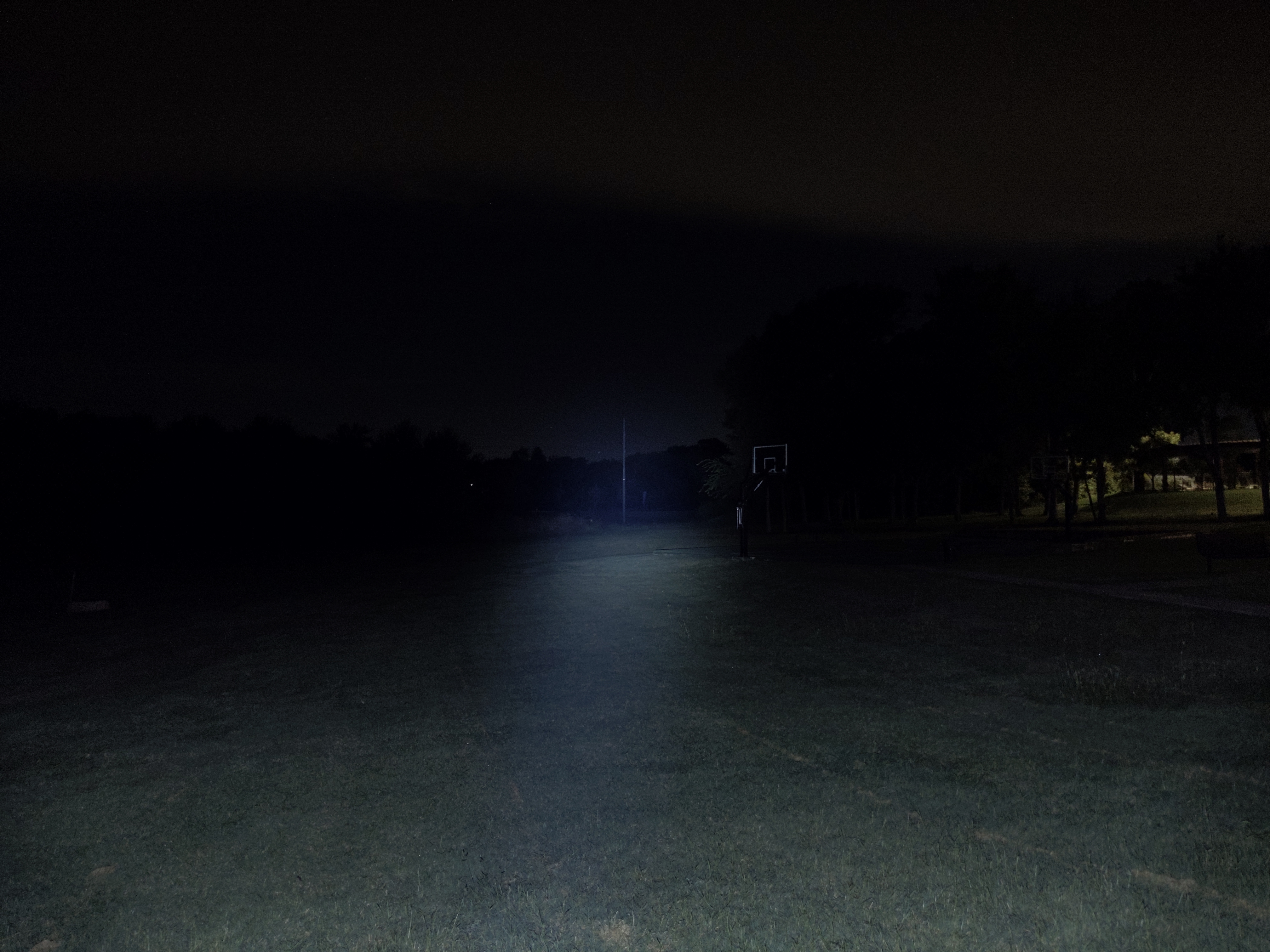
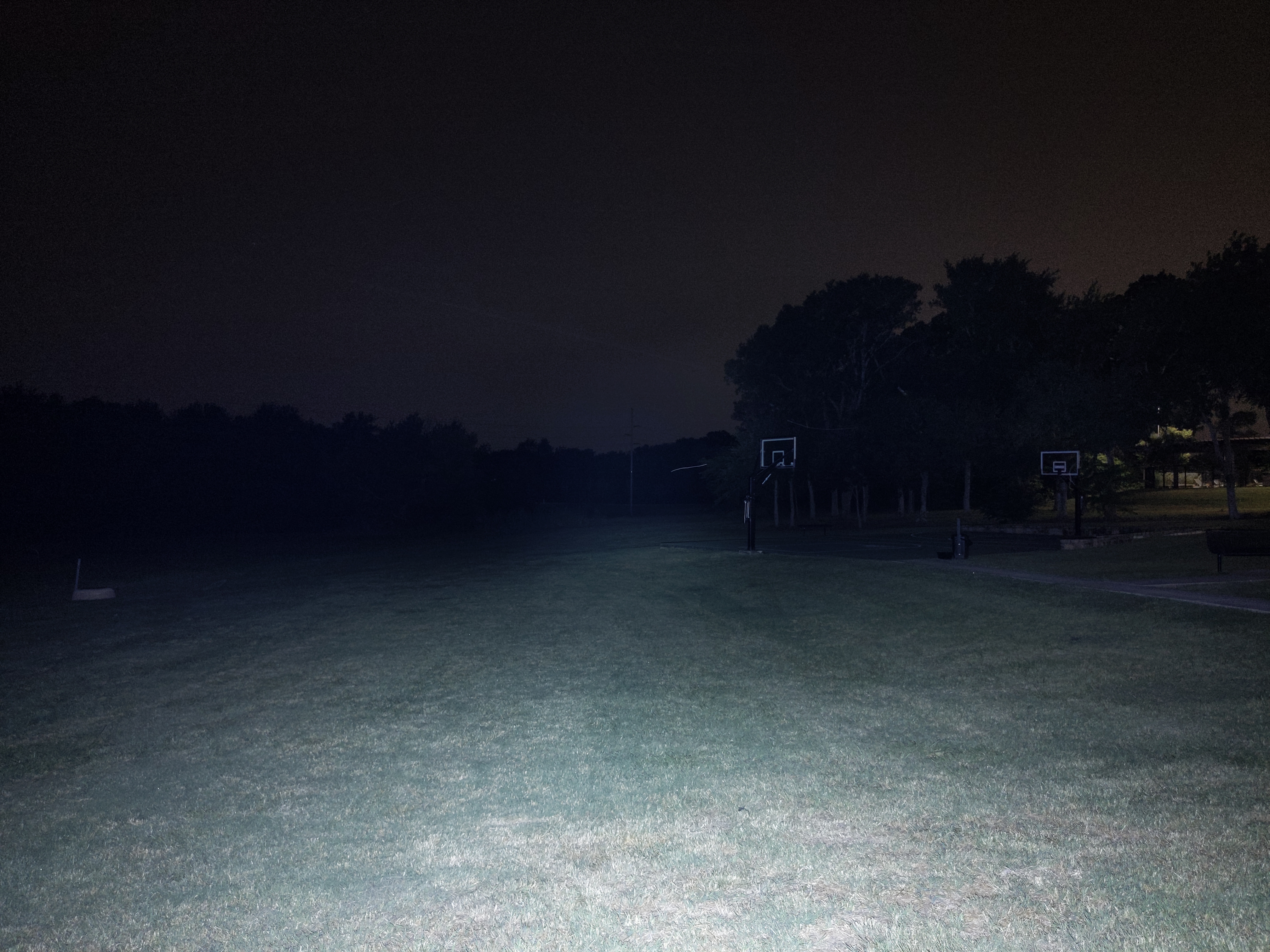
The flood beam is decently floody at 8.6cd/lm, but it’s more of a general purpose beam shape than pure flood. There’s still a hotspot, but it’s paired with bright spill. It works well and the spill is quite bright. The edges of the spill are pretty busy and not very clean because of so many diodes in a multi reflector.
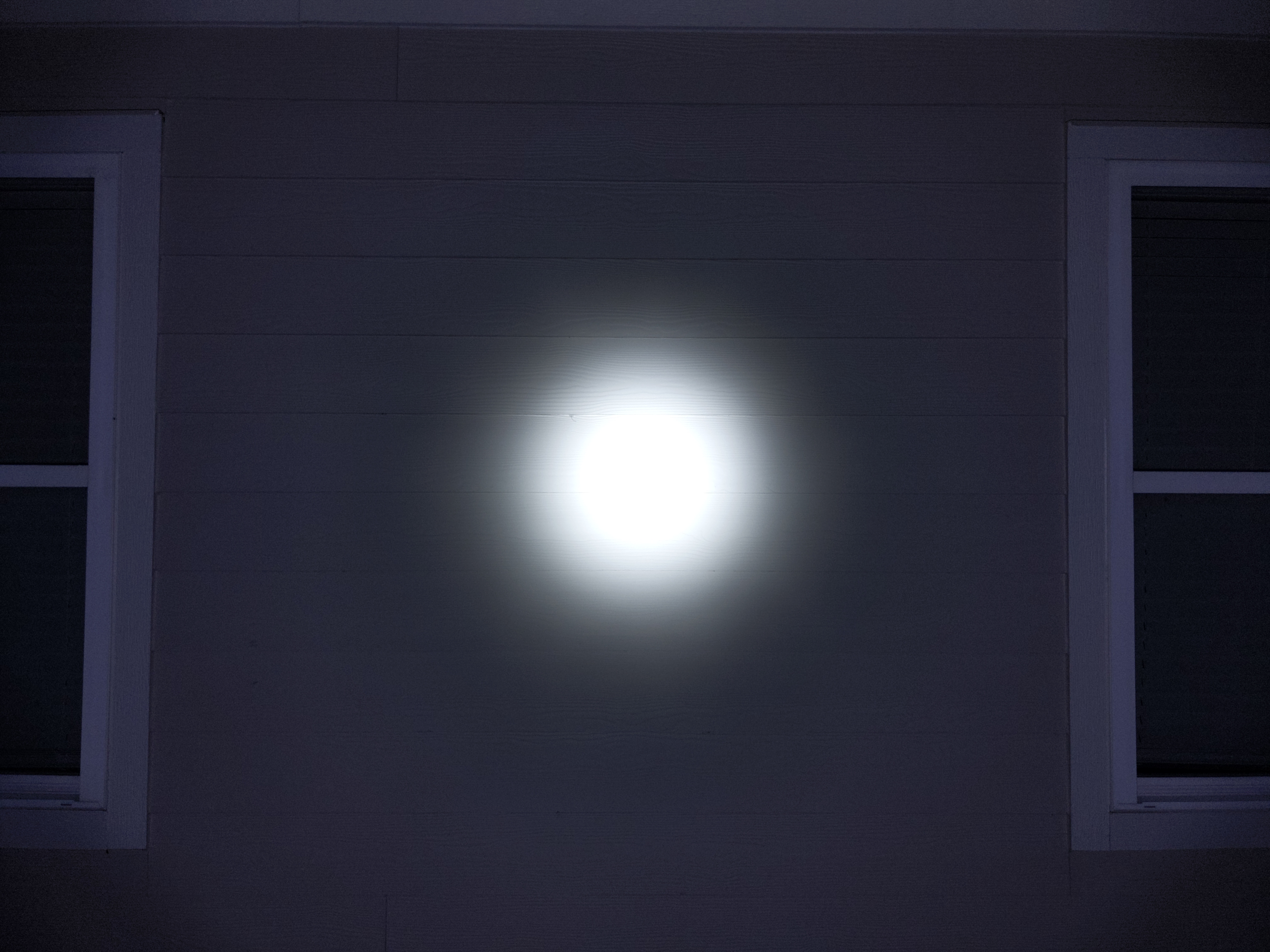
The throw beam is decently throwy at 40kcd and 16cd/lm, but can’t touch a proper single-LED thrower. Still, it’s much throwier than the flood beam and does a decent job. The hotspot is brighter and the spill is dimmer compared to the flood mode. The flower petals in the spill are quite pronounced in this mode.
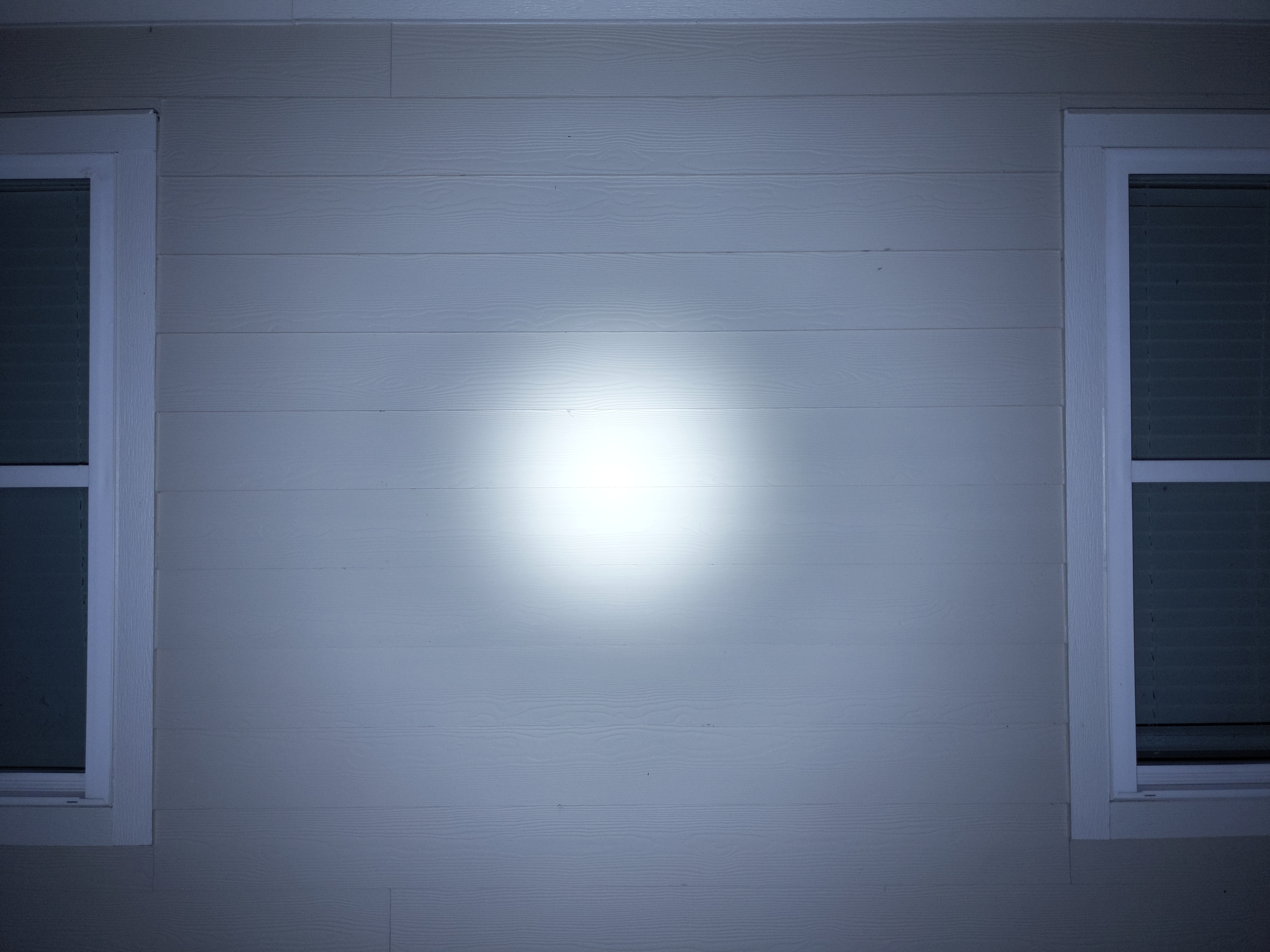
The combined beam is so similar to the flood beam that it’s superfluous and doesn’t need to exist.
In the beamshots below, camera settings are fixed and the wall is 2.8M away.
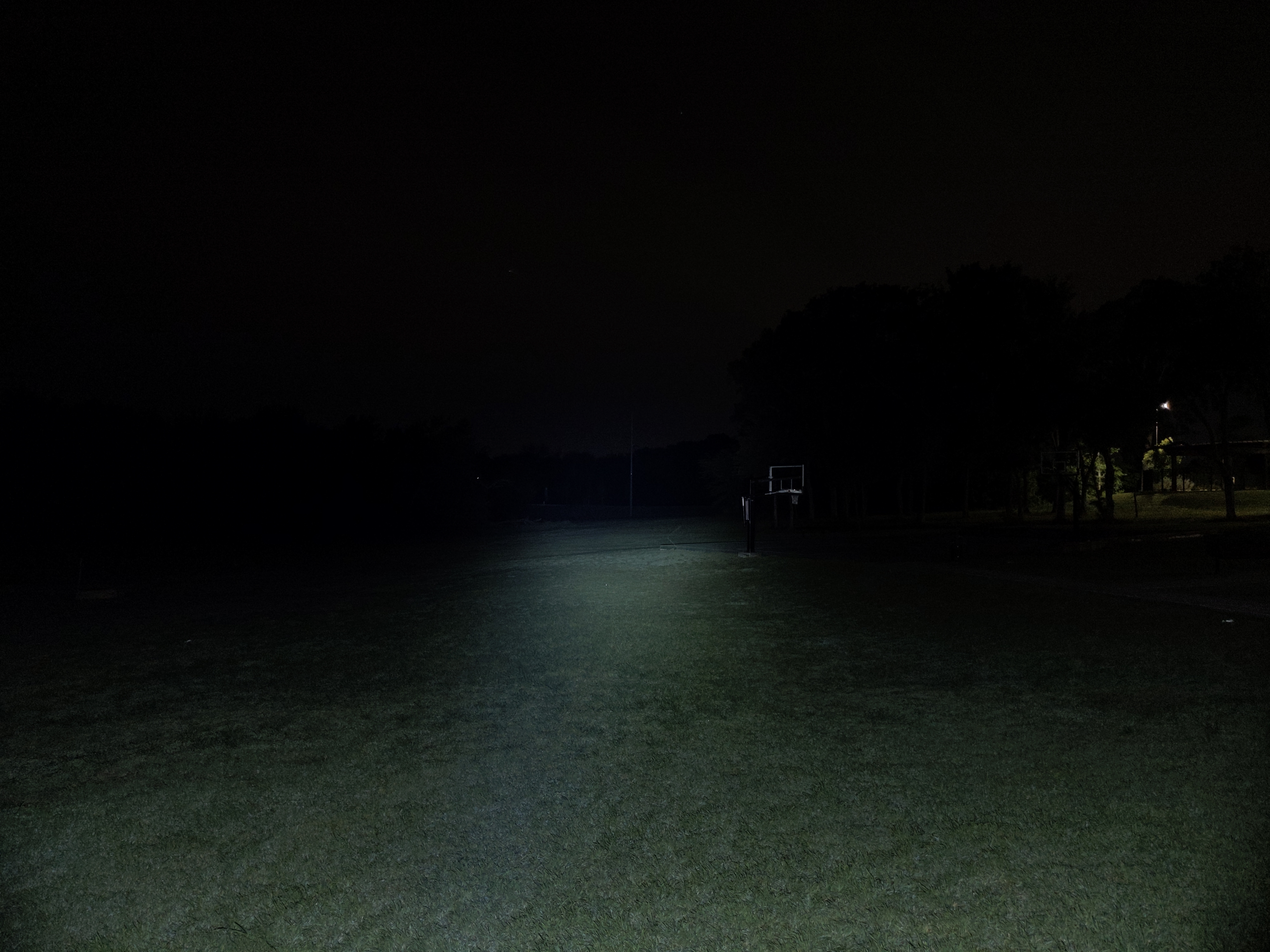
In the beamshots below, camera settings are as similar as possible, the basketball goal to the right of the hotspot is 39M away, and the power pole in the center is 185M away.
Mode Chart
Disclaimer: All of my measurements are taken at turn-on. Lumen measurements were taken on a Texas Ace 3.5″ Lumen Tube. A candela measurement was taken at 10 meters with an Opple Light Master III on the highest brightness, and other candela figures were calculated relative to that. CRI, CCT, & DUV data were taken for each mode from a few feet away at the center of the hotspot with the Opple Light Master and Waveform DUV Calculator. Runtime tests were performed with the Ceilingbounce app on my smartphone. These tests were performed with a fully charged included battery unless otherwise specified. I cannot measure moonlight directly, so moonlight readings are calculated based on the brightness relative to the next-lowest mode. None of this is professional equipment, so take these measurements with a grain of salt.
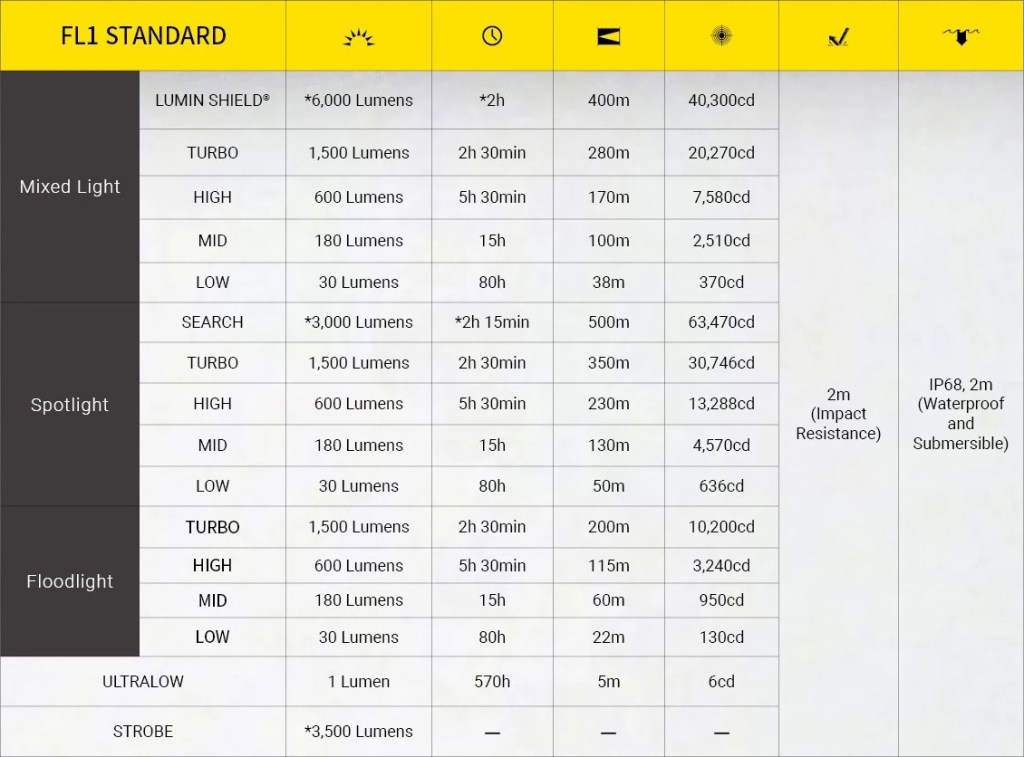
The official specs are above, followed by my own measurements below.
| Level | Lumens | Candela | Throw (Meters) | CRI (Ra) | Color Temp. (K) | DUV (Tint) |
| Luminshield | 5000 | 40000 | 400 | 69 | 5660 | 0.0020 |
| Turbo | 1500 | 13000 | 230 | 68 | 5400 | 0.0048 |
| High | 590 | 5100 | 140 | 67 | 5320 | 0.0058 |
| Medium | 180 | 1600 | 79 | 67 | 5320 | 0.0063 |
| Low | 23 | 200 | 28 | 67 | 5230 | 0.0060 |
| Level | Lumens | Candela | Throw (Meters) | CRI (Ra) | Color Temp. (K) | DUV (Tint) |
| Search | 2500 | 75000 | 550 | 69 | 5760 | 0.0019 |
| Turbo | 1300 | 39000 | 400 | 68 | 5610 | 0.0038 |
| High | 570 | 17000 | 260 | 67 | 5400 | 0.0050 |
| Medium | 200 | 6000 | 155 | 67 | 5310 | 0.0063 |
| Low | 26 | 780 | 56 | 66 | 5260 | 0.0082 |
“Search” mode is just the center dies as bright as they can get. I didn’t test any of the “mixed light” modes (except Luminshield) because they’re superfluous.
Runtime
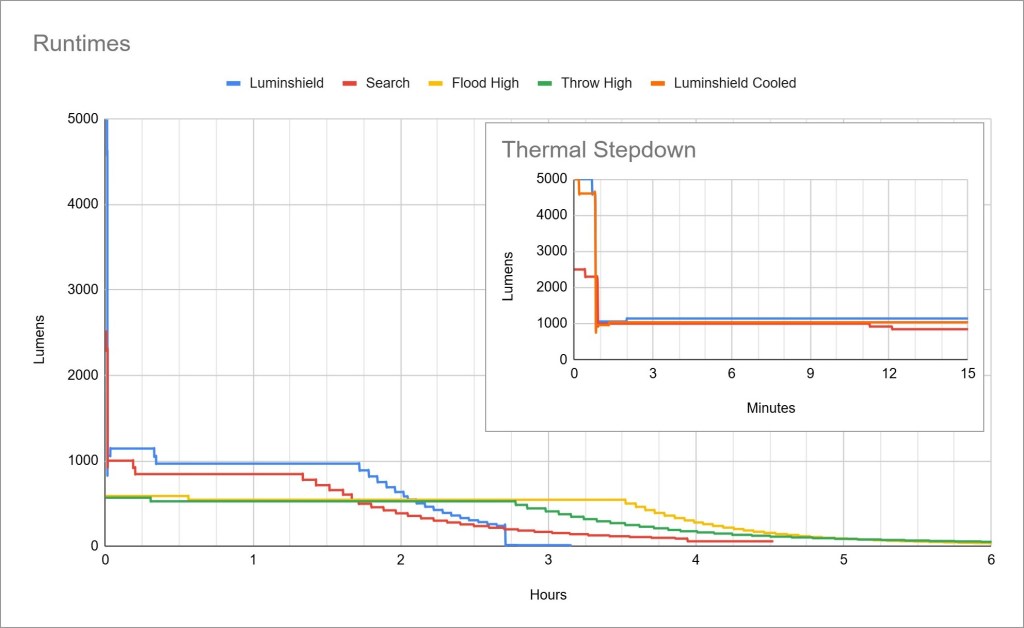
Performance is decent. Brightness is respectable. Luminshield and Search both step down heavily at 1 minute, but stay at about 1000 lumens for quite awhile. When it falls out of regulation the brightness starts a very slow decline. Then it seems to just keep running and dimming until you shut it off.
Thermal regulation: I don’t see any clear active thermal regulation here despite the marketing images claiming “advanced thermal management”. Luminshield and Search modes are clearly timed at 1 minute. They both step down there despite Search producing significantly less brightness and heat. My Luminshield Cooled test did not sustain any higher output due to active cooling.
LVP (Low Voltage Protection): I can’t tell if this light has LVP or not. When the battery gets low, it gets really dim but stays on. My longest test was over 18 hours and the light still hadn’t shut off. When I stopped the test, the battery was at 2.9V.
Driver & Regulation
The driver is a “constant current circuit”. It doesn’t look like that from my flicker testing tough.
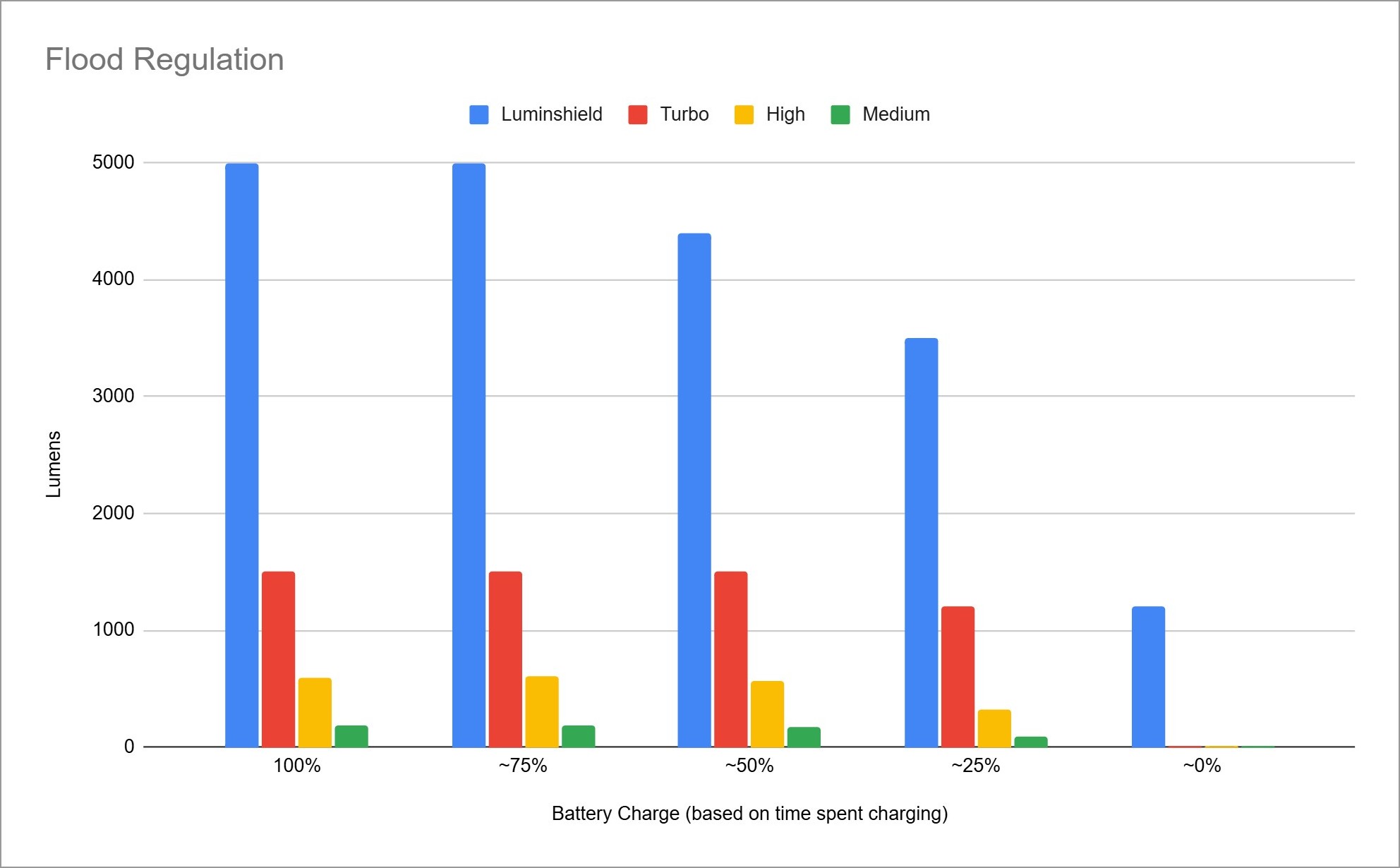
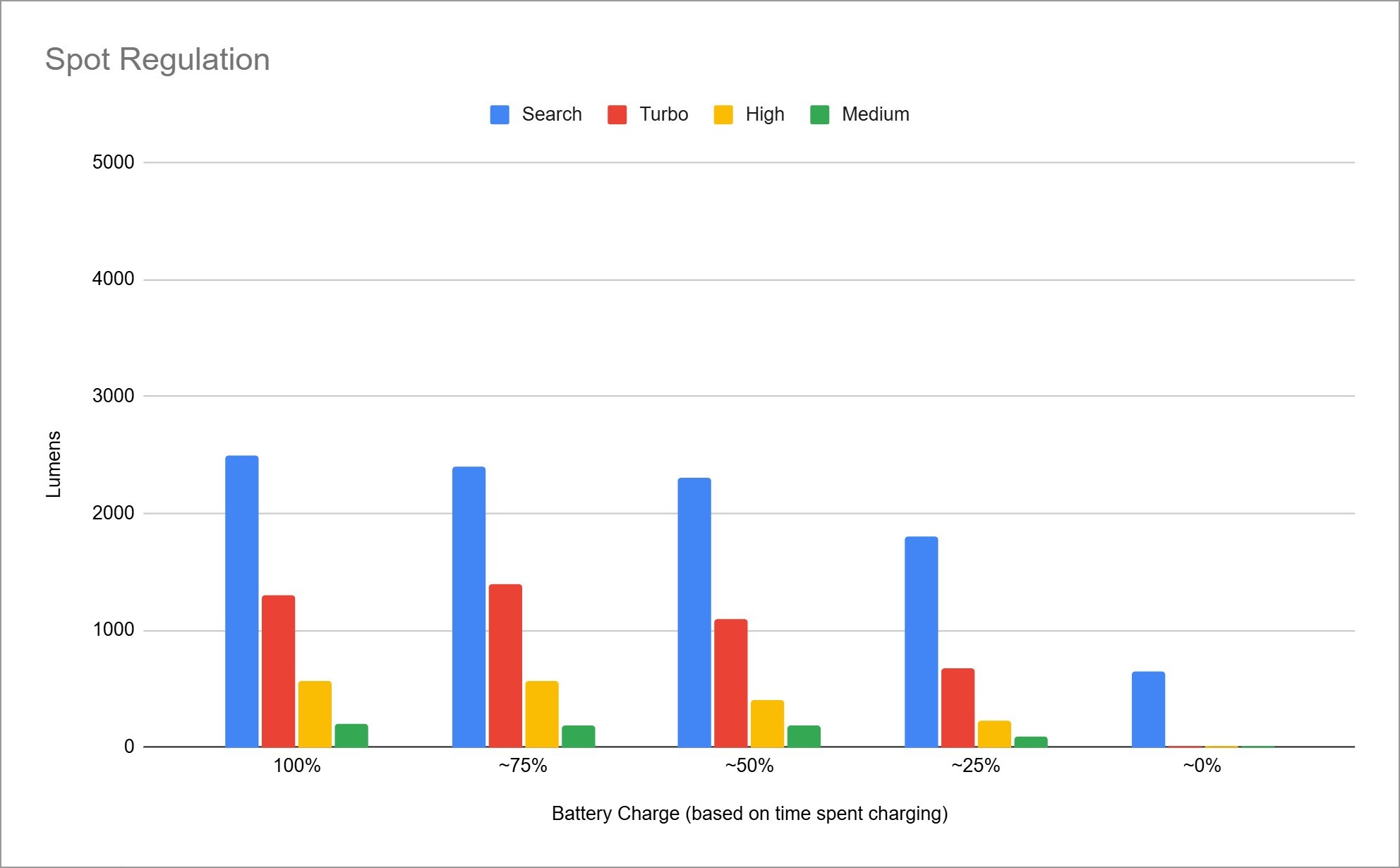
Regulation performance is below average, but not terrible. All modes are measurably affected by battery voltage, even the relatively dim ones. That said, it does maintain most of the “Luminshield” and “Search” brightness down to ~25% charge, which impressed me.
PWM: No PWM is visible to my eyes or camera, nor audible to my ears. My Opple detected some kind of flickering on every mode except Search and Luminshield. The indicator LEDs around the switch have visible PWM.
Parasitic Drain: 66 microamps. That will take 10 years to drain the included battery.
Batteries & Charging
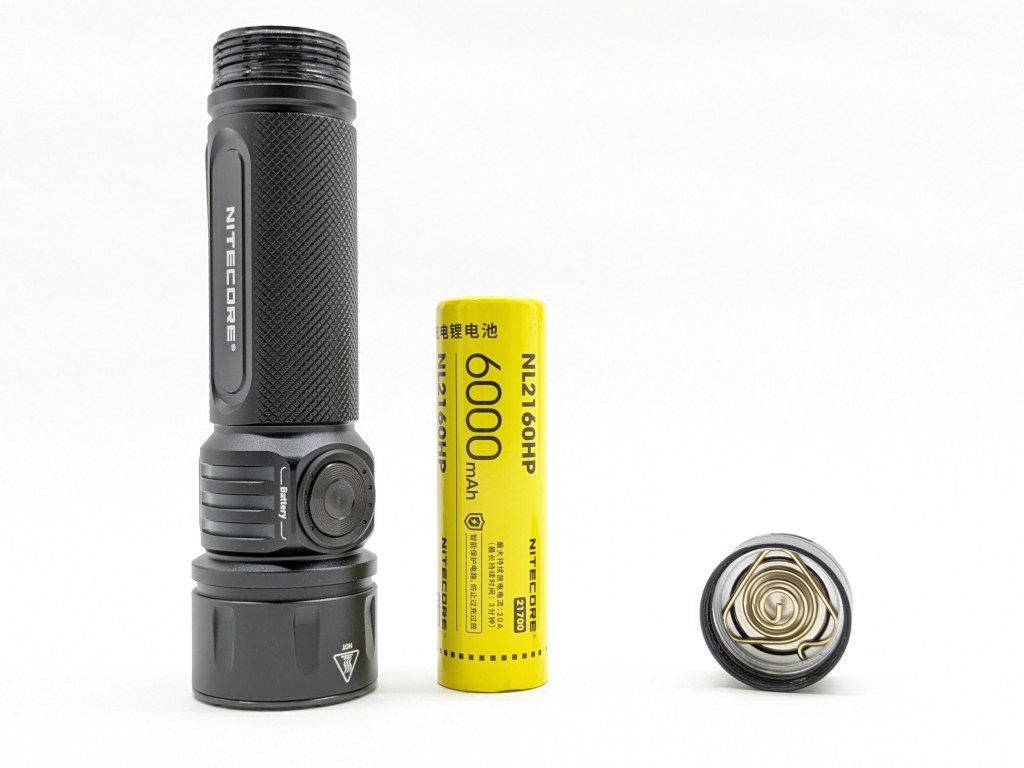
The battery included with my sample is a 6,000mAh, Nitecore-branded, protected, button-topped, 21700 cell. The marketing images and product descriptions say 5,500mAh. Either way, that’s very high capacity for a 21700 cell so it probably doesn’t have great discharge performance. A high-discharge ~4500mAh cell might provide better regulation and even more brightness.
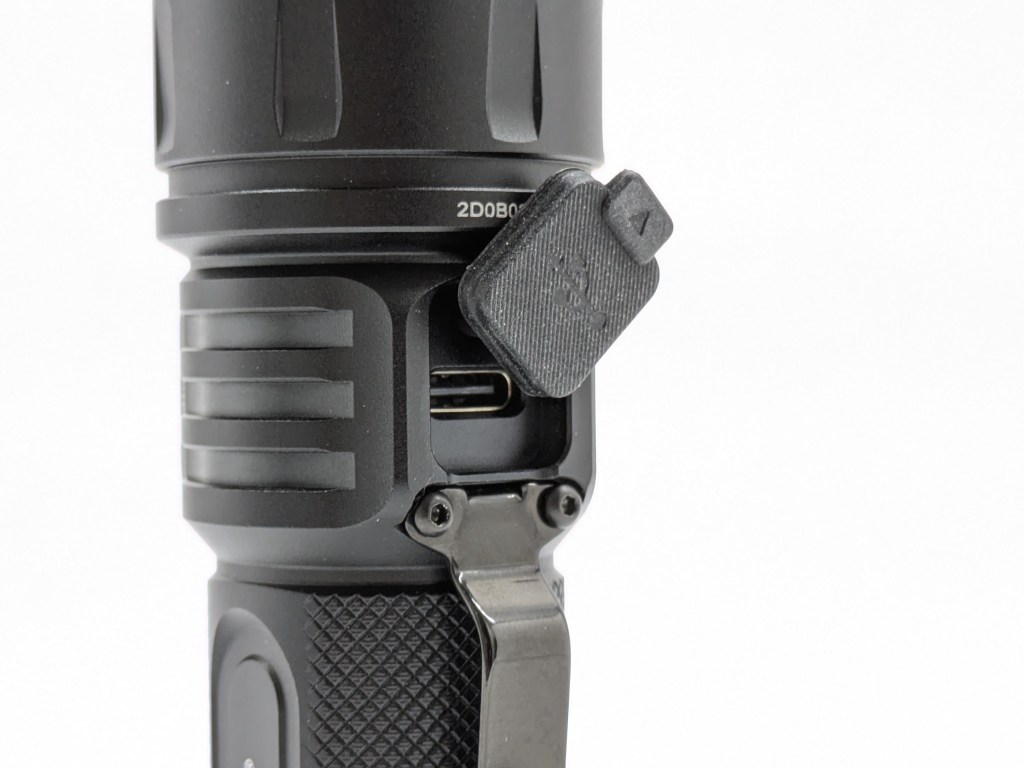
Charging is facilitated by a USB-C port opposite the button. It’s covered by a silicone flap that I don’t think will open by accident. I sometimes can’t get it open with just my fingers and need to use a tool. Charging takes a little over three hours. That’s faster than I expected with a 6,000mAh battery.
It works while plugged in, with or without a battery, but only goes up to High mode. There’s no powerbank function, which is something I expect from a light this size with a USB-C port.
The battery indicator is on the right side of the switch. It’s four discrete LEDs, my favorite kind of indicator. There’s also a brightness level indicator on the left. It’s gimmicky but looks nice. The indicators have noticeable PWM.
Switch
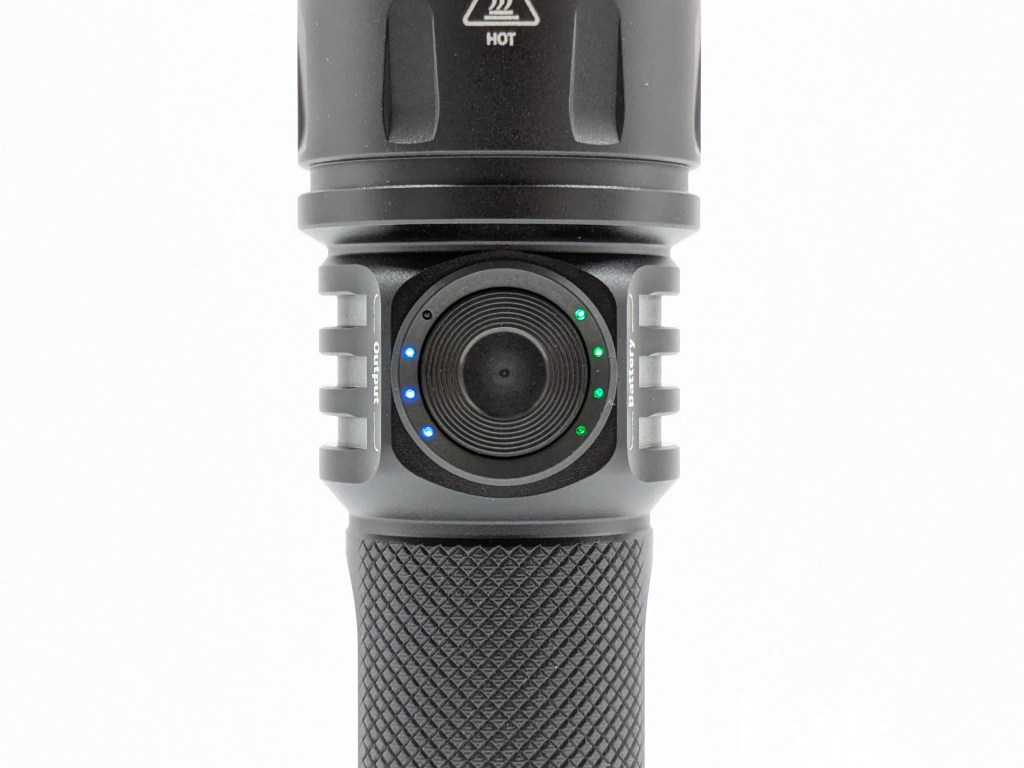
The switch is a metal e-switch on the side of the head, opposite the clip. It’s large, tactile, and audible. Since it’s so large, I imagine it might turn on by accident if you carry it frequently. Fortunately, mechanical lockout is easy and works great.
Carry & Ergonomics
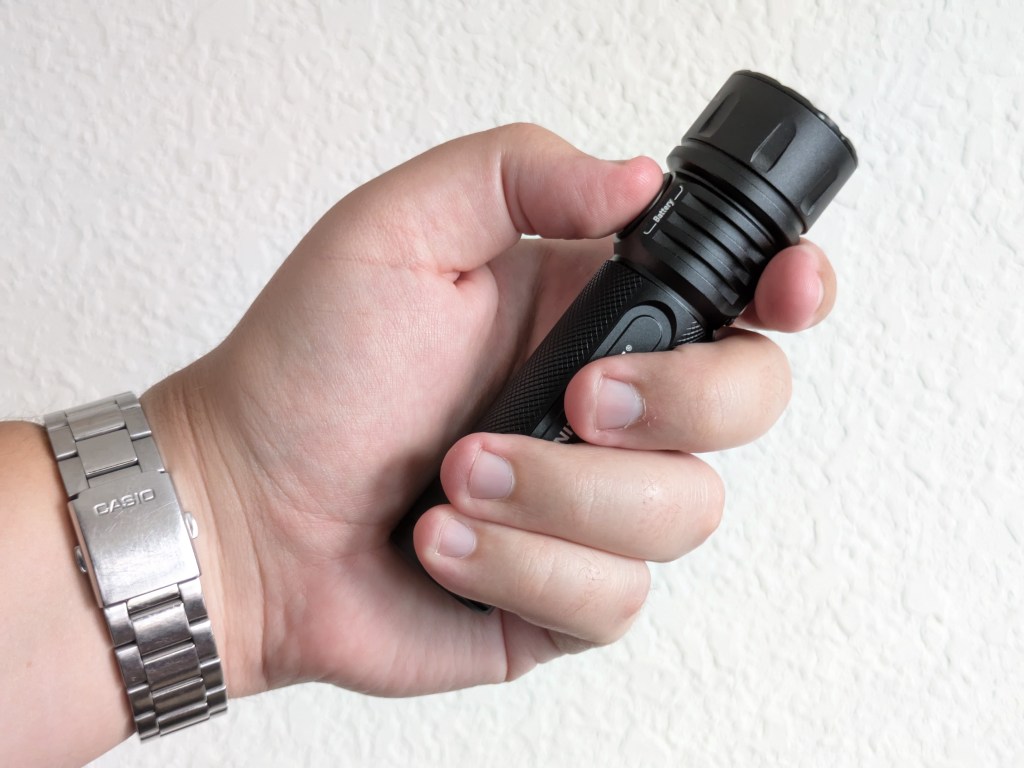
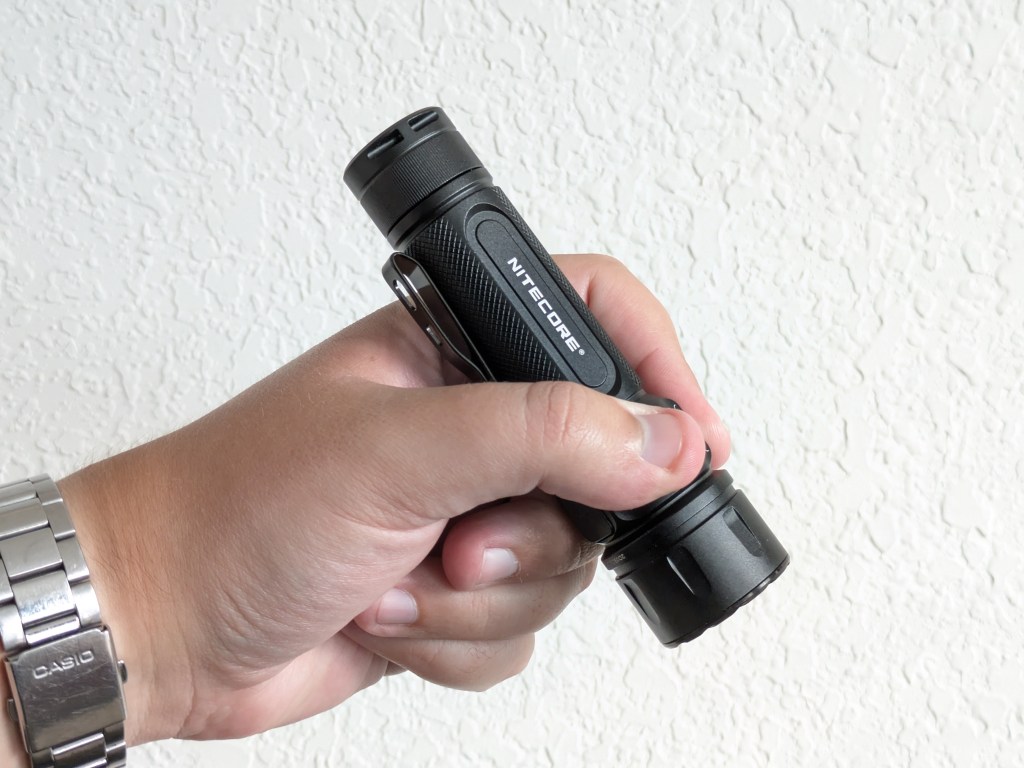
Ergonomics are excellent. It’s super comfortable to hold and use in a forward grip. A pencil grip isn’t bad either.
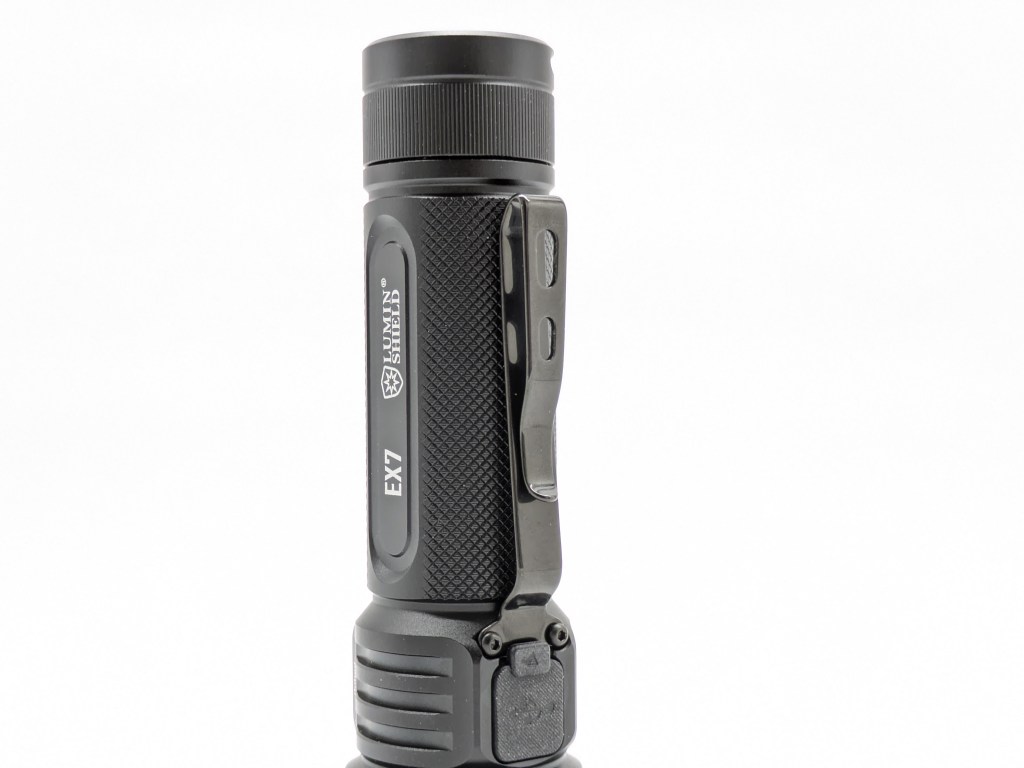
Clip score: 6.5/7
- Attachment doesn’t pop off or rotate accidentally✅
- User serviceable✅/❌
- The clip screws need a 1.3mm hex driver. I tried loosening them with a cheap 1.3mm bit, but it felt like the bit might strip. With a high quality bit, you might be able to remove the clip, but I don’t know. Half point.
- Bezel-down carry is at a reasonable depth✅
- Landing location is smooth, not on the charging port, and away from the bezel✅
- I’m giving this a pass because I think most people would carry this bezel-down, and in that case, the clip lands back on itself, which is smooth.
- Mouth/ramp and loop(s) are wide enough for pants material✅
- No bidirectional clips if the light is too big or heavy to clip to a hat✅
- I’m giving this one a pass here because the second loop inside the pocket, so it can’t catch on a seatbelt and get bent out of shape. That’s the point of this particular metric.
- Finish is durable✅
Magnet: There’s a strong magnet in the tailcap. It’s plenty strong to hold the light up on a vertical surface.
Competition
Here are some lights in the same class and how they compare.
Acebeam E75: much better UI without adjustable beam
- a bit more expensive, depending on where you buy
- not as bright, not as throwy
- various LED options (including high-CRI)
- very similar body design
- same four-LED in quad-reflector setup
- similar side switch, charging port, and pocket clip
- much better (mostly industry-standard) UI
- no adjustable beam
- worse battery indicator
- sharper bezel
- much better driver and regulation performance
Olight Seeker 4 Pro: fancy in different ways
- very similar design/layout
- more expensive
- not quite as bright or throwy
- magnetic charging on the light
- nice polymer holster with USB-C charging adapter included
- wall mount included
- combo pushbutton/rotary switch
- better (though still not ideal) UI
- very similar indicator LEDs
- pocket clip sold separately
- better driver, but poor regulation still
Emisar D4SV2: enthusiast alternative
- less expensive (no battery nor charger included though)
- advanced Anduril 2 UI (better than Nitecore’s UI, but overly-complex)
- shorter and thicker (can fit 21700 or 26650 batteries)
- single channel, dual channel, and even triple channel options
- you can get throw and flood switching/mixing by choosing two floody LEDs and two throwy LEDs
- various driver options (depending on how many channels you want)
- RGB aux LEDs
- No pocket clip
This section is not comprehensive. If I didn’t include a particular light here, it doesn’t mean it’s bad or doesn’t deserve to be here. I simply cannot list every possible competitor.
Conclusion
The build quality, ergonomics, switch, indicators, charging, brightness, and runtime are great. The clip is good. The adjustable beam is fine but I think a different implementation with two throw LEDs and two flood LEDs would have been better. This multi-die LED seems better suited for a small single-reflector light. The driver does not live up to the advertised “constant current” and “advanced thermal management” claims. It lacks a power bank function, which I expect in something this size. I can overlook those things, but not the confusing UI. It frequently does the opposite of what I want it to do and it ruins the light.
Thanks to FlashlightGo.com for sending me this light for review! They carry what I think is the best alternative, Acebeam E75.

 Grizzly's Reviews