- Pricing & Availability
- What comes in the box?
- Design & Construction
- Size & Measurements
- User Interface
- Emitter & Beam
- Mode Chart
- Runtime
- Driver & Regulation
- Batteries & Charging
- Switch
- Carry & Ergonomics
- Competition
- Conclusion
Pricing & Availability
Acebeam sent me this light in exchange for an honest review. Here is the official product page and the Amazon US listing where you can see current pricing. At the time of writing it’s $55 USD, but you can use code “ACEK12020” for 15% off!
What comes in the box?
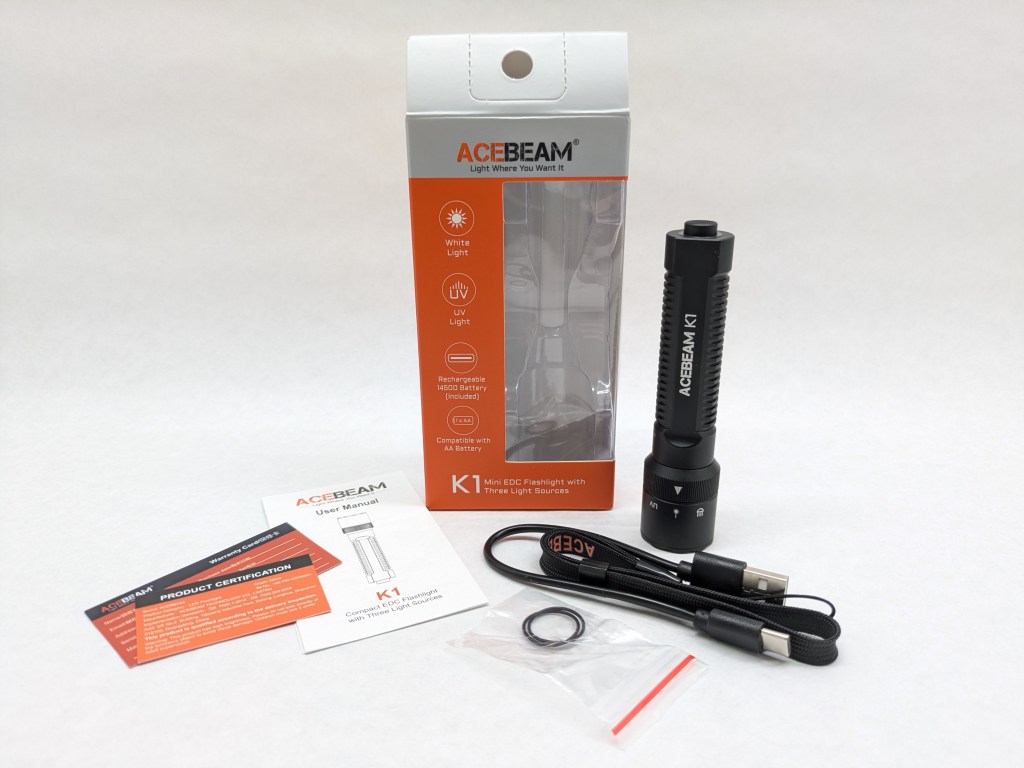
K1 comes in a retail box that shows off the light. Inside is:
- The light itself
- Battery (inside the light)
- User manual
- USB A-to-C charging cable
- Wrist lanyard (odd, there’s no lanyard hole/loop on the light)
- Spare O-rings
Design & Construction
K1 is a traditional flashlight shape with a flared head and narrow body. It’s on the smaller side and the body has flat spots to make it carry a bit thinner. The screw-on clip and rotary selector on the head are nice touches.
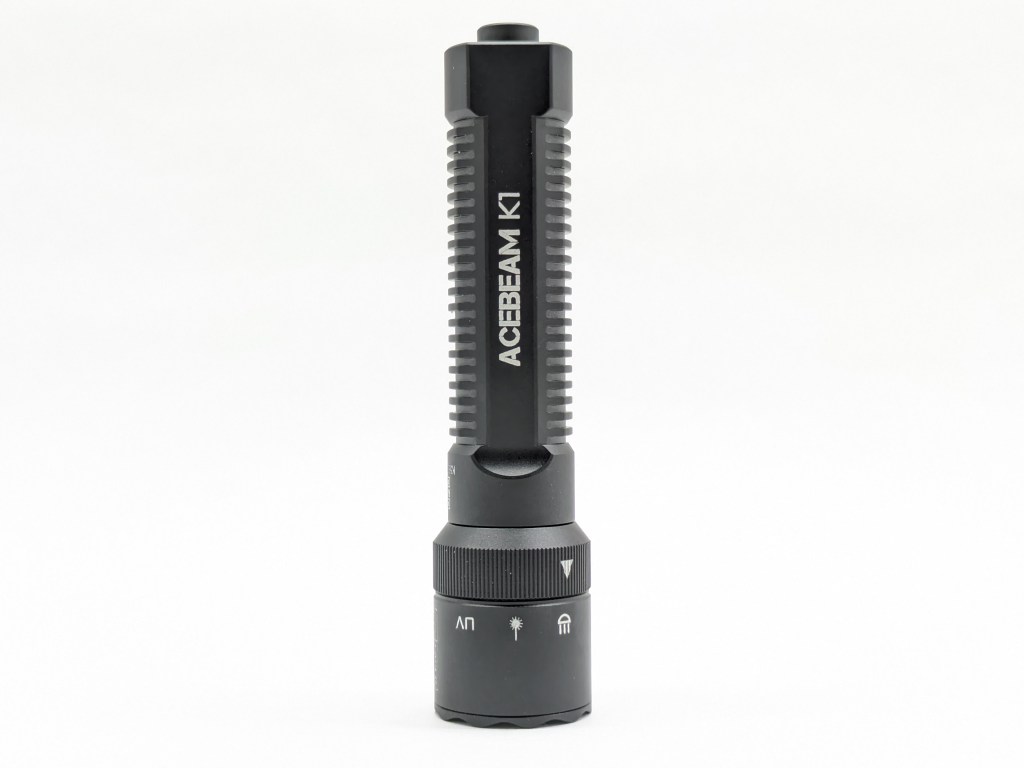
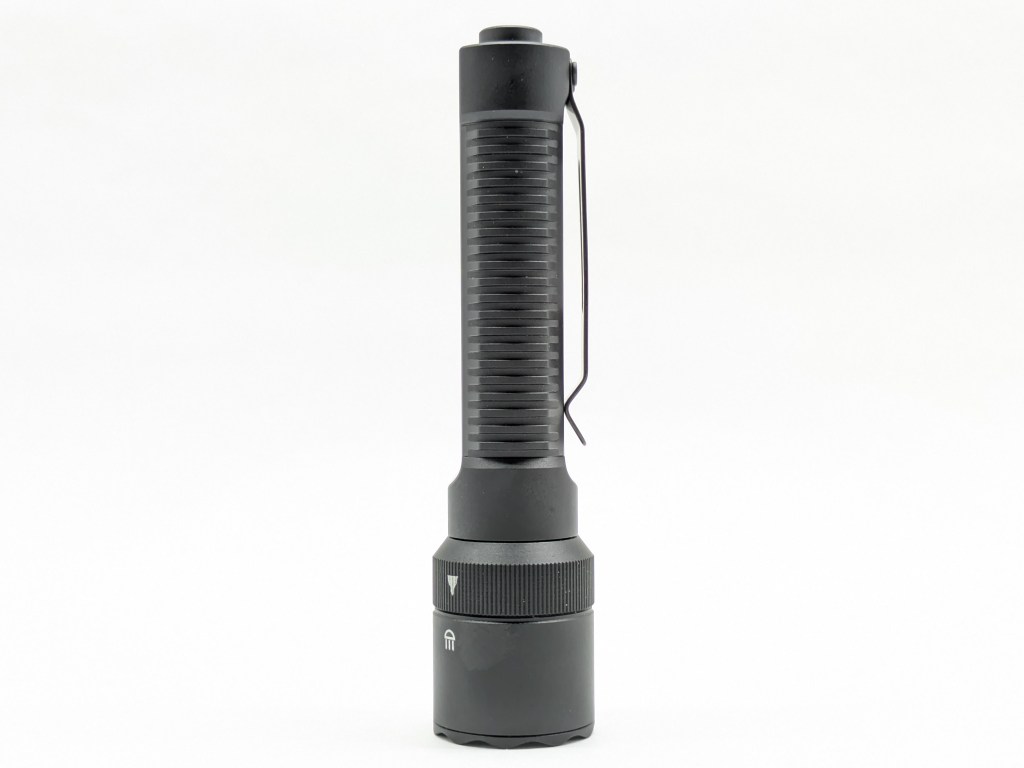
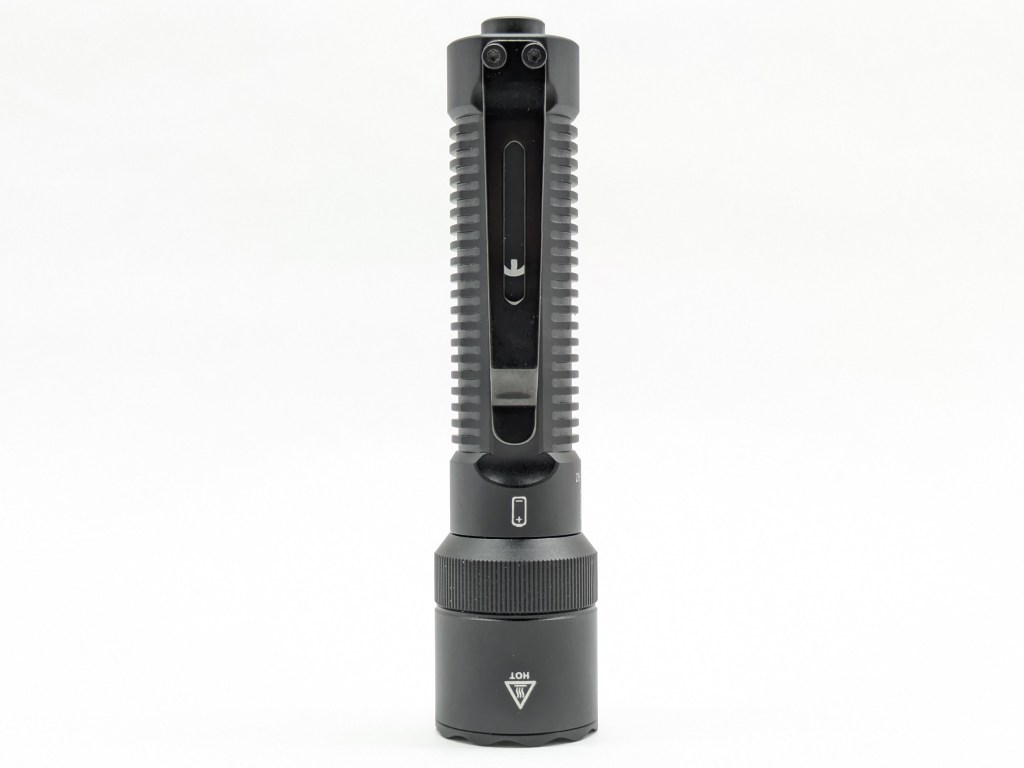
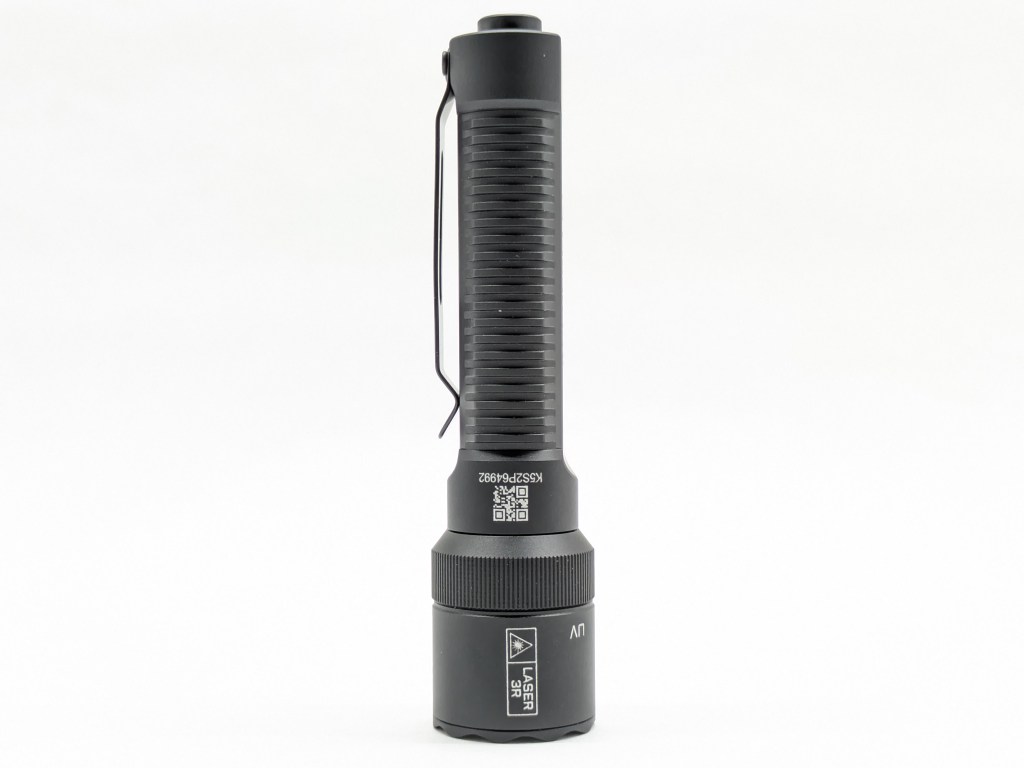

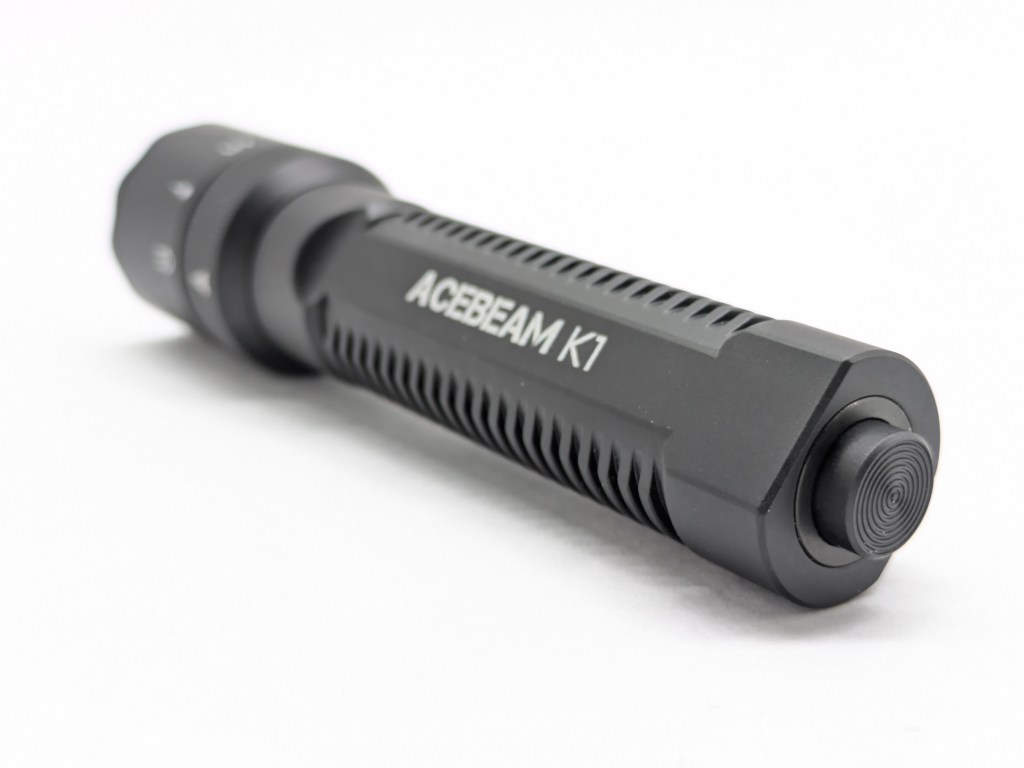
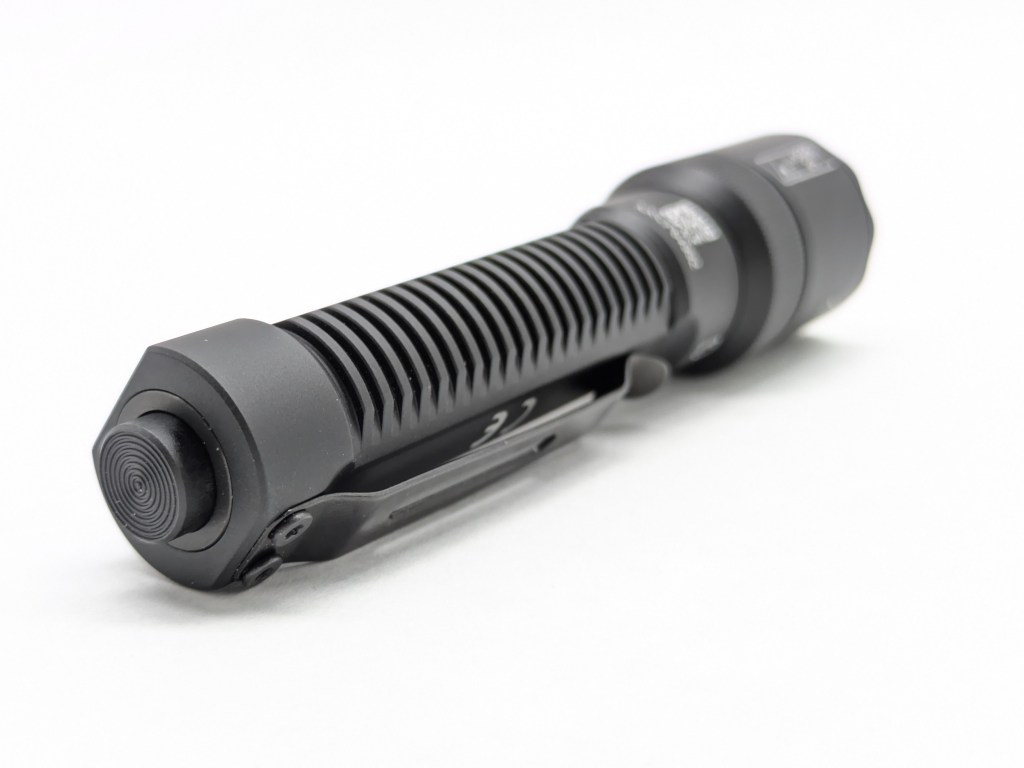
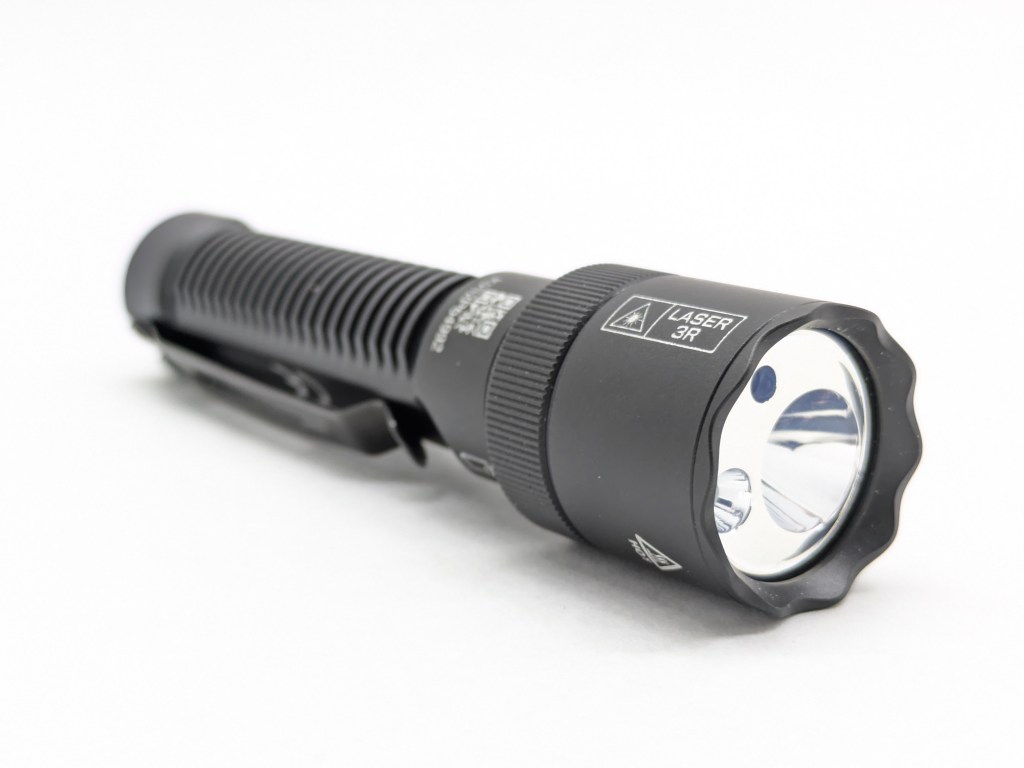
Build quality is great. The finish is particularly nice. If I had to find something to gripe about, I’d say the switches could be smoother.
Size & Measurements
Olight i3E | Acebeam K1 | Skilhunt MiX-7 G2+ | Mini Maglite | Olight Warrior 3S
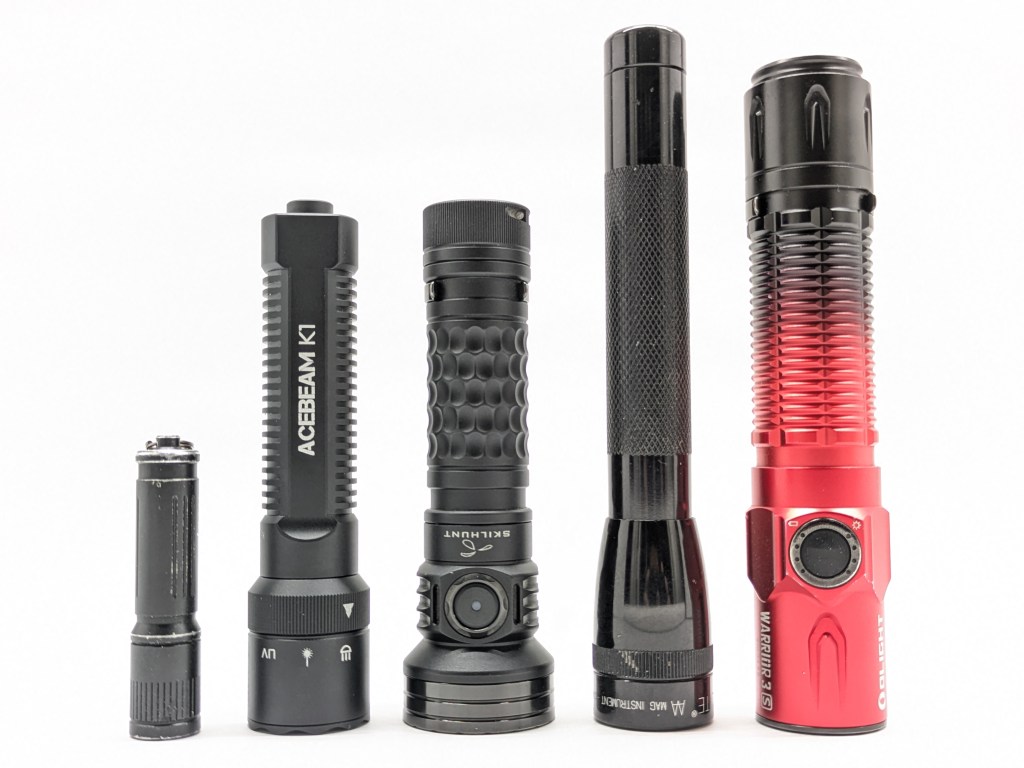
| Measurement | Measured (mm) |
|---|---|
| Bezel Diameter | 25.6 |
| Length | 110.0 |
| Switch Diameter | 10.1 |
| Body Tube Diameter | 16.0-20.0 |
| Pocket Clip Screw Spacing | 5.9 |
| Included Battery Length | 50.2 |
| Weight with included battery (g) | 78 |
User Interface
I like how simple and straightforward this UI is, but I’d prefer if it were faster and without mode memory.
How it works:
- Half-press: momentary on. Release to turn off.
- Full press: constant on. Press again to turn off.
- Mode changes: Repeatedly turn on, off, and back on. Quick half-presses in succession will let you cycle modes quickly. It has mode memory, so it will turn back on in the last mode you used.
- Channel selection: Turn the rotary knob to choose which channel you want to use. You can only use one at a time.
Notes:
- It’s slow. The driver takes a noticeably amount of time to fire up the LED after you press the switch. It’s long enough that I can half-press the switch and release it before the LED turns on. That makes it feel slow and I don’t like it.
- It has mode memory. I prefer my mechanical-switch lights to always start in low mode, then I can quickly tap through to the mode I want. This also contributes to it feeling slow, because I have to turn it on, analyze if this mode is the right one, and then change it if needed.
- It’s simple. They did a great job making this UI intuitive instead of cluttering it with features. Having a separate rotary channel selector makes this possible.
Emitter & Beam
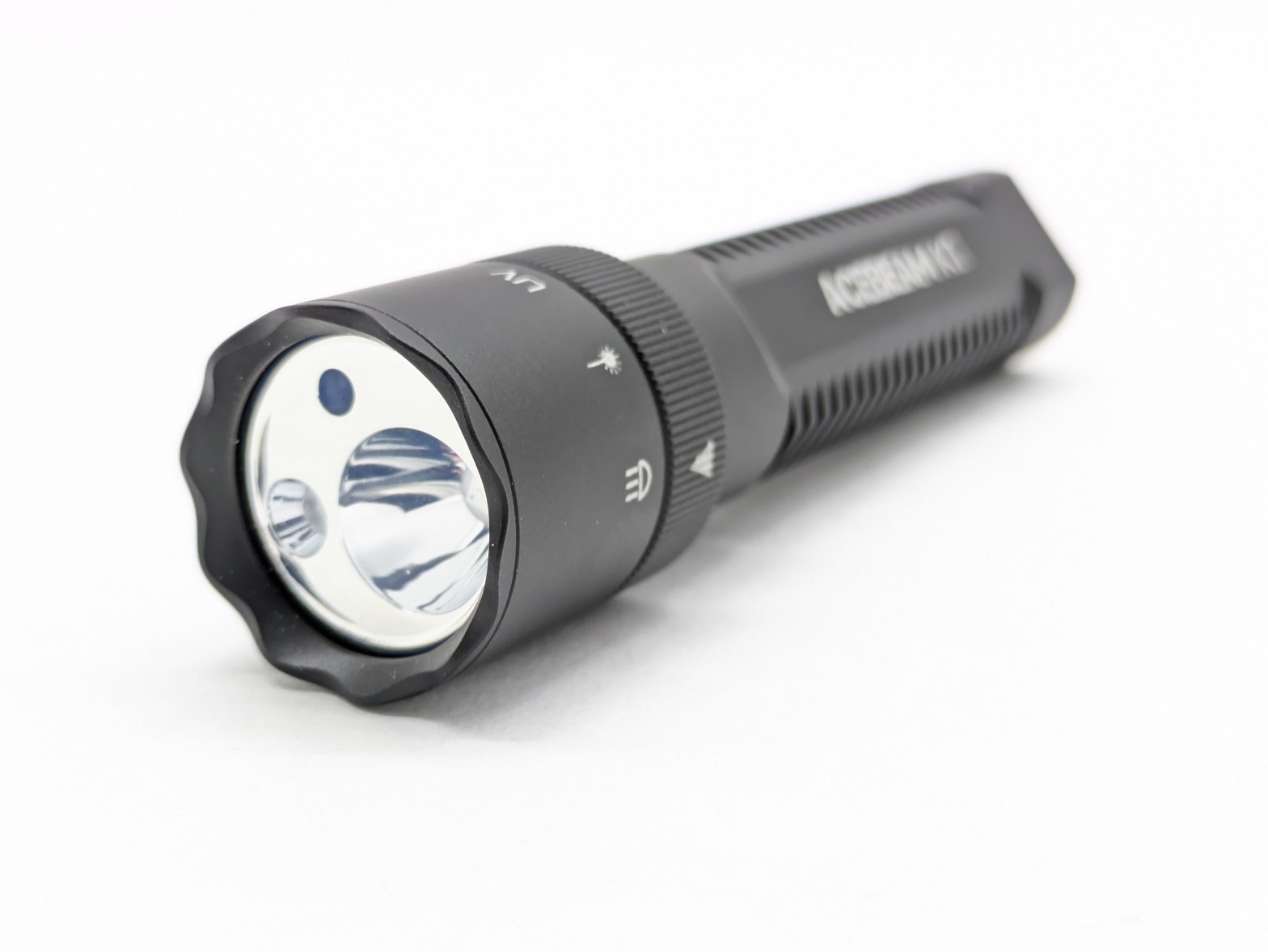
The main white LED is a CREE XP-LR. It’s got a small, round, domeless die that provides surprisingly good throw performance. It’s a nice departure from the overly-floody LEDs usually included in competing combo lights, but I it doesn’t have the nicest color properties. There’s also a UV diode and a green laser diode. They all sit in a smooth multi-reflector where the white LED portion takes up the most space. This combination of white, UV, and laser is very popular right now.
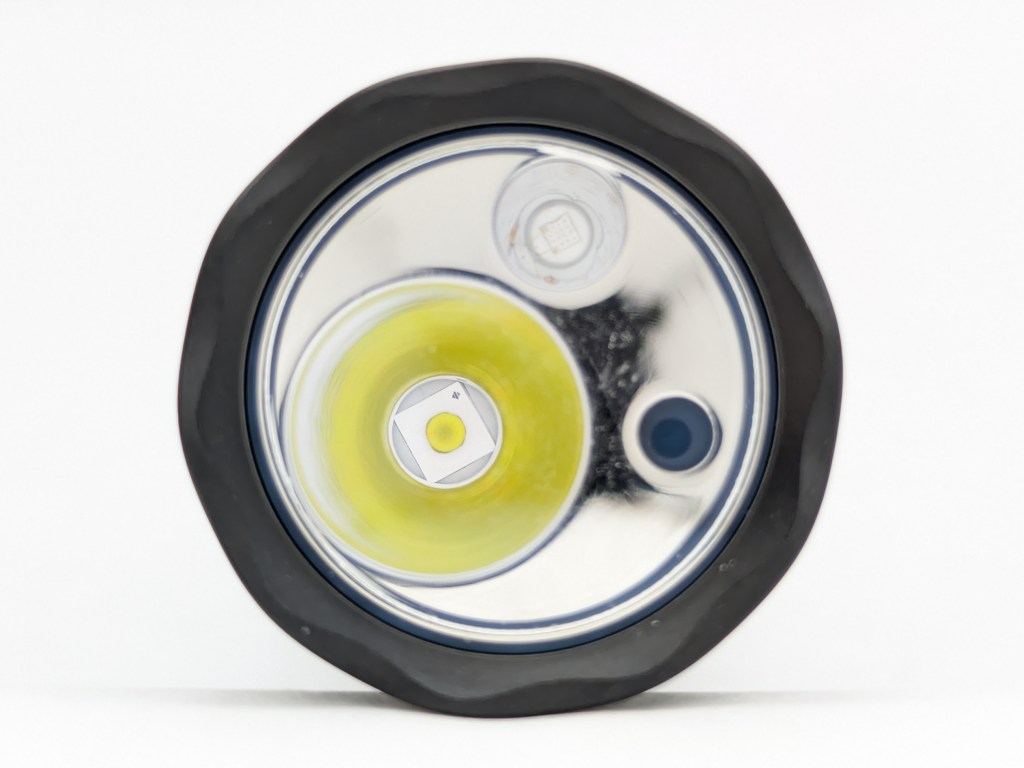
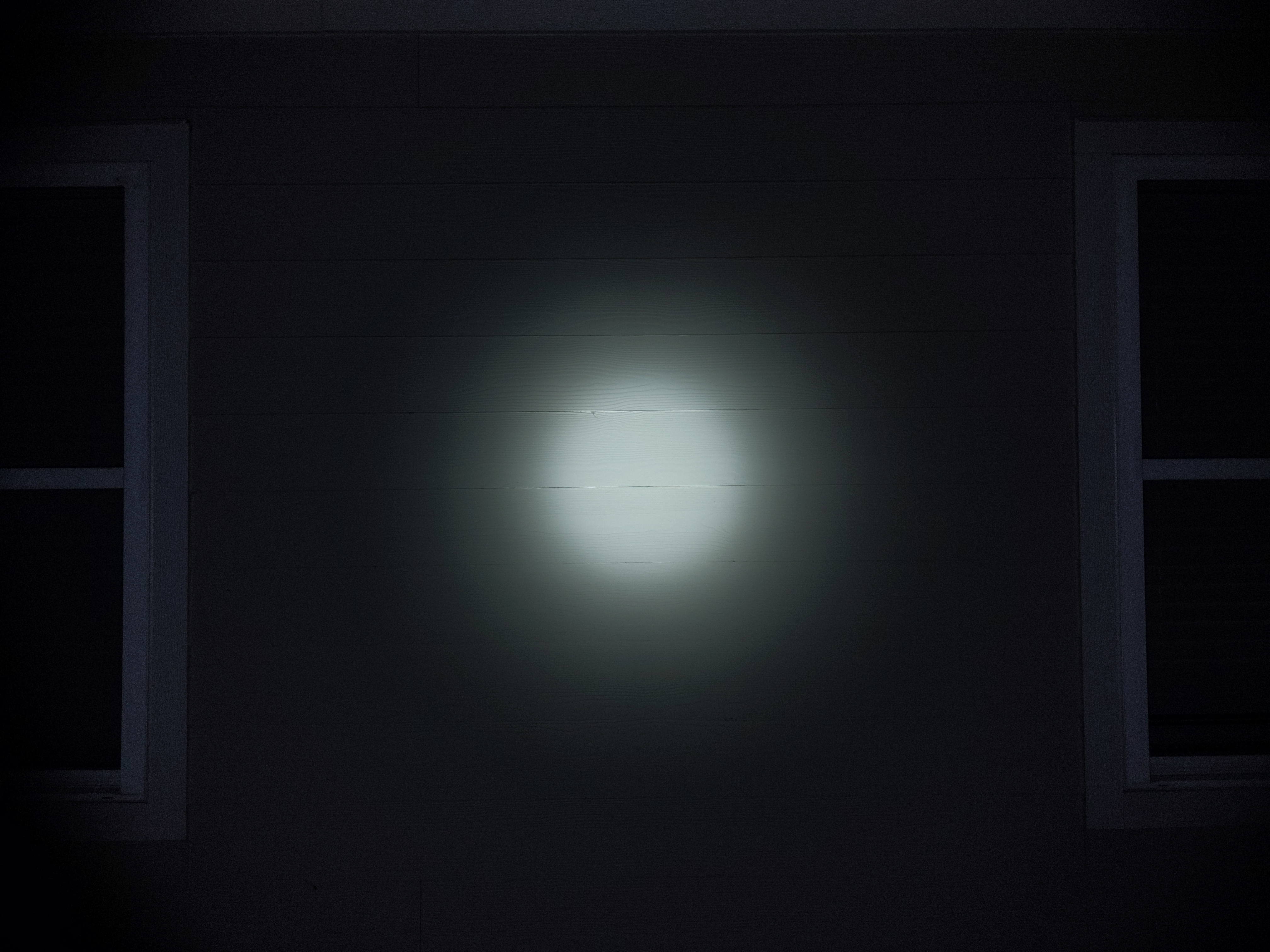
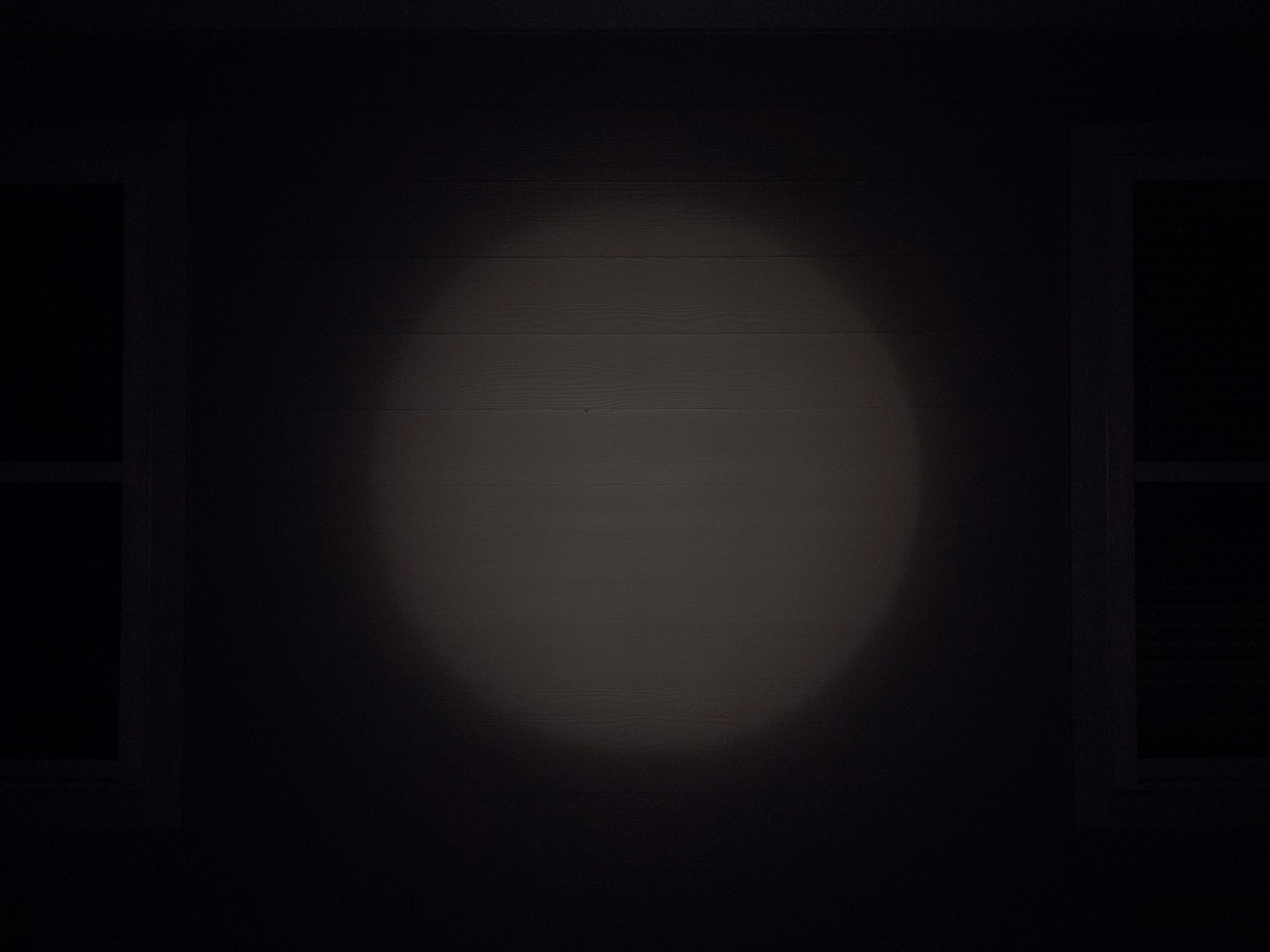
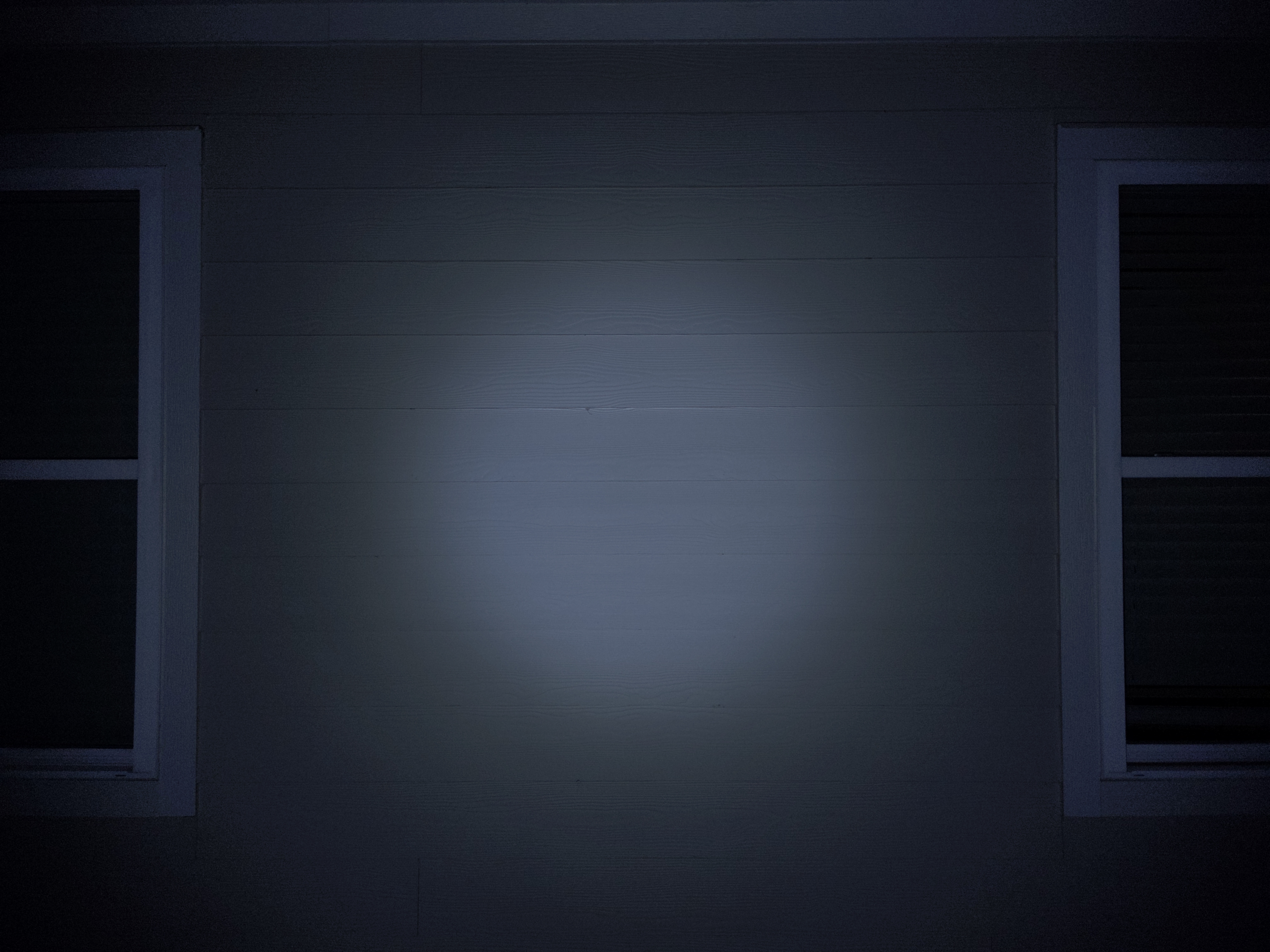
The beam is on the throwy side, with a fairly crisp hotspot. The spill is almost perfectly round with just a hint of a flat spot on one side from the bezel. I find this beam a lot more useful than the overly-floody beams found on most white+laser+UV competitors in the flat EDC light space. This UV light does not have a ZWB2 filter, so it emits some visible light and looks less impressive than lights with a ZWB2 filter.
In the beamshots below, camera settings are fixed and the wall is 2.8M away.
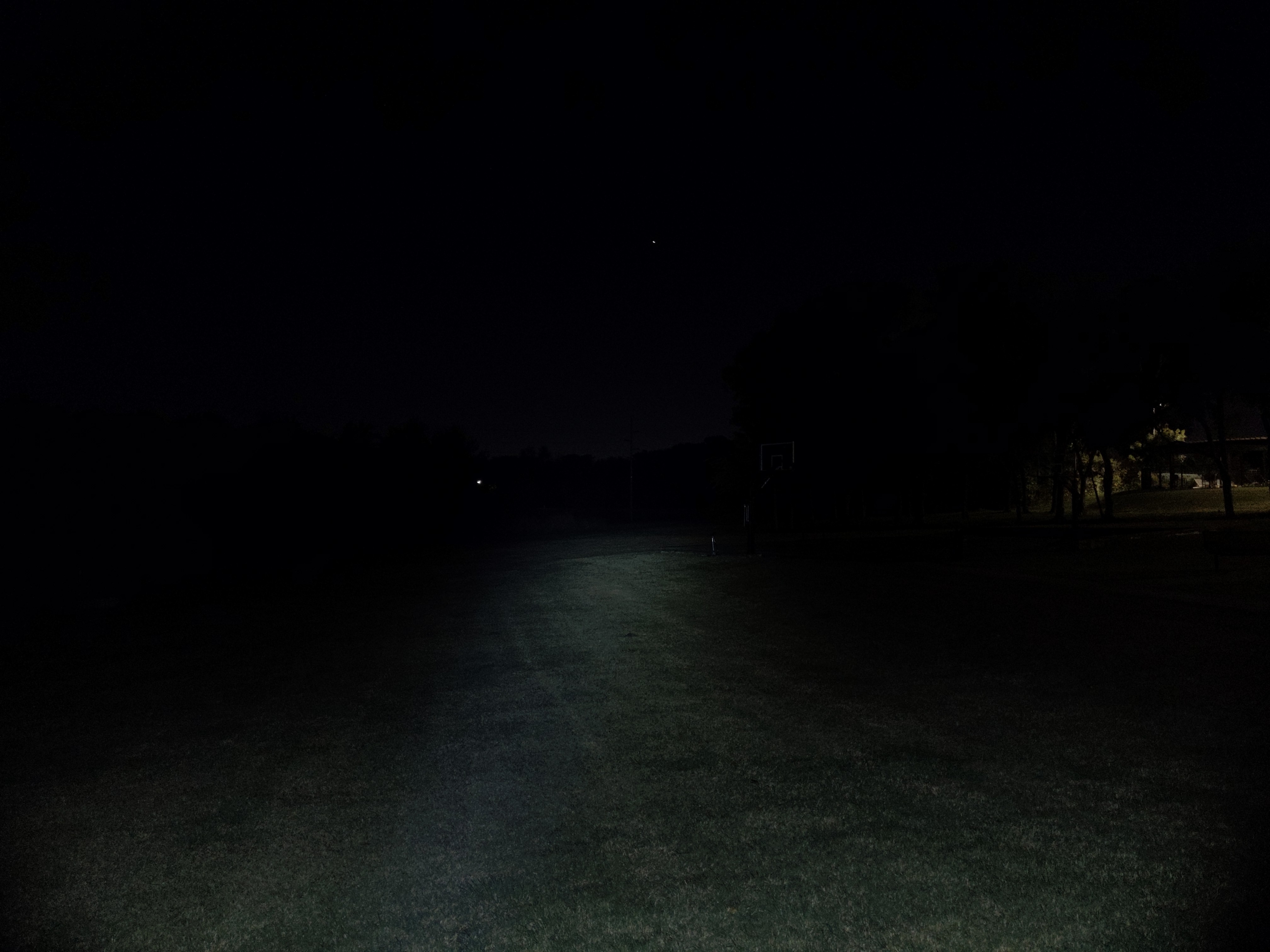
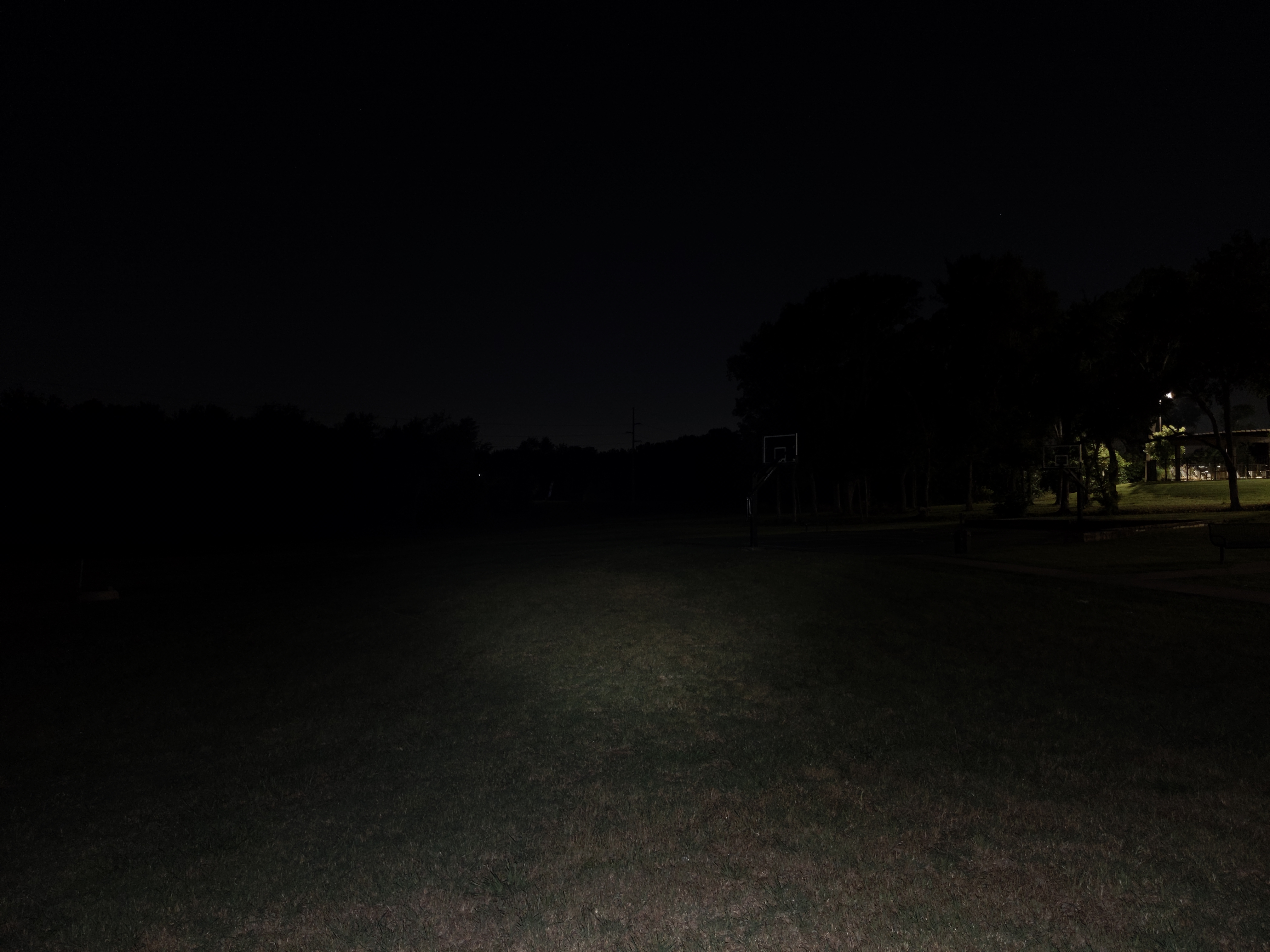
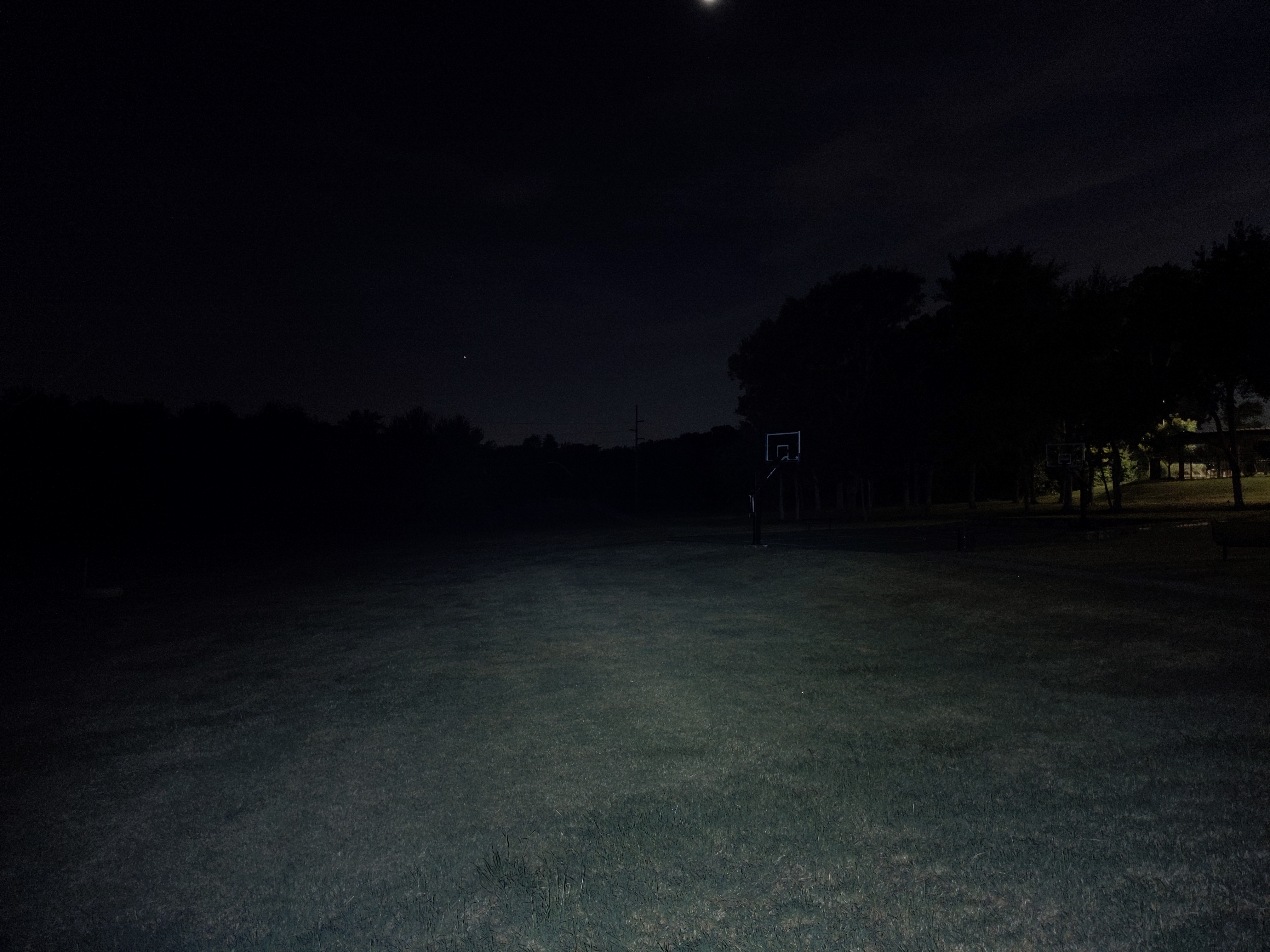

In the beamshots below, camera settings are as similar as possible, the basketball goal to the right of the hotspot is 39M away, and the power pole in the center is 185M away.

Mode Chart
Disclaimer: All of my measurements are taken at turn-on. Lumen measurements were taken on a Texas Ace 3.5″ Lumen Tube. A candela measurement was taken at 10 meters with an Opple Light Master III on the highest brightness, and other candela figures were calculated relative to that. CRI, CCT, & DUV data were taken for each mode from a few feet away at the center of the hotspot with the Opple Light Master and Waveform DUV Calculator. Runtime tests were performed with the Ceilingbounce app on my smartphone. These tests were performed with a fully charged included battery unless otherwise specified. I cannot measure moonlight directly, so moonlight readings are calculated based on the brightness relative to the next-lowest mode. None of this is professional equipment, so take these measurements with a grain of salt.
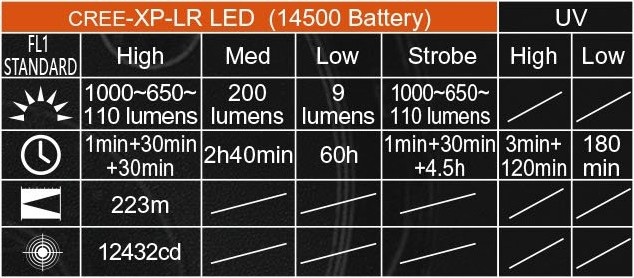
The official specs are above, followed by my own measurements below.
| Level | Lumens | Candela | Throw (Meters) | CRI (Ra) | Color Temp. (K) | DUV (Tint) |
| High | 850 | 13000 | 230 | 66 | 5710 | 0.0104 |
| Medium | 160 | 2500 | 99 | 64 | 5370 | 0.0126 |
| Low | 5 | 76 | 17 | 65 | 5230 | 0.0127 |
Runtime
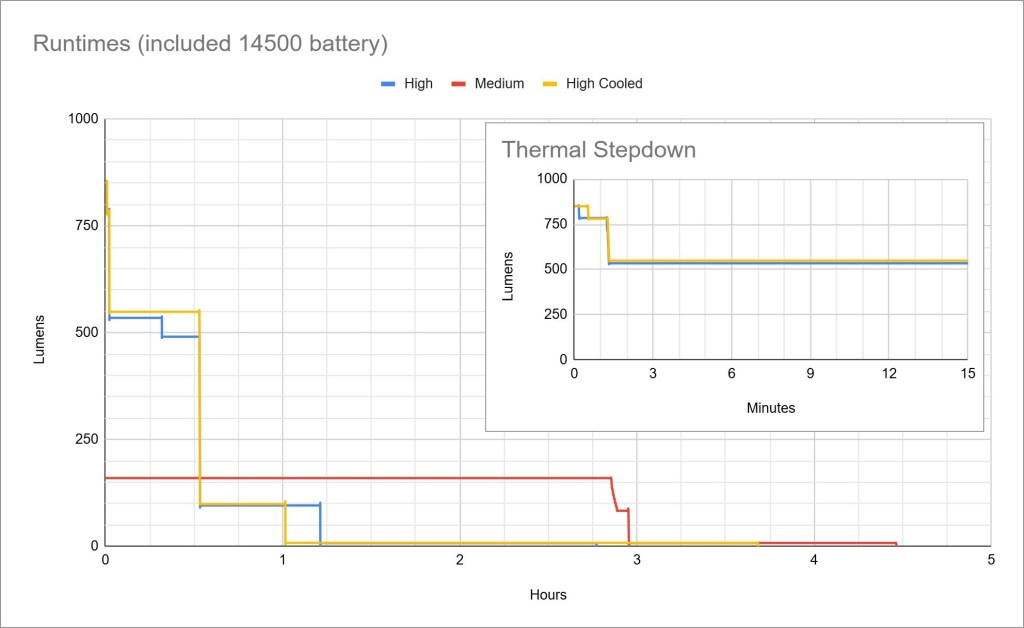
The performance impressed me. Sustained output is high for a 14500 light (~500lm) and I like how long Medium mode runs perfectly flat (almost three hours).
Thermal regulation: My Turbo and Turbo Cooled tests are pretty close. The initial stepdown at 1 minute seems to be timed, but the differences in output after that might be active thermal regulation. If there is active thermal regulation, it doesn’t make a noticeable difference.
LVP (Low Voltage Protection) is not present. K1 relies on the included battery’s protection circuit to shut off when the battery is empty.
Driver & Regulation
The driver: I asked Acebeam what kind of driver they’re using in K1, but didn’t get an answer. Based on its performance, I’m guessing the white LED is boost-driven when on a AA battery and effectively linear-driven on a 14500 cell.
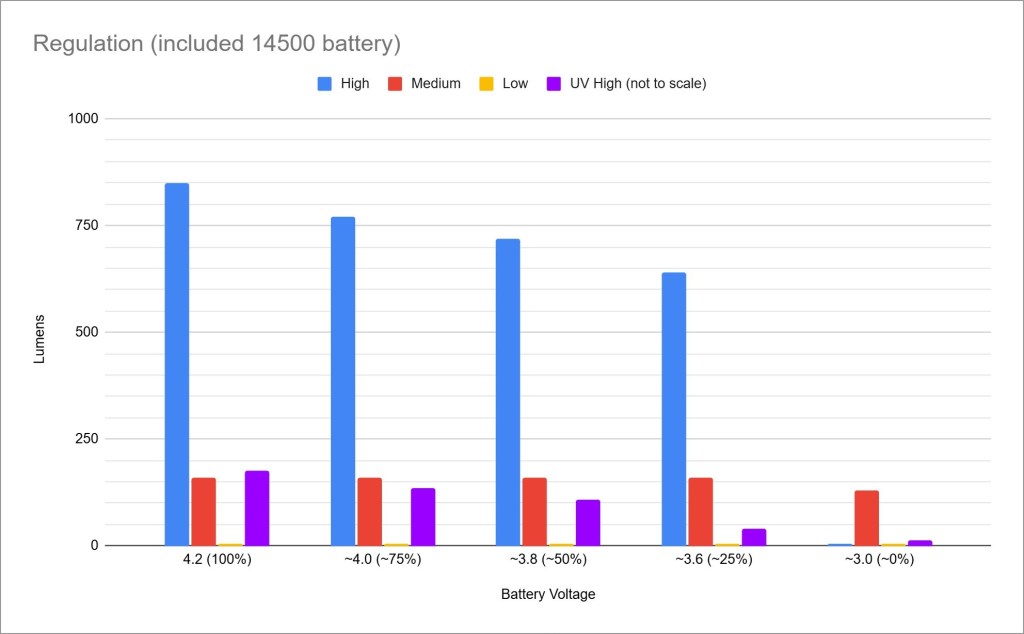
Regulation performance is good/average. It maintains most of the High mode brightness down to ~25% charge, and all the other white modes are flat down to 25% charge or less. That’s exactly what I want because it shows the components are high quality and they’re being pushed hard for great performance. The UV regulation is not as good, which is pretty common on combo lights like this one.
PWM: No PWM is visible to my eyes or camera, nor audible to my ears. My opple picked up some flickering in Low white mode, but the other modes are flicker-free.
Parasitic Drain: There is no parasitic drain because this light uses a mechanical switch.
Batteries & Charging
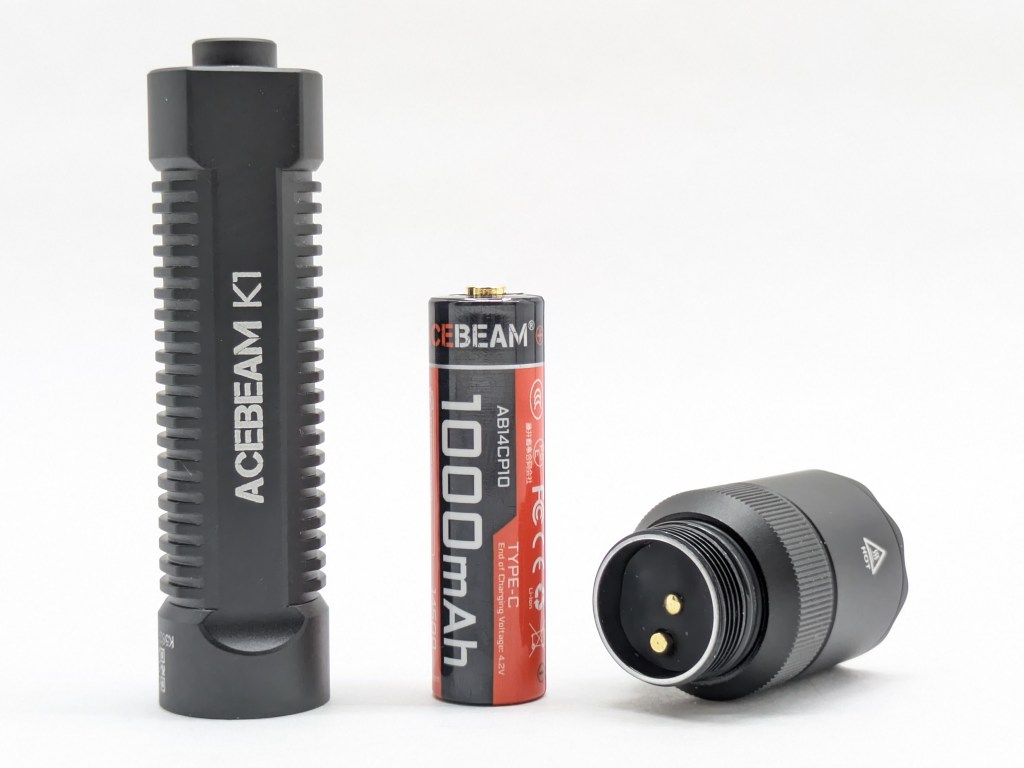
The battery included is an Acebeam-branded, 1000mAh, protected, button-topped, 14500 cell with an integrated USB-C charging port. Alternatively, K1 accepts standard Alkaline or NiNh AAs, but it won’t get as bright with those batteries. It has physical reverse polarity protection so you must use a button-topped battery, and there’s no LVP so protected cells are recommended. All of my testing is on the included battery.
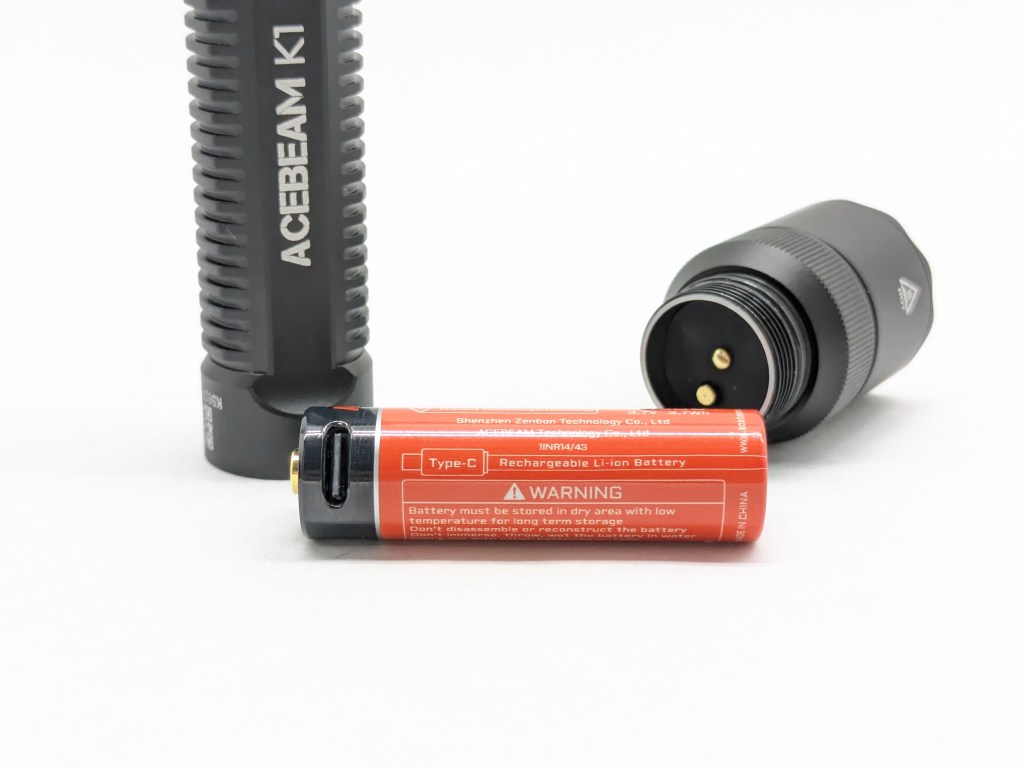
Charging is facilitated by a USB-C port on the side of the battery. Charging takes just over two hours. The end of the battery glows red when charging and green when full. There’s no battery indicator on the light itself.
Switch
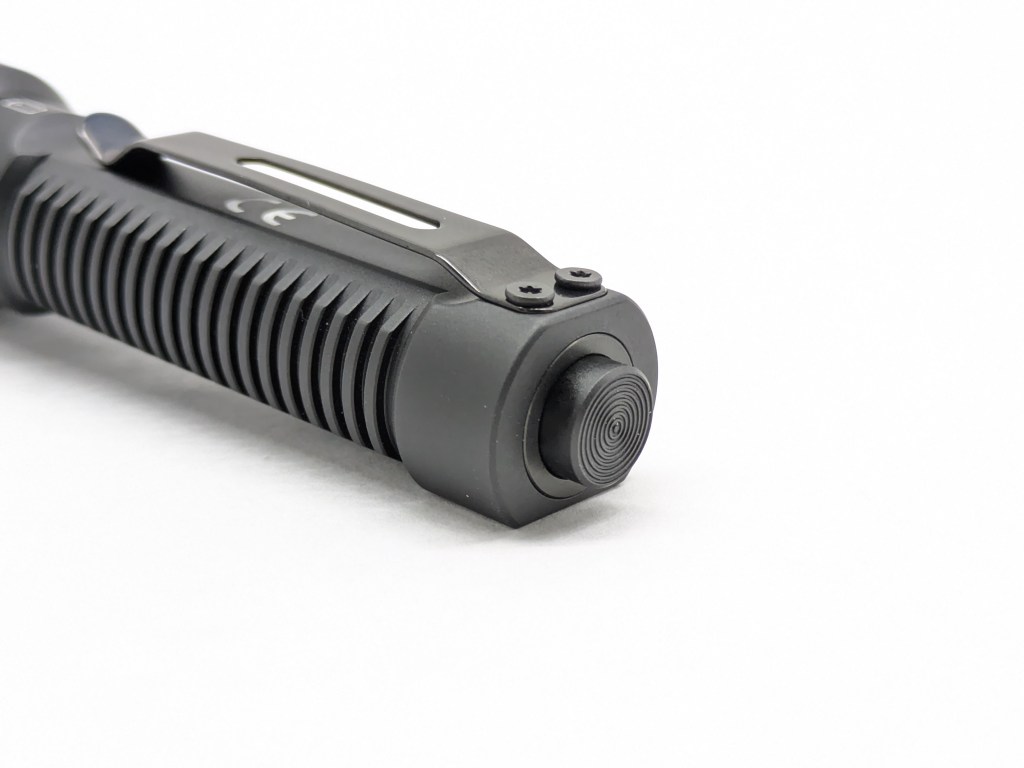
K1’s power switch is a forward-clicky mechanical switch located on the tail. It’s got a metal boot and feels well made, but stiff. You can half-press it from off for momentary activation. This switch itself is fine, but it feels laggy and unresponsive because the driver takes a few milliseconds to respond to the switch being pressed.
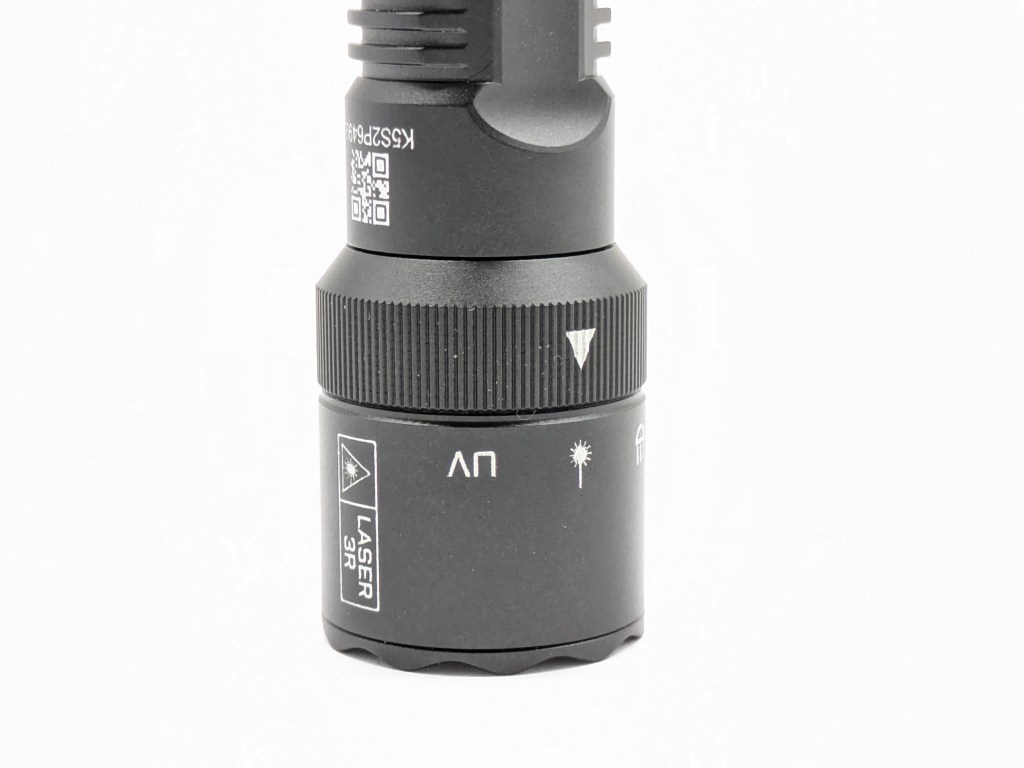
K1’s channel selector is 3-position rotary toggle on the head to choose between white light, laser, and UV. It’s easy to rotate with one hand and has good detents. I love when multi-channel lights have a dedicated selector like this. It’s so much more intuitive than a series of specific holds and clicks to change channel. My only complaint is it’s a little gritty and could be smoother.
Carry & Ergonomics
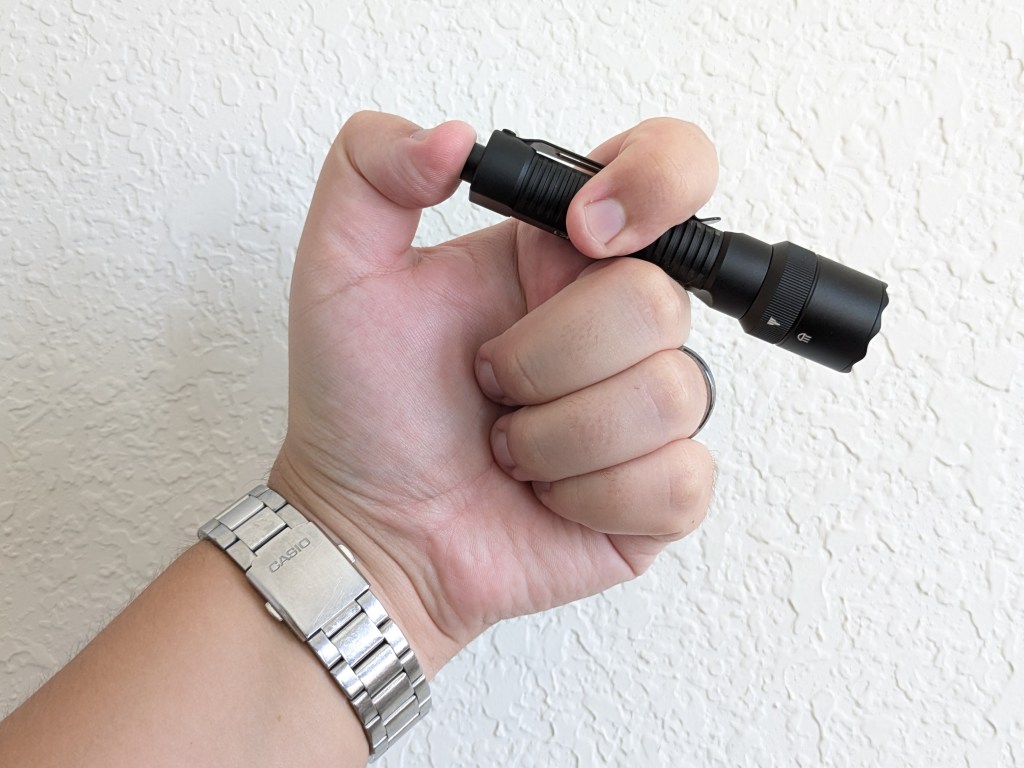
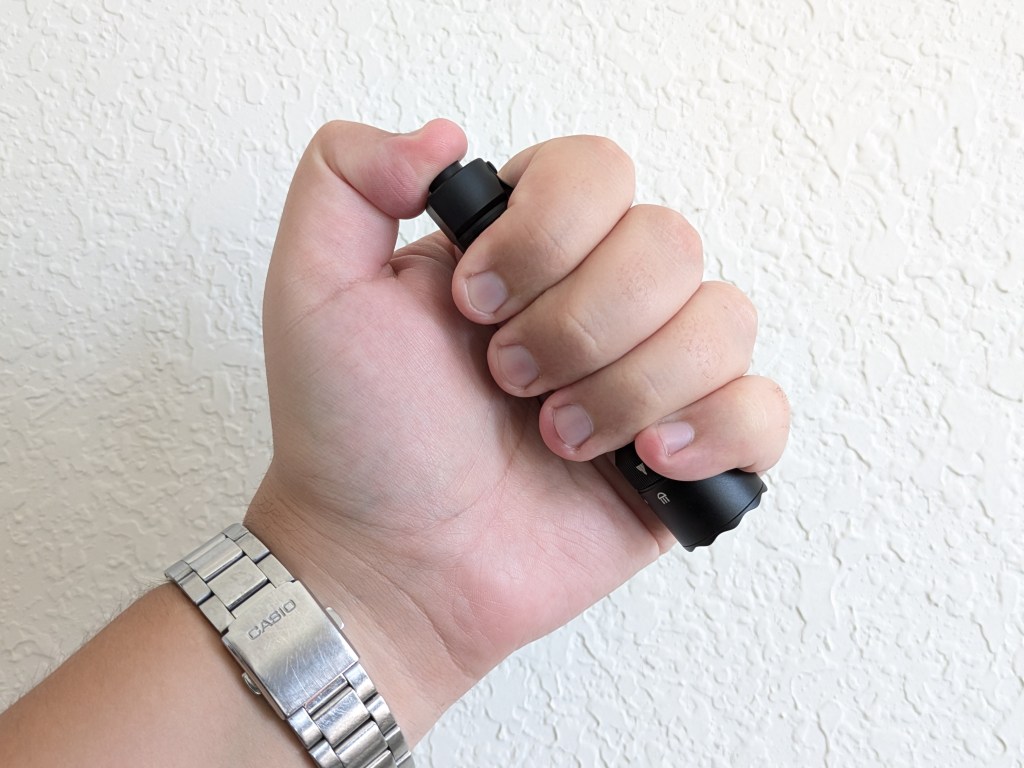
Ergonomics are good. It’s comfortable to hold and use in a reverse or cigar grip. There’s no one grip that lets you access both switches, but it’s small enough that turning it around in your hand isn’t cumbersome.
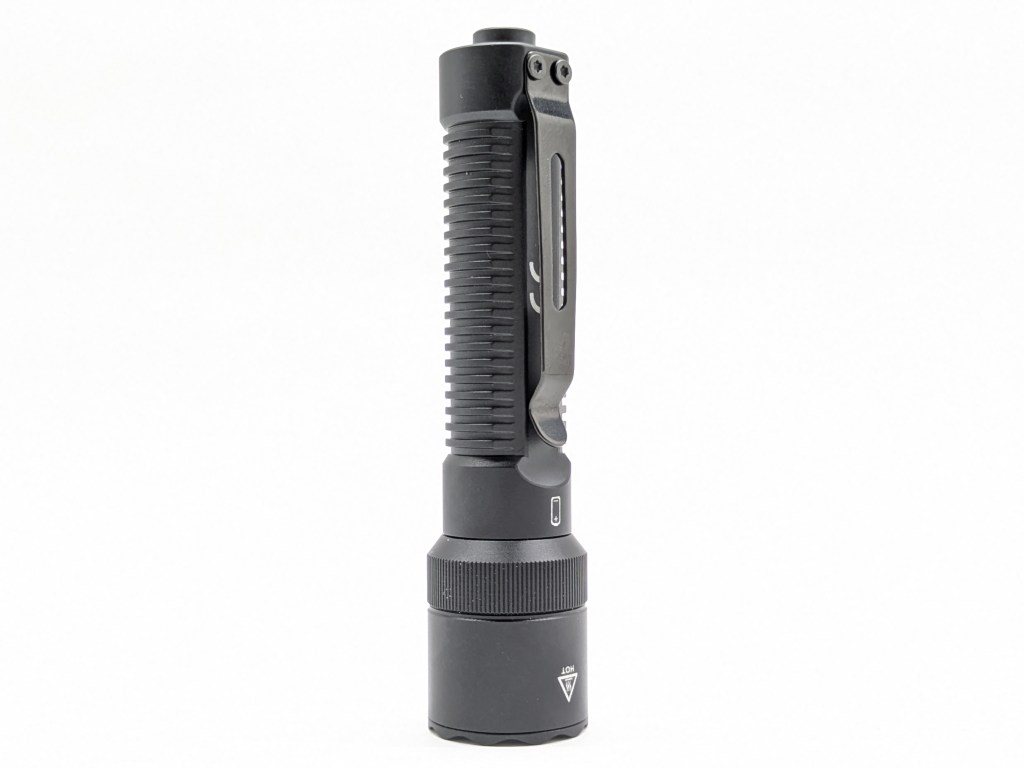
Clip score: 7/7
- Attachment doesn’t pop off or rotate accidentally✅
- Can be removed and bent back into shape if needed✅
- Bezel-down carry is at a reasonable depth✅
- Landing location is smooth, not on the charging port, and away from the bezel✅
- Mouth/ramp and loop(s) are wide enough for pants material✅
- Finish is durable✅
- No bidirectional clips without reason✅
Competition
Here are some lights in the same class and how they compare.
Thrunite Defender: flat alternative
- a bit more expensive
- a bit lower build quality
- more brightness, less throw
- retains laser and UV
- side switch and side rotary selector
- USB-C charging and built-in battery
- bidirectional clip and magnetic tailcap
- there are LOTS of flat EDC lights with white, laser, and UV. I picked this one as an example because I think it’s the best bang for buck in its class.
Acebeam Tac AA V2: white-light-only alternative
- lower price
- similar size and shape
- white light only
- same 14500 battery with USB-C charging on said battery
- bidirectional clip
- should be able to tailstand
- programmable UI
Skilhunt MiX-7 Gen 2: RGB alternative
- more expensive
- uses an 18350 battery (normal version) or 18650 battery (plus version) instead of 14500
- proprietary magnetic USB charging built into the light
- white, UV (with ZWB2 filter), red, green, and blue with stepped color mixing
- a few different white LED options
- side e-switch, no separate channel selector
- wider head, shorter length (for 18350 version)
- magnetic tailcap
- one of my favorite lights of all time
This section is not comprehensive. If I didn’t include a particular light here, it doesn’t mean it’s bad or doesn’t deserve to be here. I simply cannot list every possible competitor.
Conclusion
Flat EDC flashlights have been flooding the market in the last year or two, most with three channels (white, UV, and laser) and built-in batteries. Acebeam K1 strikes me as a direct competitor to those, offering most of the same core features (compact size, easy carry, and three channels) with a user-serviceable battery. I love the size, brightness, beam shape, and rotary channel selector. I like the price, regulation performance, ergonomics, clip, forward-clicky switch, USB-C user-swappable battery, laser, and UV beams. The build quality is good overall but the switches could be smoother. I appreciate the UI’s simplicity but dislike its lag and mode memory.
Thanks to Acebeam for sending me this light for review!

 Grizzly's Reviews