
- Pricing & Availability
- What comes in the box?
- Design & Construction
- Size & Measurements
- User Interface
- Emitter & Beam
- Mode Chart
- Runtime
- Driver & Regulation
- Batteries & Charging
- Switch
- Carry & Ergonomics
- Competition
- Conclusion
Pricing & Availability
FlashlightGo.com sent me this light in exchange for an honest review. Here is the product page on their site and the Amazon US page where you can see current pricing. At the time of writing it’s $56 USD.
What comes in the box?
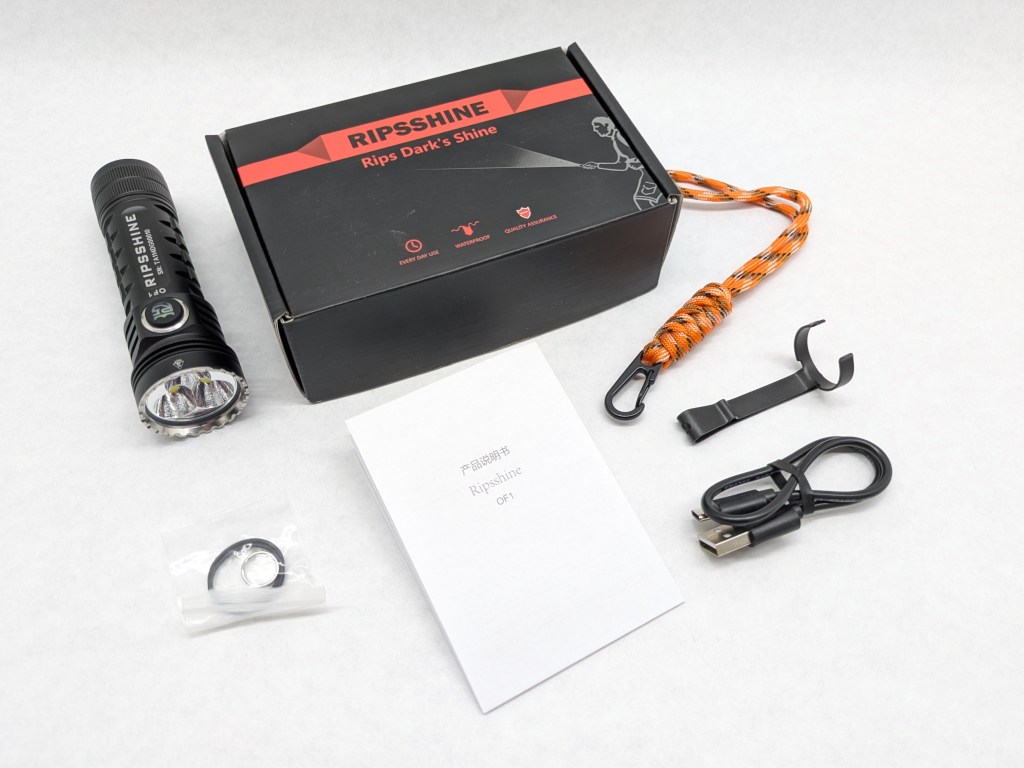
OF1 comes in a fairly basic cardboard box with a foam insert. Inside is:
- The light itself
- Battery (inside the light)
- User manual
- USB A-to-C charging cable
- Paracord lanyard
- Pocket clip
Design & Construction
The design is pretty standard for an e-switch hotrod. Short head, several LEDs, switch on the side. It works.

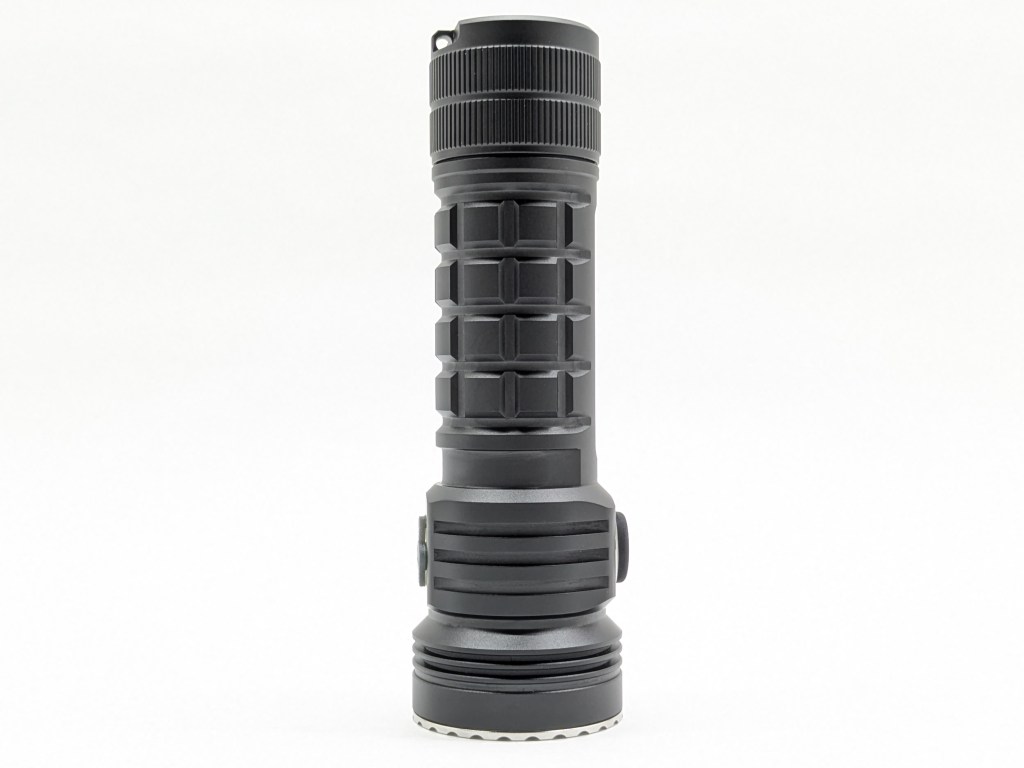
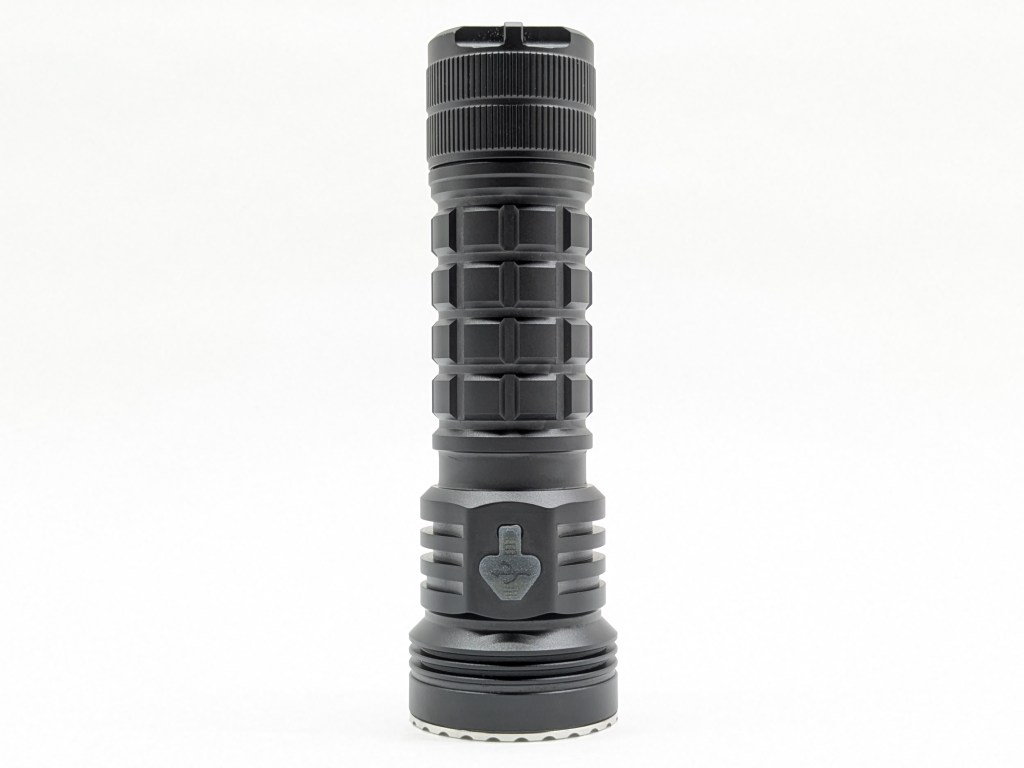
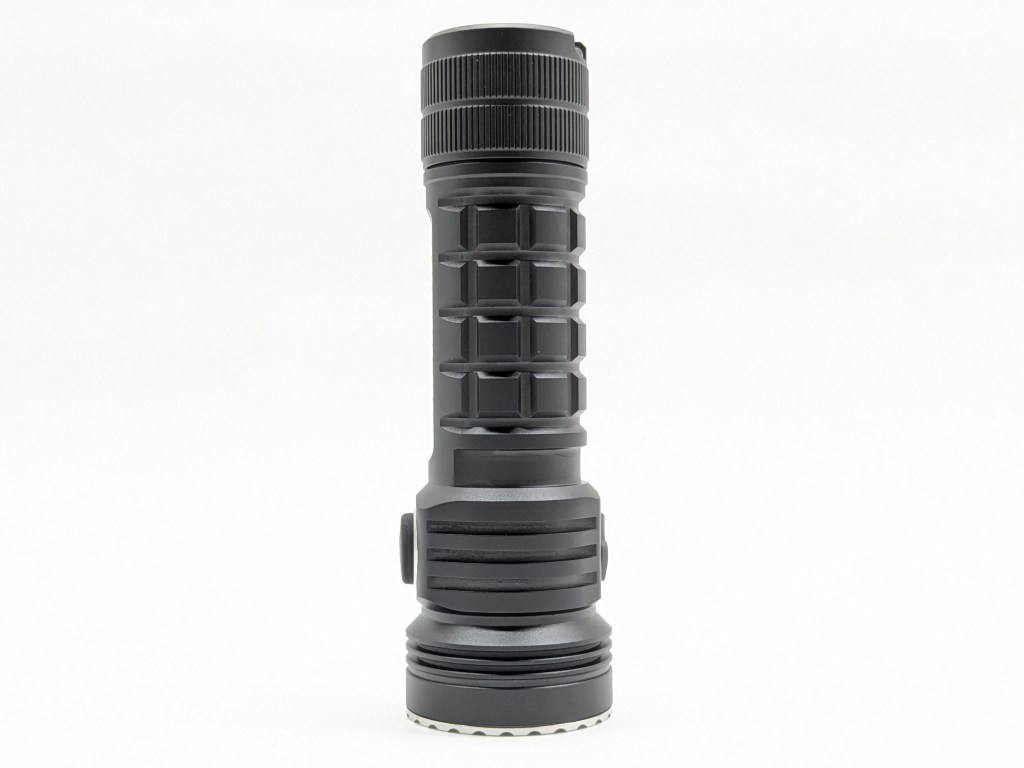
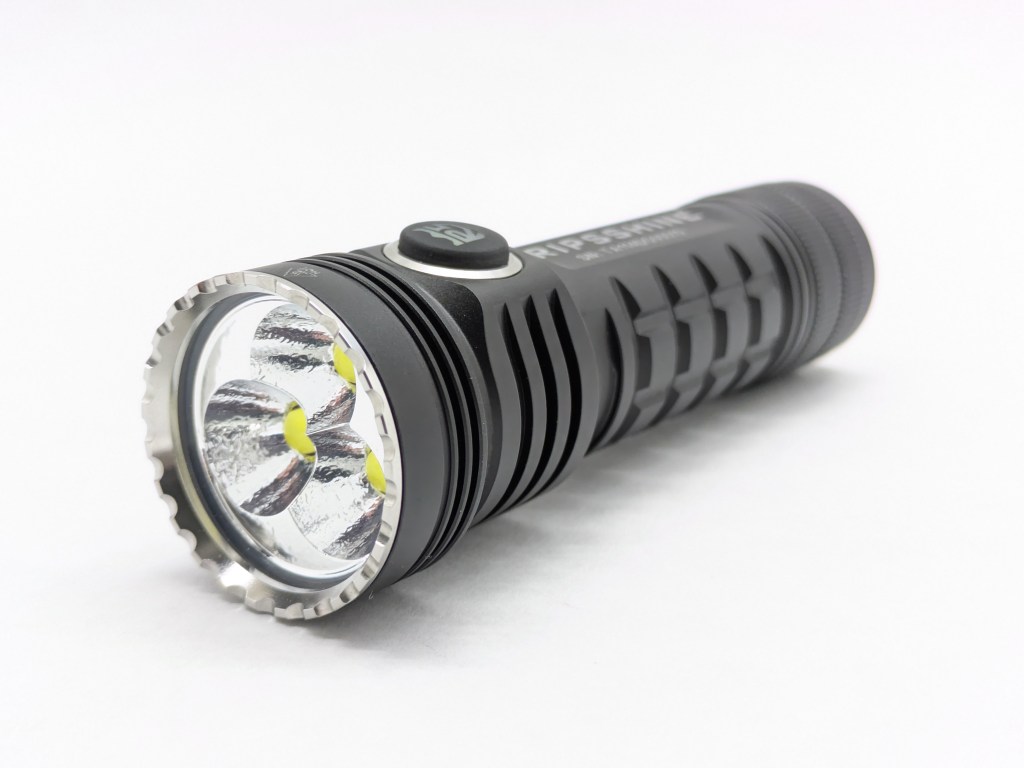
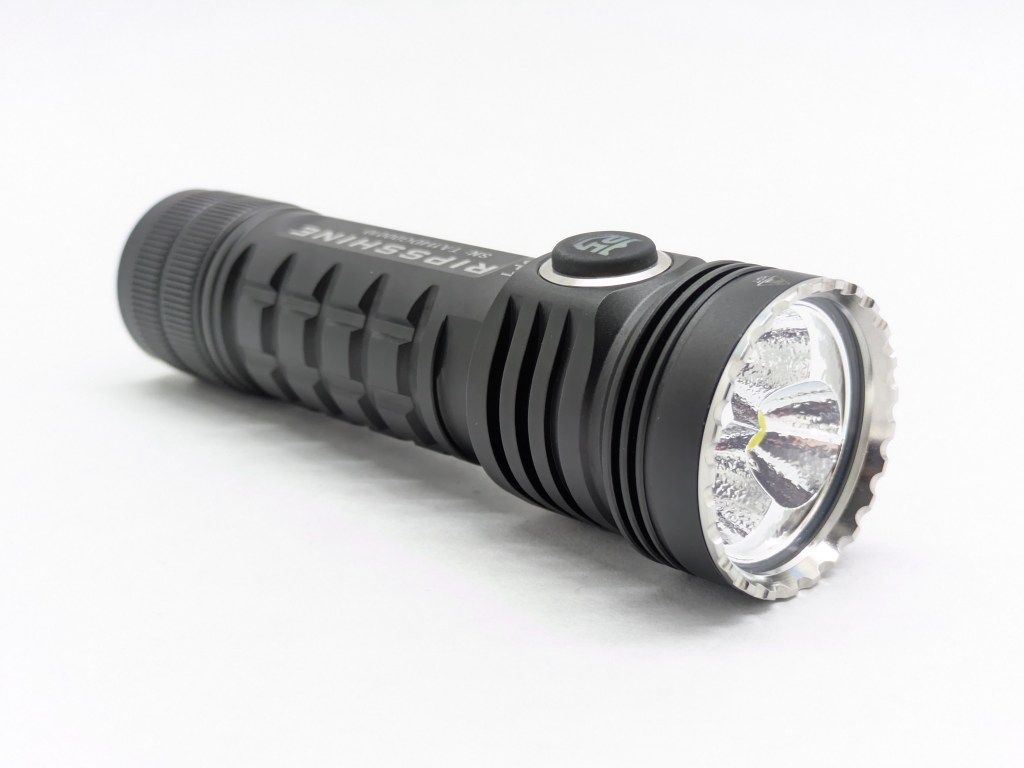
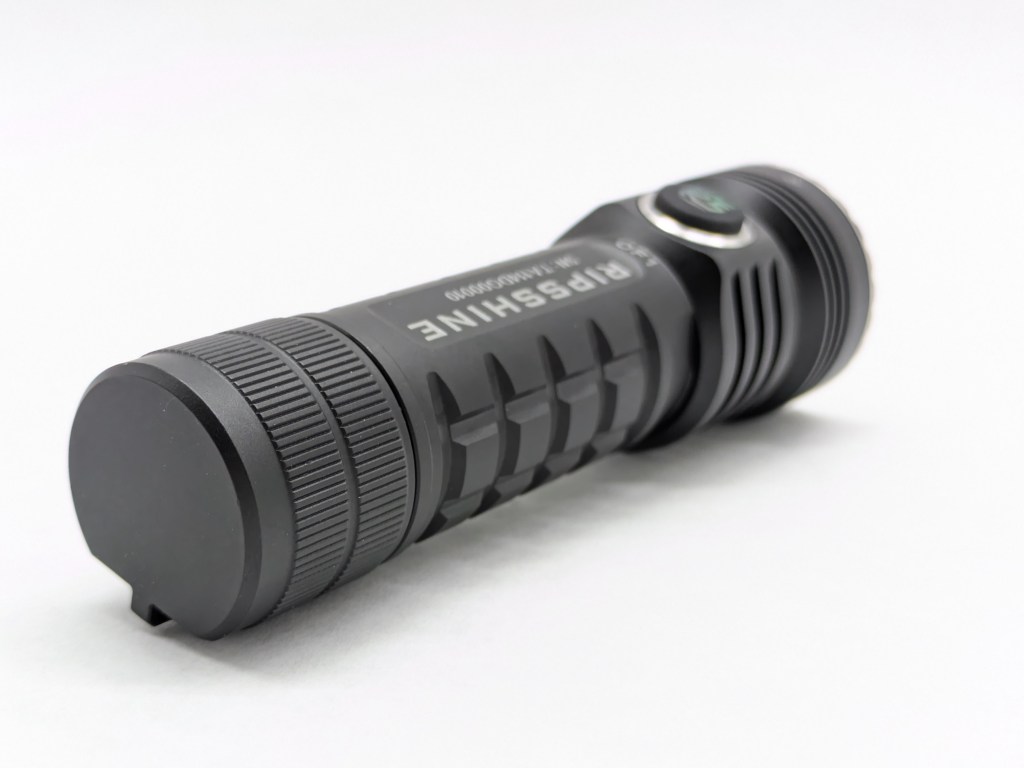
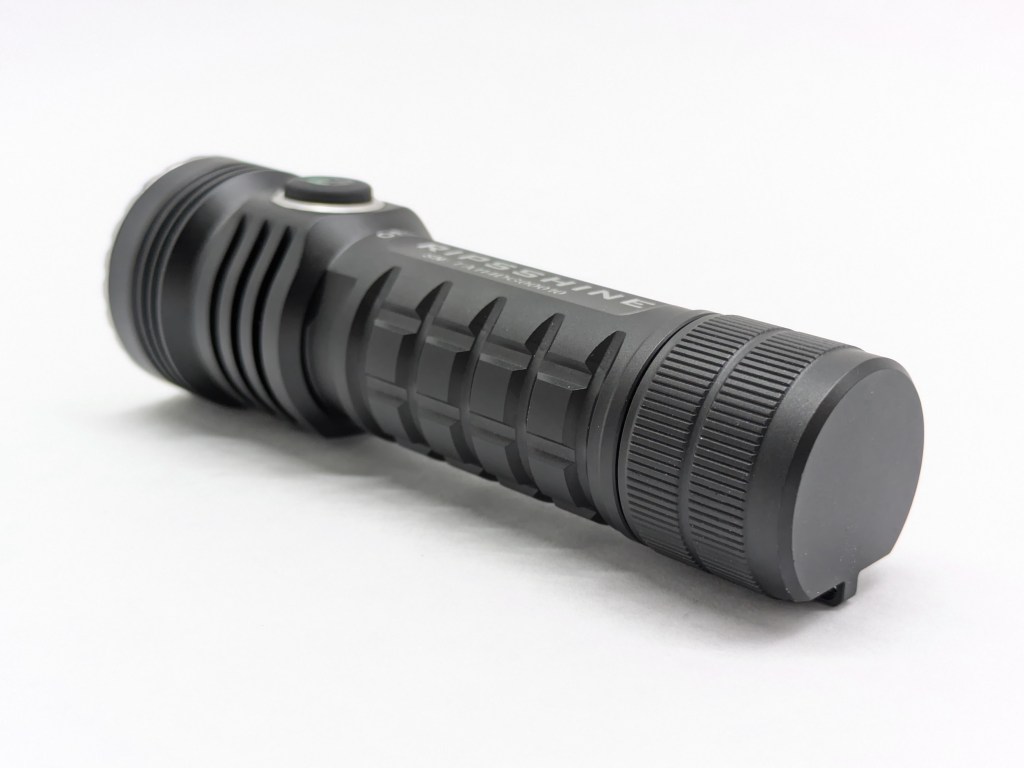
External build quality is good. It doesn’t “wow” me but I have no complaints.
Size & Measurements
Mini Maglite | Vastlite Versa Bow | Ripsshine OF1 | Olight Warrior 3S | Surefire G2X Pro
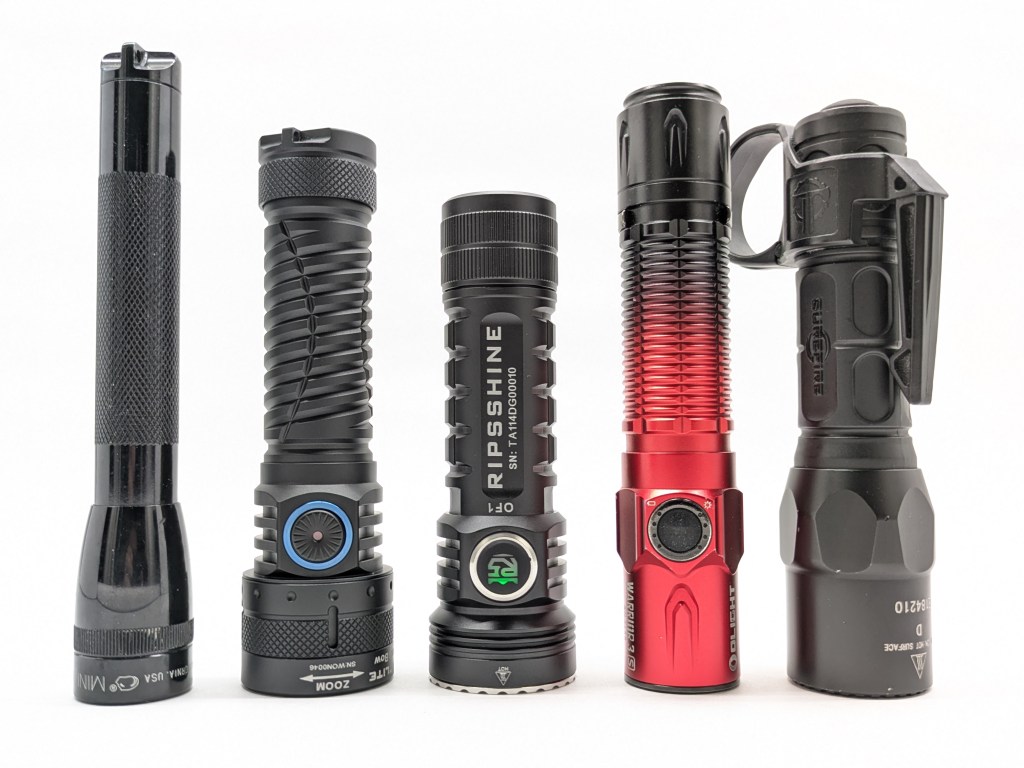
| Measurement | Measured (mm) |
|---|---|
| Bezel Diameter | 35.0 |
| Length | 113.7 |
| Switch Diameter | 12.0 |
| Lens Thickness | 2.0 |
| Lens Diameter | 32.5 |
| Reflector Hole Diameter | 5.7 |
| Reflector Diameter | 32.6 |
| Reflector Height | 8.7 |
| MCPCB Size | ~24 |
| LED Footprint | 5050 |
| Body Tube Diameter | 27.0 |
| Pocket Clip Slot Width | 6.1 |
| Pocket Clip Slot Diameter | 24.8 |
| Tailcap Diameter | 28.4 |
| Tailcap Length | 21.8 |
| Included Battery Length | 72.8 |
| Weight with included battery (g) | 178 |
User Interface
This light comes with an advanced, configurable firmware called Anduril 2. I’m not covering it in detail here but I’ll put it through the checklist. The default simple mode works fine, but I put it into advanced mode and made some configuration changes to suit my preferences. There are no flashing pads that I can see, so firmware updates may not be possible.
Basic E-switch UI Checklist: 11/12
- 1C on/off✅
- 1H to change brightness✅
- Stepped levels✅
- By default it’s smooth ramping, but you can set it to stepped
- Main rotation is Low-Med-High✅
- This is configurable. By default it’s smooth ramping, but you can set it to have as few or as many modes as you like.
- Moonlight shortcut: 1H from off✅
- Low shortcut: 1H from Moonlight✅
- Turbo shortcut: 2C from anywhere✅
- Strobe shortcut: 3C from anywhere❌
- 3C activates the battery voltage readout mode. Strobe is 3H. I wish these were reversed to be more industry-standard.
- Mode memory for Low, Medium, and High✅
- This is configurable. By default it will memorize the last mode you used unless it’s accessed via shortcut. One cool thing you can do is called “manual mode memory” where you can set the light to always come on at a particular brightness, regardless of the last mode used.
- No mode memory for Moonlight, Turbo, and Strobe✅
- If you access these via shortcut they will not be memorized. If you access it by ramping to that level, it will be memorized by default.
- 4C or separate switch to lock/unlock✅
- Does something when you click the switch in Lockout mode✅
- Momentary moonlight. Handy!
Emitter & Beam
OF1 has three Cree XHP50.2 LEDs, likely the 3V version. They’re a great choice for maximum brightness, but don’t have great color properties. They sit in a triple reflector with an orange-peel finish.
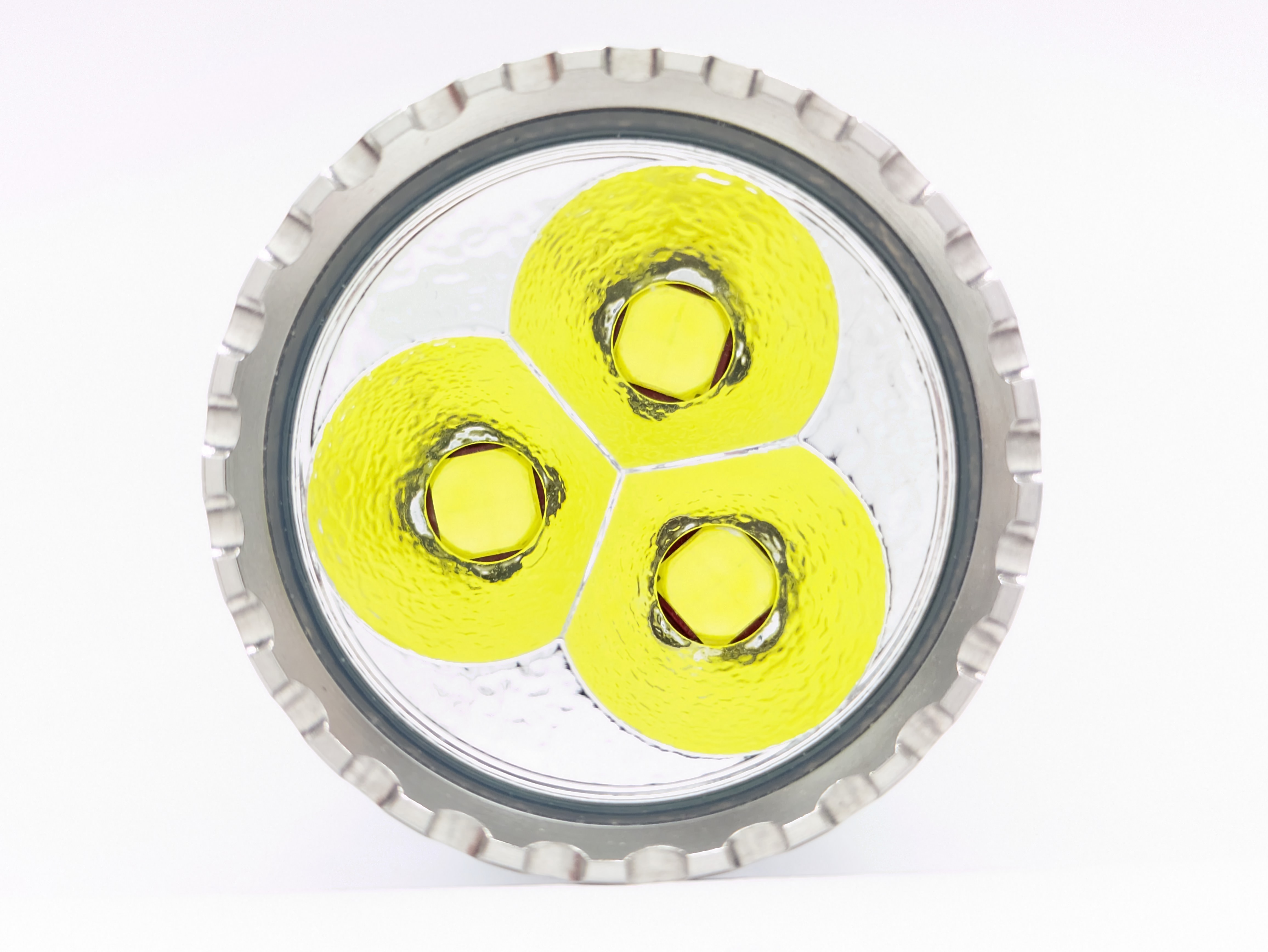

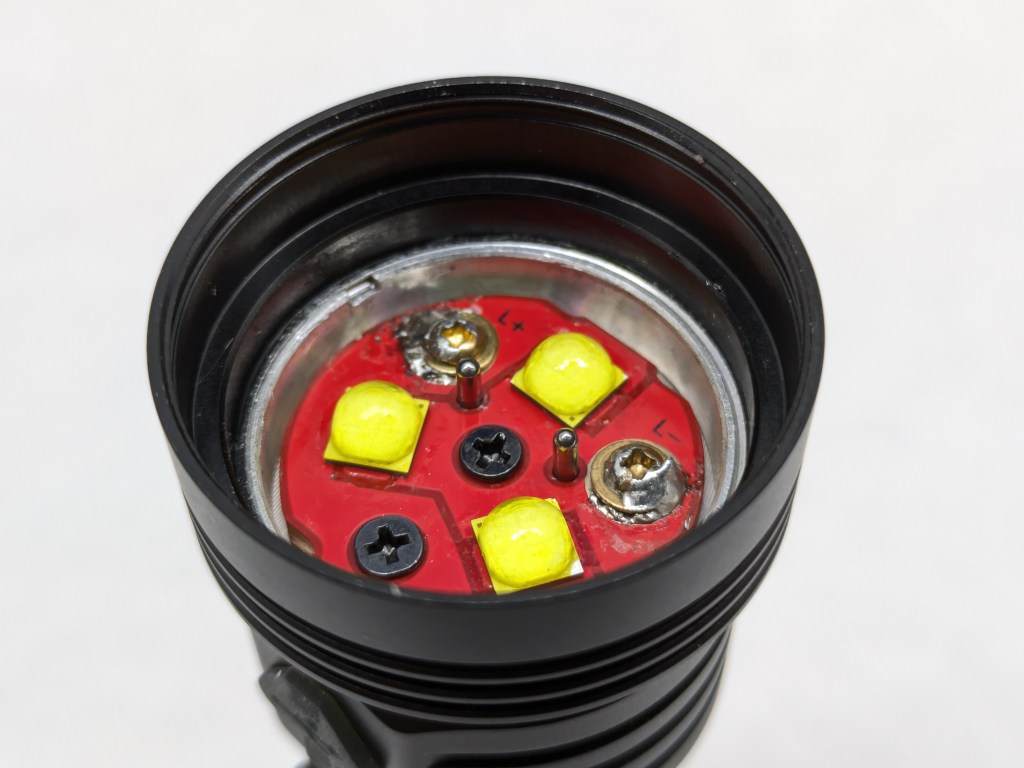
Under the reflector looks weird. The MCPCB has no wires, just screws. Two of them are brass and are (somewhat poorly) soldered to the MCPCB. Good luck removing that for emitter swaps. There’s also two pins sticking up that mate into the back of the reflector. They look like pogo pins but I can’t think of an electrical reason they’d need to connect to the reflector. Perhaps they’re just for alignment.
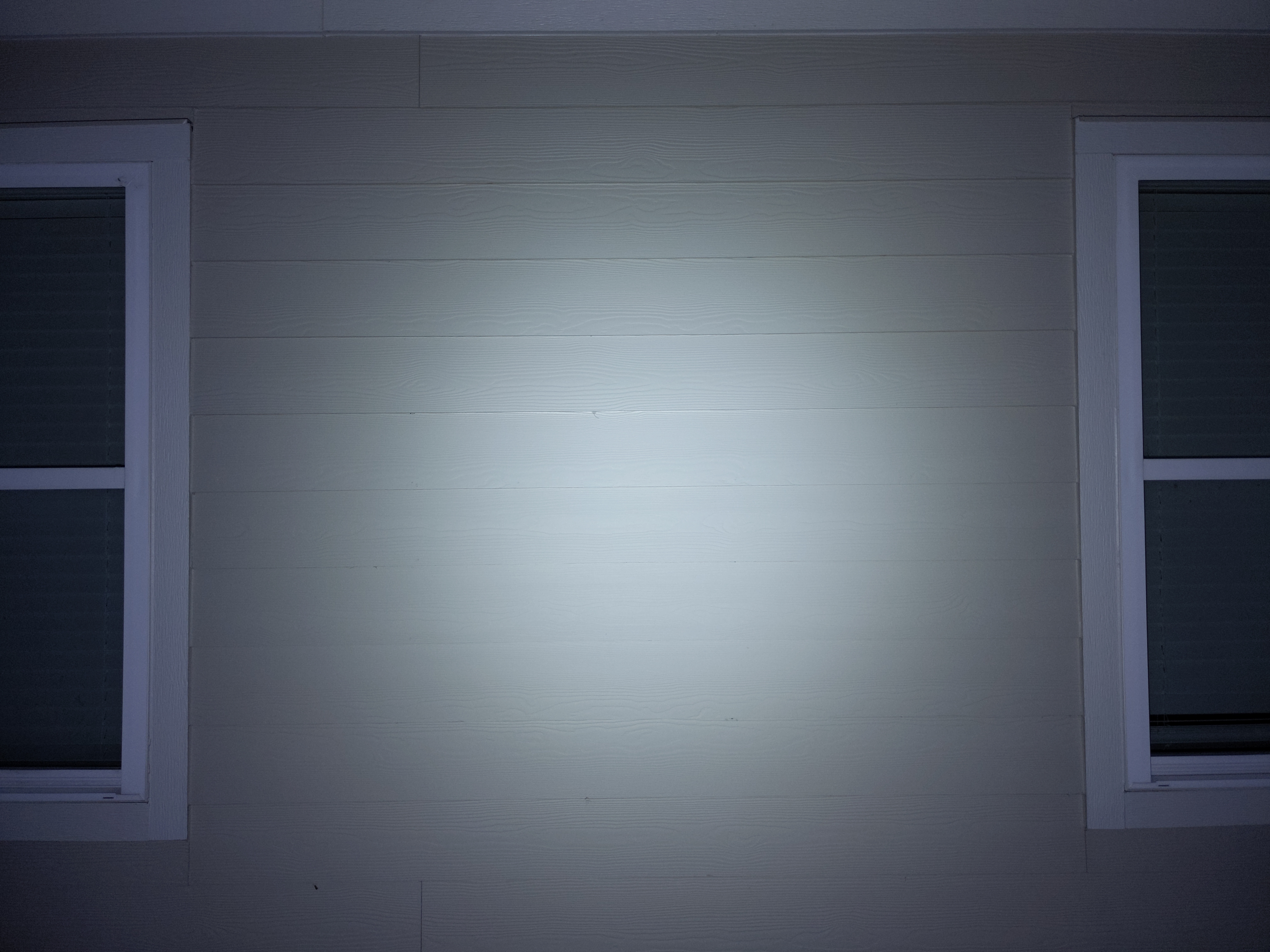
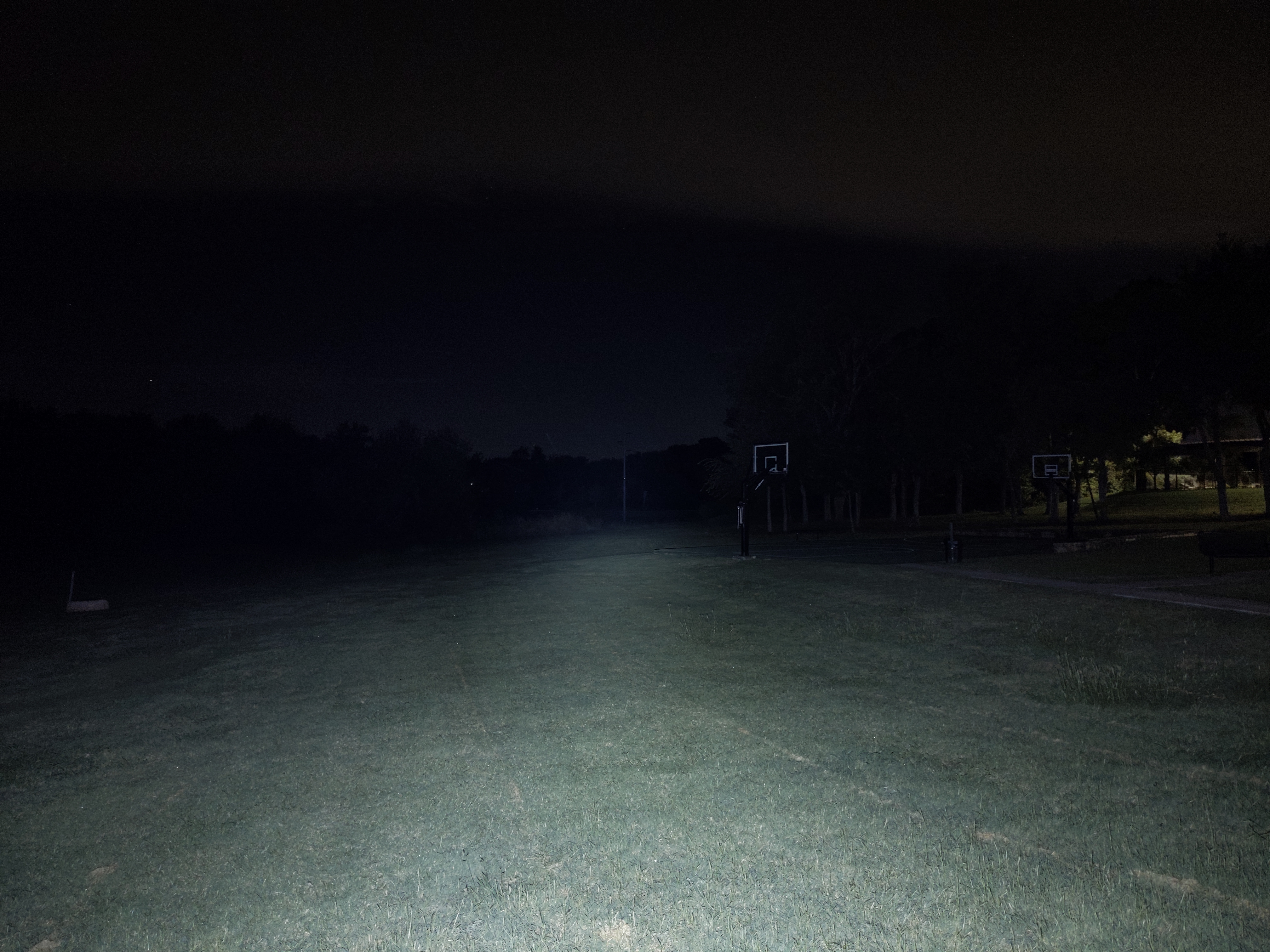
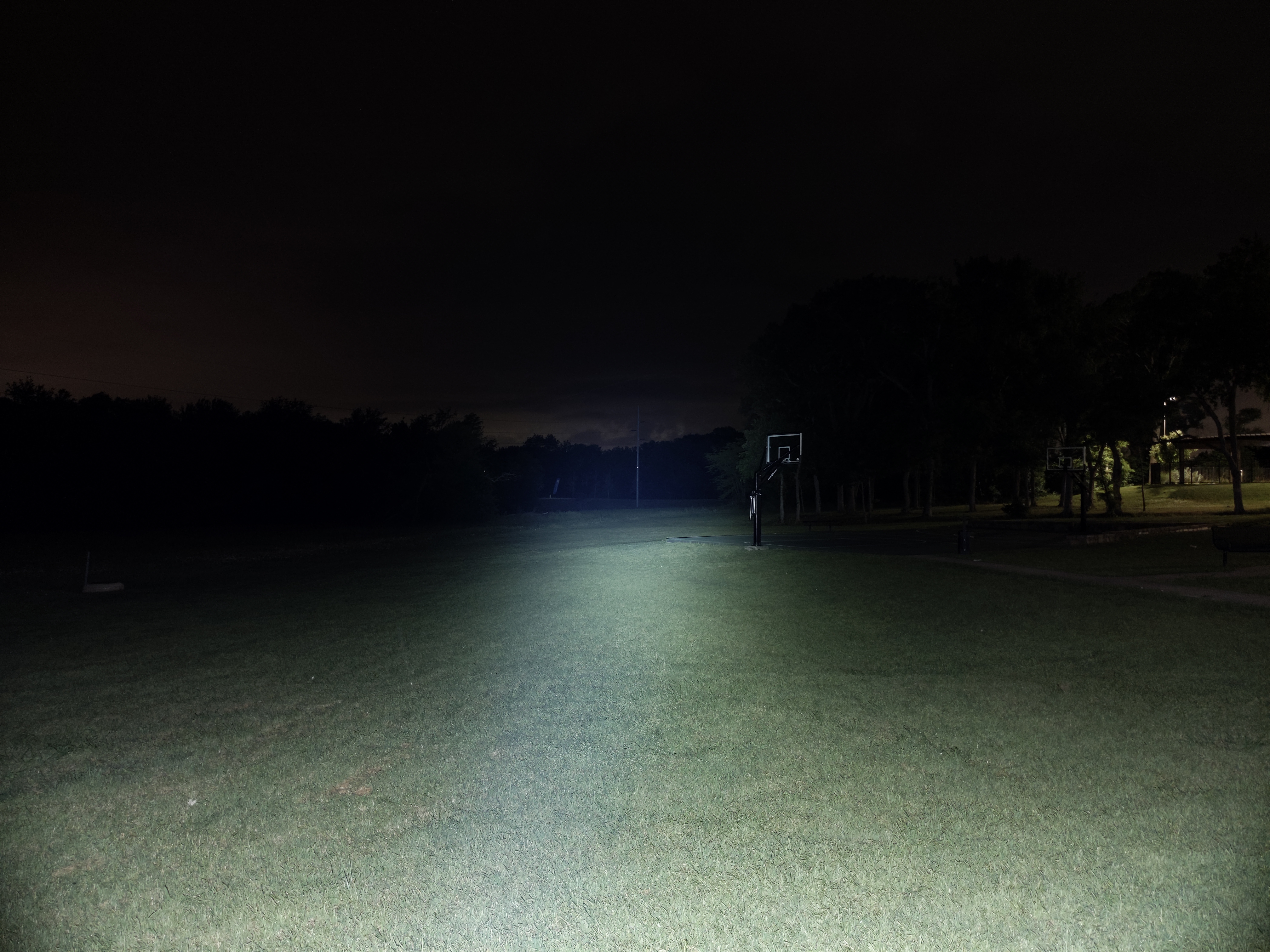
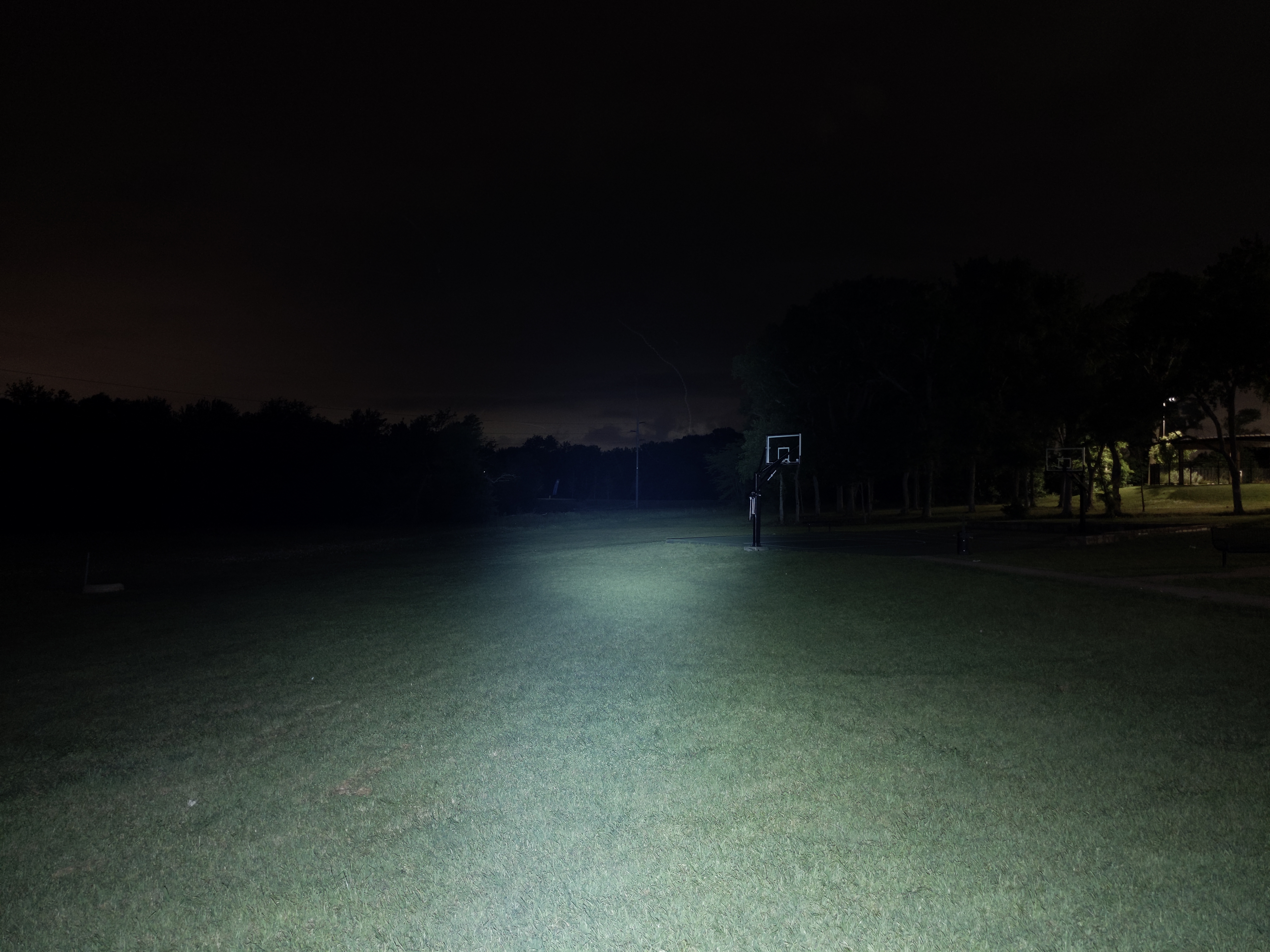
The beam is quite floody (2.3cd/lm) with a wide hotspot and wide spill. That spill has soft flower petals from the triple reflector, and there’s a bit of tint-shift.
In the beamshots below, camera settings are fixed and the wall is 2.8M away.
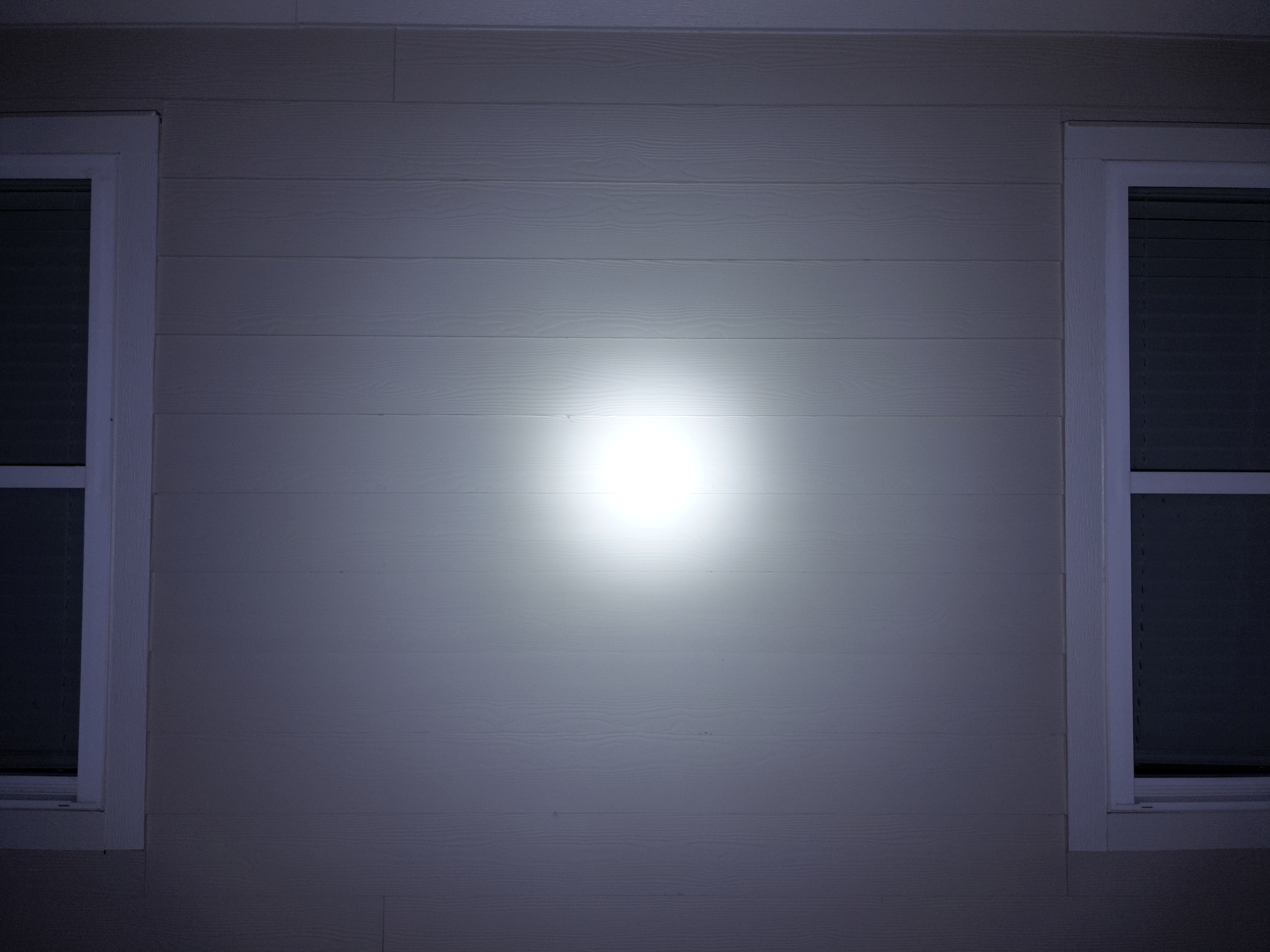
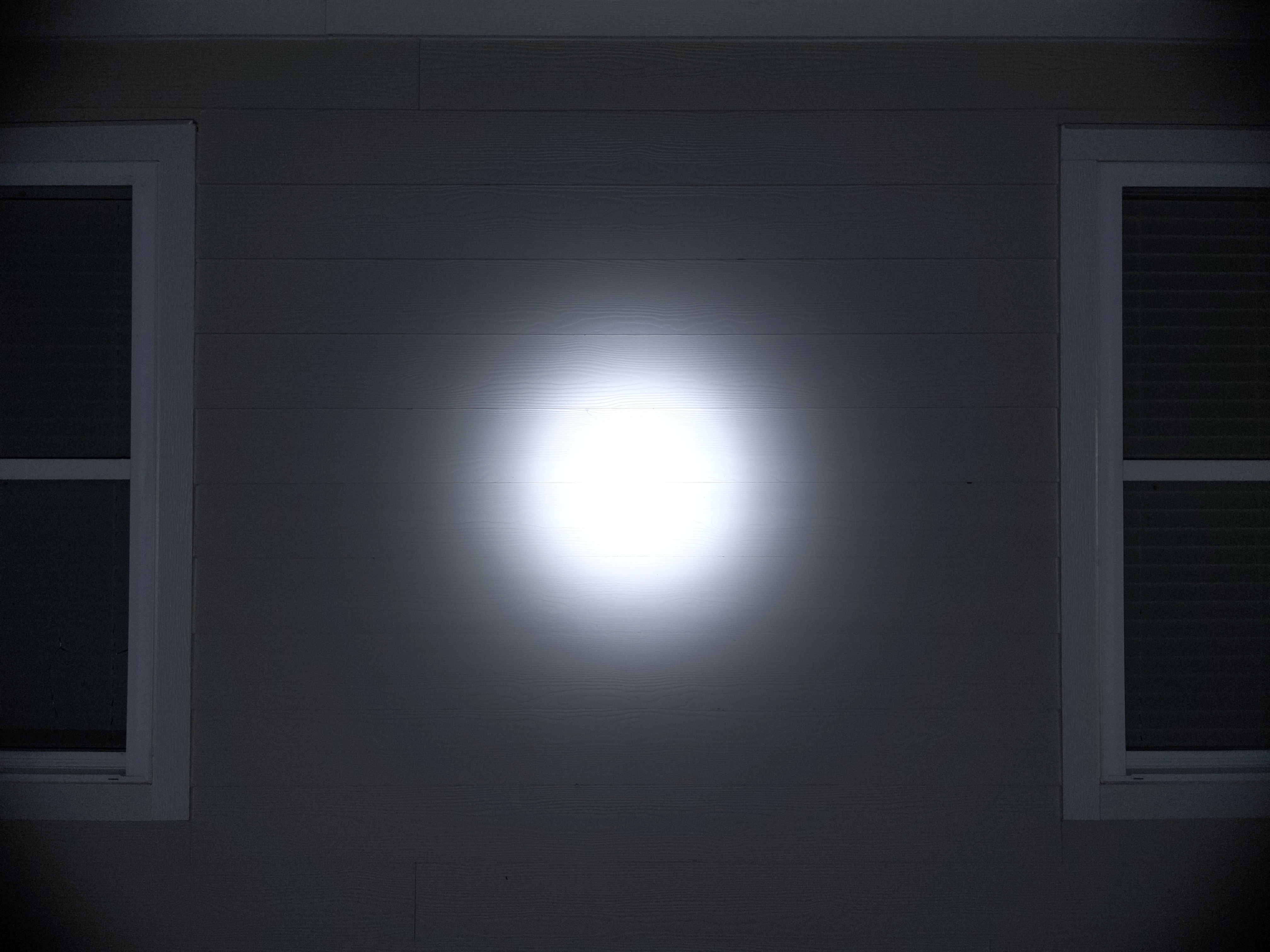
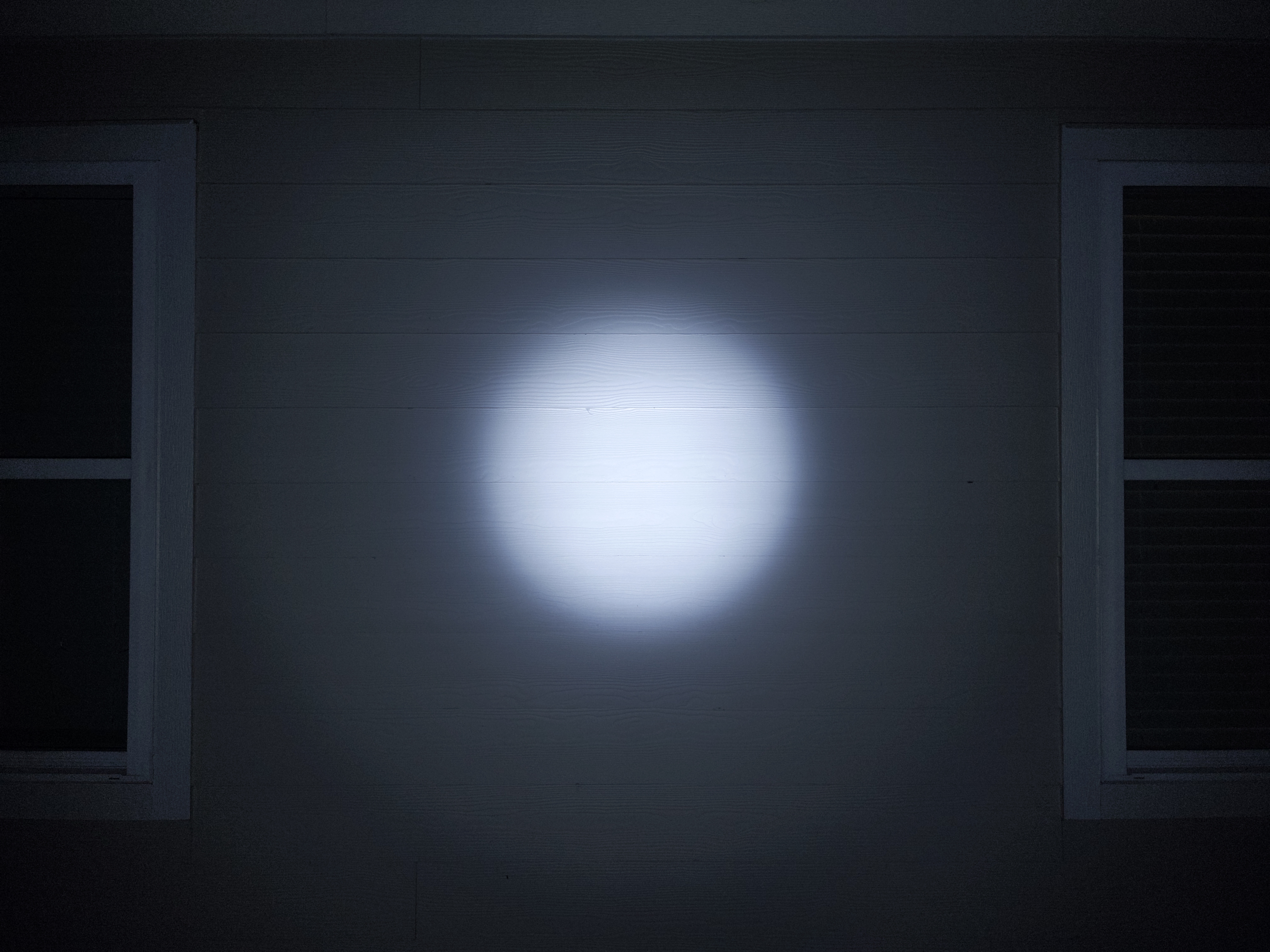
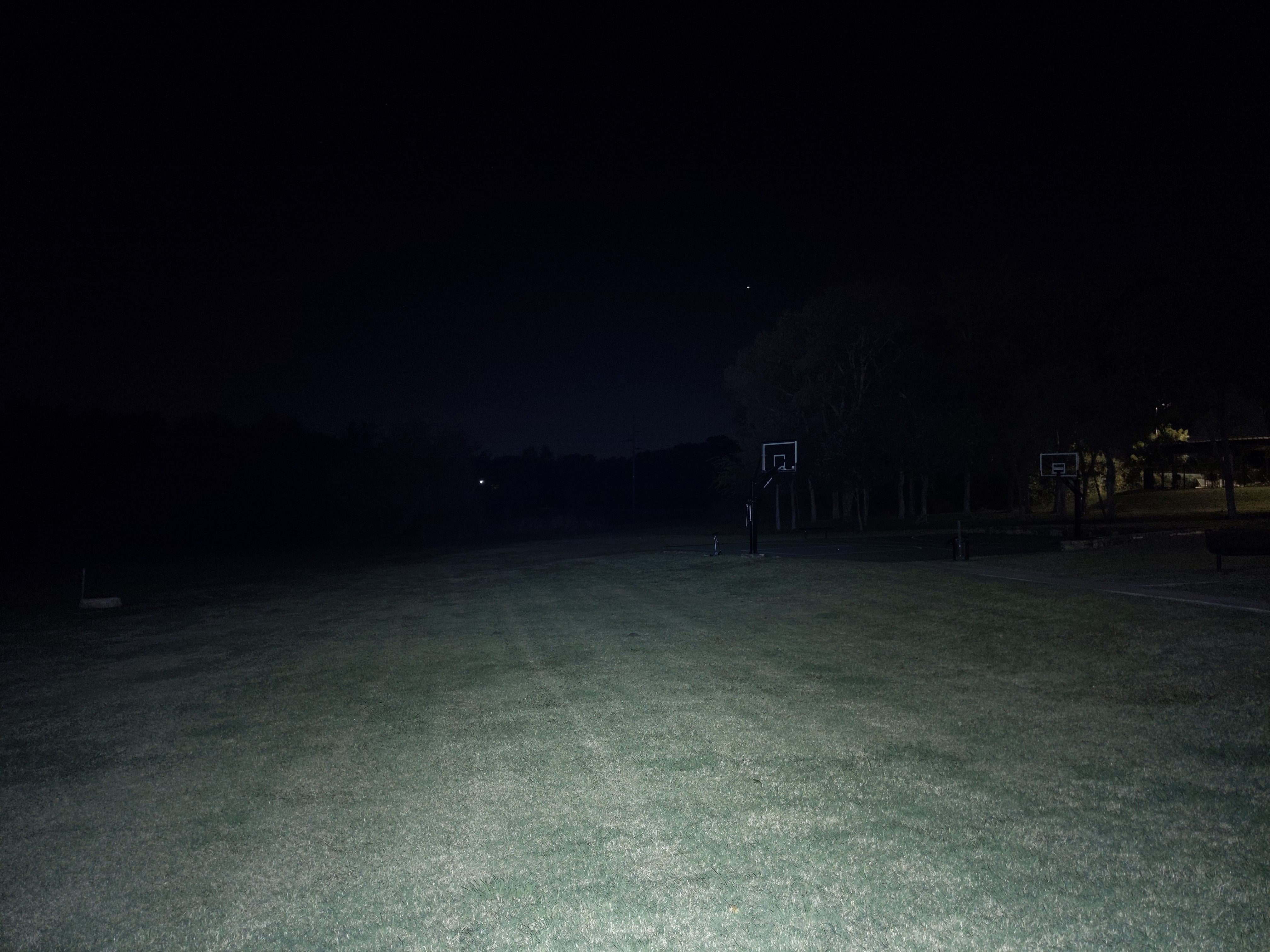
In the beamshots below, camera settings are as similar as possible, the basketball goal to the right of the hotspot is 39M away, and the power pole in the center is 185M away.
Mode Chart
Disclaimer: All of my measurements are taken at turn-on. Lumen measurements were taken on a Texas Ace 3.5″ Lumen Tube. A candela measurement was taken at 10 meters with an Opple Light Master III on the highest brightness, and other candela figures were calculated relative to that. CRI, CCT, & DUV data were taken for each mode from a few feet away at the center of the hotspot with the Opple Light Master and Waveform DUV Calculator. Runtime tests were performed with the Ceilingbounce app on my smartphone. These tests were performed with a fully charged included battery unless otherwise specified. I cannot measure moonlight directly, so moonlight readings are calculated based on the brightness relative to the next-lowest mode. None of this is professional equipment, so take these measurements with a grain of salt.

The official specs are above, followed by my own measurements below. It falls significantly below the “10000lm” and “22800cd” claims. Disregard the official “High” mode specs because I don’t know what Anduril level that actually is.
| Level | Lumens | Candela | Throw (Meters) | CRI (Ra) | Color Temp. (K) | DUV (Tint) |
| Turbo (150) | 6500 | 15000 | 250 | 70 | 6200 | 0.0034 |
| High (113) | 2500 | 5800 | 150 | 69 | 6240 | 0.0043 |
| Medium (75) | 330 | 760 | 55 | 68 | 6010 | 0.0060 |
| Low (38) | 33 | 76 | 17 | 66 | 5800 | 0.0098 |
| Moon (1) | 0.25 | 1 | 2 | 67 | 5730 | 0.0084 |
Runtime
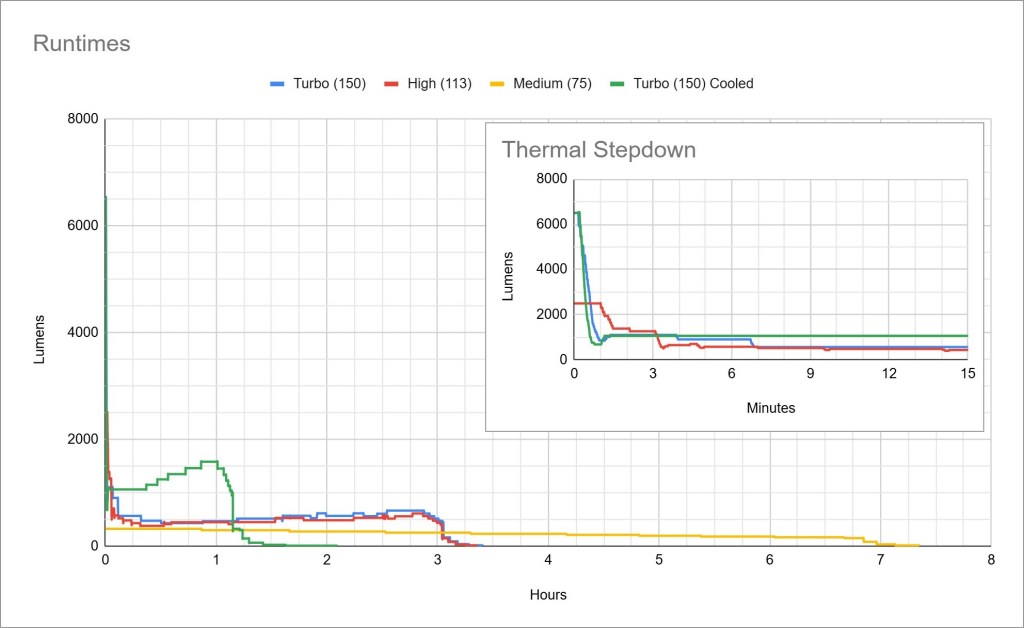
Performance is what I’d expect from a hotrod. It gets bright but drops off quickly. Sustained output is ~500lm; lower than many other lights in this size class. Total runtime is decent, partially because the sustained output is relatively low.
Thermal regulation: My Turbo Cooled test shows a significant increase in sustained brightness. Anduril has very active thermal regulation that continually adjusts brightness based on temperature. You can even see the brightness steadily increase as the battery drains. I think the light produces less heat as the battery’s voltage comes down closer to the LEDs’ voltage.
LVP (Low Voltage Protection): Anduril should have both a low voltage stepdown and an eventual low voltage shutoff. It stepped down to Moonlight in all my tests but I didn’t wait long enough for it to shut completely off. It will run in Moonlight mode for hours and hours.
Driver & Regulation
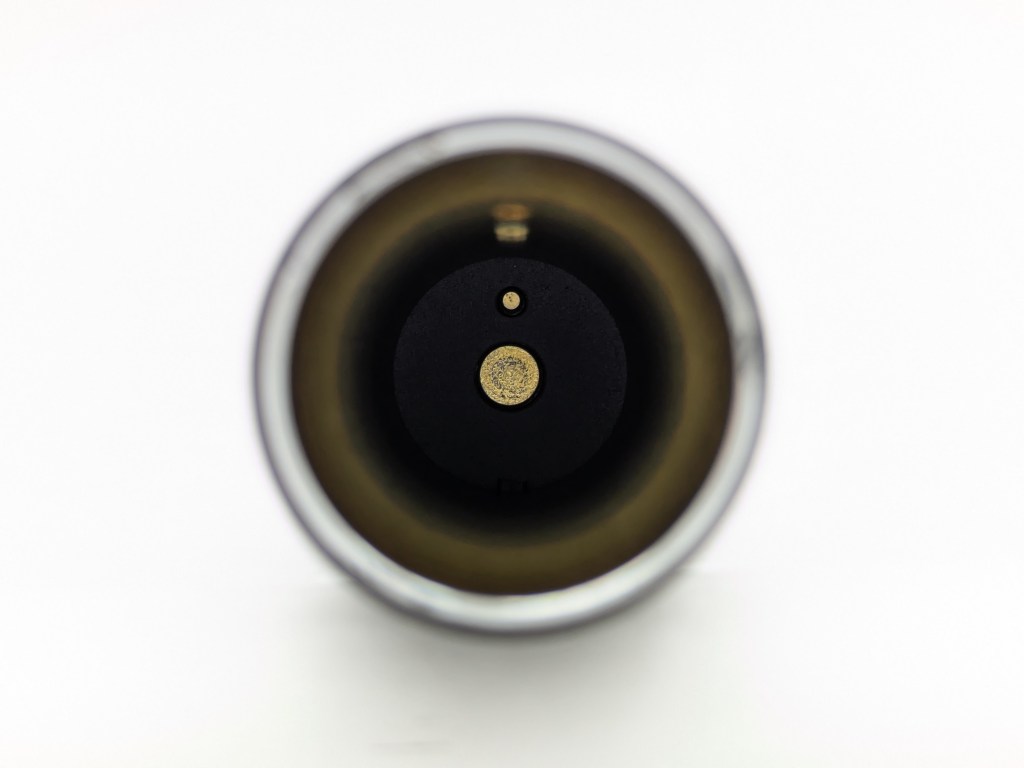
The driver is a FET circuit. FET drivers are cheap to produce and supply a lot of current for big brightness, but they’re poorly regulated and inefficient by nature. Here’s a helpful photo a reader posted showing the driver removed.

Regulation performance is below average but not terrible. It maintains most of the Turbo brightness down to ~25% charge, and all the other modes are flat down to 25%, but all modes are affected by battery voltage. It’s not really noticeable in normal use until the battery is virtually empty though.
PWM: There is audible PWM on High mode. If I’m in the room with it, I can hear it.
Parasitic Drain: I took some parasitic drain measurements with a multimeter that looked great, but then I noticed the light was draining in my drawer over a few days. So I did more testing based on voltage over time. The light’s parasitic drain is under 100 microamps with the switch LED off, perfectly acceptable. However, I found the included battery has its own aggressive parasitic drain, discharging itself from 4.07V to 3.63V in less than five days. I recommend skipping the optional battery and using a different cell instead.
Batteries & Charging

The battery included is a Rippshine-branded, button-topped, 5000mAh, 21700 cell. I don’t think it’s protected. 5000mAh seems a bit high for a hotrod like this, and I wonder if a bit lower capacity, higher-discharge battery would provide more brightness, particularly when it’s not fully charged. Flat top batteries fit and work, but jostling the light will make it turn off. The battery included with my sample has major self-discharge. I let FlashlightGo know so they can investigate the rest of their stock, but it may be worth buying a different battery to use in this light.
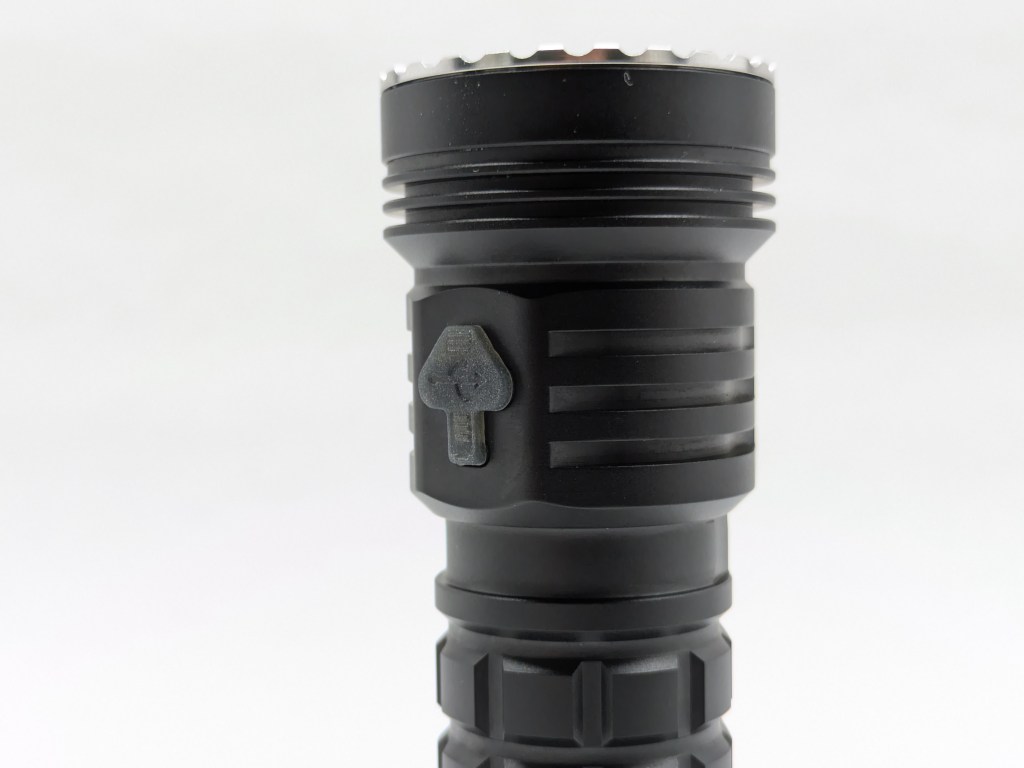
Charging is facilitated by a USB-C port on the head directly opposite the button. It’s covered by a small silicone flap. Charging takes just under 2.5 hours. While charging, the switch will blink blue. When charging is finished, the switch will glow solid blue. That’s in addition to and independent from the green indicator light controlled by Anduril. It works while plugged in, but brightness is limited if the battery is disconnected. There’s no powerbank function, which I expect a light this size to have.
The battery indicator is Anduril 2’s standard tripe-click to make the light blink out the battery voltage. It’s slow and unintuitive, but better than nothing. I prefer one or more dedicated indicator LEDs.
Switch
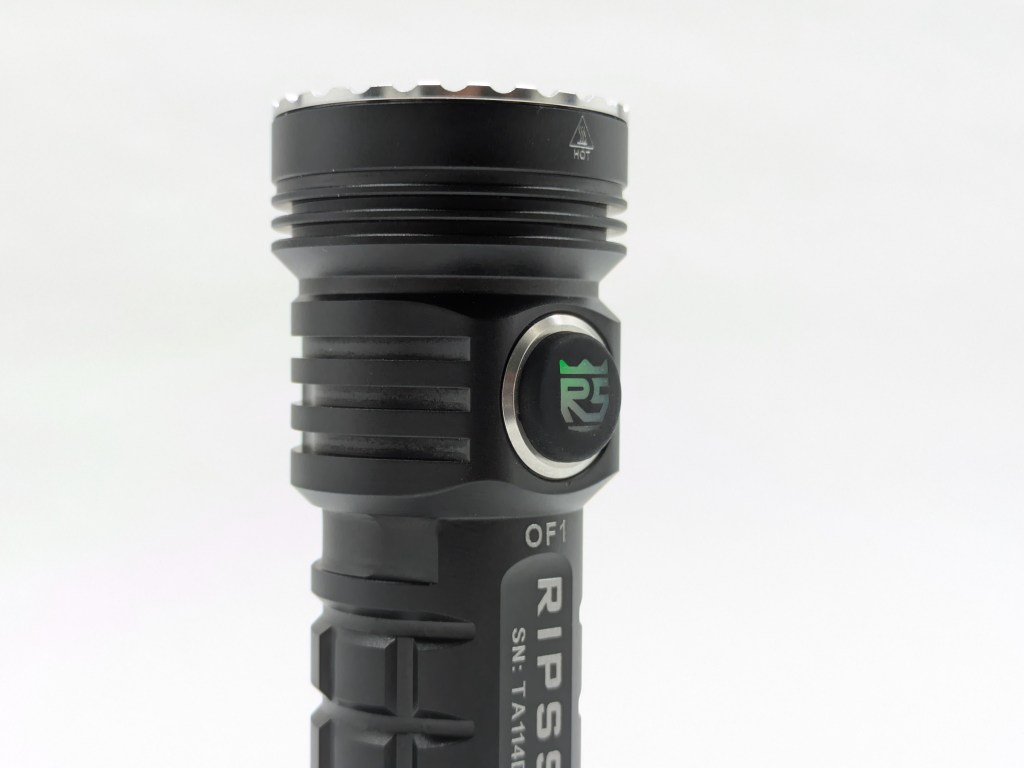
This is a great switch. It’s super tactile, audible, accessible, and consistent. I wouldn’t want it on an EDC light because it might get pressed by accident, but it’s a treat to use. It makes all the Anduril 2 configuration clicking much easier. The green backlight is configurable through the Anduril 2 firmware (bright, dim, blinking, or off). It is not a battery indicator and is not RGB.
Carry & Ergonomics
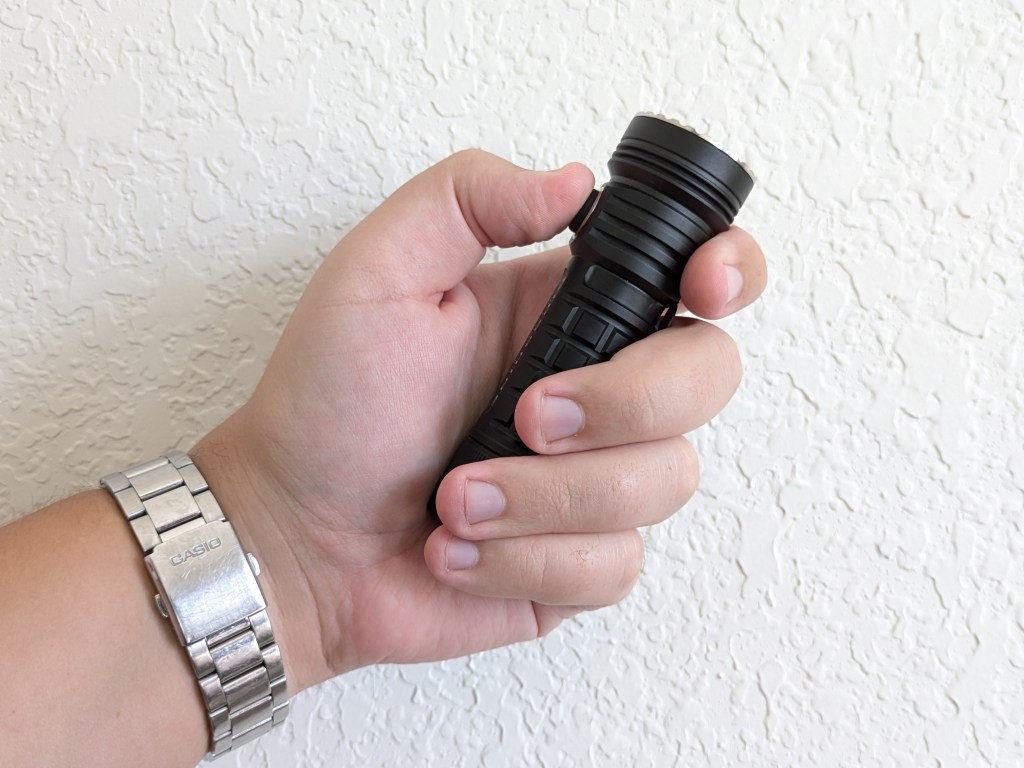
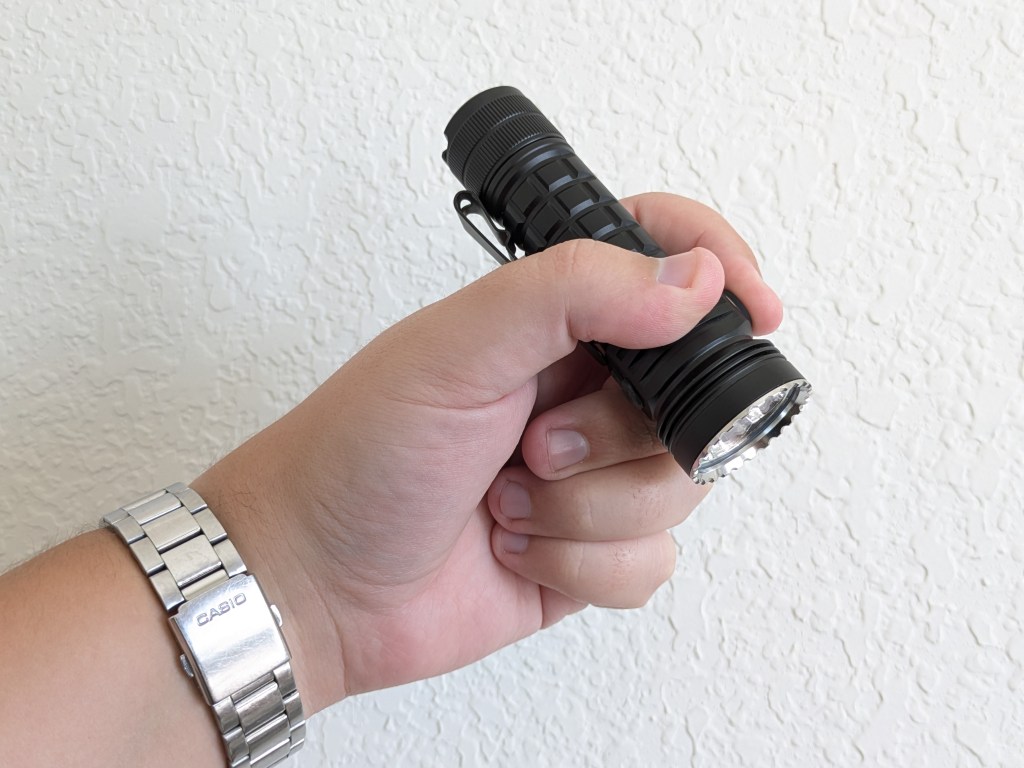
Ergonomics are good. It fits well in the hand and the button is easily accessible in a forward or pencil grip. It even works in a reverse grip if you press the switch with your pinky.
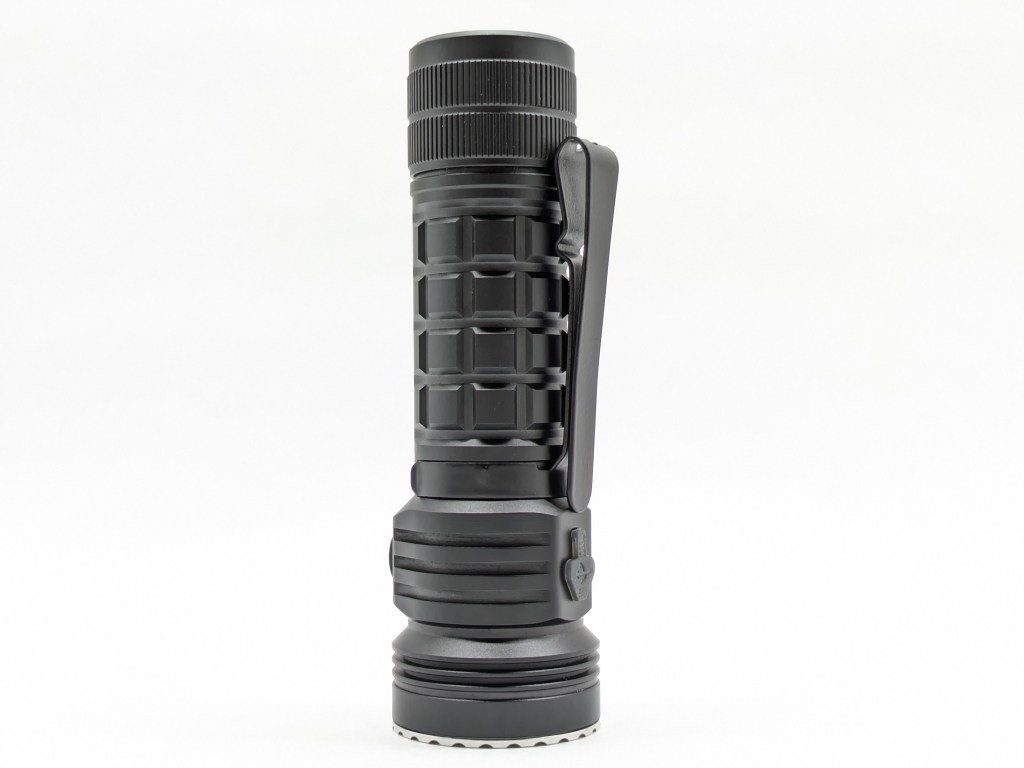
Clip score: 5/7 (this score is deceptively high, the lack of a mouth/ramp is a huge problem)
- Attachment doesn’t pop off or rotate accidentally✅
- Can be removed and bent back into shape if needed✅
- Bezel-down carry is at a reasonable depth✅
- Landing location is smooth, not on the charging port, and away from the bezel✅
- It lands right by the charging port but the port opens toward the bezel, not toward the clip, so it doesn’t cause any issues.
- Mouth/ramp and loop(s) are wide enough for pants material❌
- It has no mouth/ramp at all, failing a critical aspect of clip design. If you really wanted to you could bend a mouth/ramp into it, but I’m not sure the finish would hold up to that.
- Finish is durable❌
- It appears to be painted or powder-coated, not the more durable chemical black treatment used on most clips
- No bidirectional clips without reason✅
- This one attaches to the head to avoid rotating, and consequently avoids the snagging issue found on most tail-mounted bidirectional clips.
Magnet: There’s a magnet in the tailcap and it’s strong enough to hold the light up on a vertical surface.
Competition
Here are some lights in the same class and how they compare.
Emisar D4K: established alternative
- similar price (depending on the options you choose)
- similar layout, but a bit smaller
- no battery nor charging solution included
- various LED options
- various driver options
- various body color & material options
- various other customization options (including multi-channel)
- better pocket clip
- same Anduril 2 firmware/UI
- RGB aux LEDs under the switch and lens instead of single-color under the switch
- I don’t think it can get quite as bright
- not available on Amazon
Fireflies X4 Stellar: premium alternative
- more expensive
- RGB auxiliary LEDs behind the main optic
- various LED options
- very high quality driver
- typically excellent build quality (though they occasionally have poor QC)
- same Anduril 2 firmware/UI
- USB-C charging built in behind a magnetic cover, battery optionally included
- optional lantern diffuser hood
- better pocket clip
- not available on Amazon
Acebeam E75: non-Anduril alternative
- About twice the price
- lower peak brightness, about double sustained brightness
- 2-3 LED options
- a bit better build quality
- much higher quality driver
- simpler, more industry-standard UI
- similar USB-C charging, battery included
- much better pocket clip
- battery indicator LED instead of blinky readout
This section is not comprehensive. If I didn’t include a particular light here, it doesn’t mean it’s bad or doesn’t deserve to be here. I simply cannot list every possible competitor.
Conclusion
It’s been quite awhile since I had a light with Anduril 2. It’s more fun than I remembered. I love the switch and USB-C charging. I like the ergonomics, brightness, magnet, and UI (after I made some changes). The performance and build quality are fine. I dislike the audible PWM, lack of powerbank function, and the included battery’s high self-discharge. I strongly dislike the clip, and it largely ruins the light for me.
Thanks to FlashlightGo for sending me this light for review!

 Grizzly's Reviews
