Pricing & Availability
Skilhunt sent me this light in exchange for an honest review. Here is the official product page where you can see current pricing. At the time of writing it’s $77 USD for this configuration.
What comes in the box?
M300 V4 comes in Skilhunt’s standard retail box with a window to display the light. Inside is:
- The light itself
- Battery (inside the light)
- Pocket clip (not installed)
- User manual
- Magnetic USB charging cable
- Wrist lanyard
- Spare O-rings
- Spacers for shorter batteries

Design & Construction
The design is similar to previous M300 models, with some updates to the UI, emitter options, a magnetic tailcap, and a proximity sensor. I’m delighted that they offer an all-black option without blue accents! I think it looks smart.


Build quality is good. I have no complaints and it feels well made.
Size & Measurements
Surefire G2X | Zebra SC65 | Skilhunt M400 V4 | Olight ArkPro Ultra | Mini Maglite

| Measurement | Measured (mm) |
|---|---|
| Bezel Diameter | 31.5 |
| Length | 123.5 |
| Switch Diameter | 9.6 |
| LED Footprint | 5050 |
| Body Tube Diameter | 25.4 |
| Pocket Clip Slot Width | 5.3 |
| Pocket Clip Slot Diameter | 24.1 |
| Tailcap Diameter | 27.9 |
| Tailcap Length | 17.7 |
| Included Battery Length | 74.7 |
| Weight with included battery (g) | 170 |
Switch & User Interface
The switch is satisfactory. It’s Skilhunt’s plastic side e-switch they use in a few other models. It’s tactile, somewhat audible, and recessed below the retaining ring. In my experience, it doesn’t turn on by accident. The switch and charge ports are indistinguishable in the dark, so having the clip installed can help with orientation.

This UI works like most other e-switch UIs. My only complaint is there are too many modes.
Basic E-switch UI Checklist: 11/12
- 1C on/off✅
- 1H to change brightness✅
- Stepped levels✅
- Main rotation is Low-Med-High❌
- There’s a 4th mode in there. That’s one too many.
- Moonlight shortcut: 1H from off✅
- Low shortcut: 1H from Moonlight✅
- This is a BIG improvement from previous Skilhunt lights. On previous models, 1H from Moonlight would cycle between two Moonlight levels.
- Turbo shortcut: 2C from anywhere✅
- Strobe shortcut: 3C from anywhere✅
- Mode memory for Low, Medium, and High✅
- No mode memory for Moonlight, Turbo, and Strobe✅
- It will memorize which of the two Turbo modes you use, but that won’t over-ride your main memorized mode. That’s the point of this criterion, so it passes.
- 4C or separate switch to lock/unlock✅
- It’s 4C to lock/unlock, and unlocking turns on Moonlight mode.
- Does something when you click the switch in Lockout mode✅
- Momentary Moonlight. Handy!
Notes:
- The lower Turbo mode is superfluous. If I want Turbo, I’ll use the real Turbo. If I want the light to not step down, I’ll use High mode. I don’t need something in the middle. It doesn’t really get in the way though.
- Entering lockout mode will activate the switch beacon. That makes the switch glow briefly every ~2 seconds. Double clicking in lockout mode will disable the beacon until the next time you enter lockout mode. Just loosening the tailcap for mechanical lockout works great too.
- There are 3 different blinky modes (strobe, sos, and beacon). You can switch among them with a hold, and it will remember which one you last used the next time you triple click into a blinky mode.
Emitter & Beam
Skilhunt offers two LED options: a Luminus SFT70 in 6500K, and an “SL-F50S High CRI 5000K”. It’s always nice to have a high efficiency option (SFT70) and a nice-looking high-CRI option (F50S). I chose the F50S for the nicer color properties. I tried to remove the bezel but couldn’t get it loose.

Proximity sensor: That little black hole in the reflector is a proximity sensor. In either of the two Turbo modes, if shining directly on an object up close, the sensor will detect it and lower the brightness to avoid burning the object. If you don’t want the sensor, you can disable it by holding the switch for 5 seconds while the light is off.
The beam is balanced, not floody, but not particularly throwy either. There’s a distinct hotspot with soft edges, and relatively narrow spill for peripheral illumination. It’s a great beam that does well enough close up and far away.
In the beamshots below, camera settings are fixed and the wall is 2.8M away.


In the beamshots below, camera settings are as similar as possible, the basketball goal to the right of the hotspot is 39M away, and the power pole in the center is 185M away.


Mode Chart
Disclaimer: All of my measurements are taken at turn-on. Lumen measurements were taken on a Texas Ace 3.5″ Lumen Tube. A candela measurement was taken at 10 meters with an Opple Light Master III on the highest brightness, and other candela figures were calculated relative to that. CRI, CCT, & DUV data were taken for each mode from a few feet away at the center of the hotspot with the Opple Light Master and Waveform DUV Calculator. Runtime tests were performed with the Ceilingbounce app on my smartphone. These tests were performed with a fully charged included battery unless otherwise specified. I cannot measure moonlight directly, so moonlight readings are calculated based on the brightness relative to the next-lowest mode. None of this is professional equipment, so take these measurements with a grain of salt.

The official specs are above, followed by my own measurements below.
| Level | Lumens | Candela | Throw (Meters) | CRI (Ra) | Color Temp. (K) | DUV (Tint) |
| Turbo | 2600 | 24000 | 310 | 100 | 5410 | -0.0005 |
| High-Turbo | 1500 | 14000 | 240 | 100 | 5300 | 0.0006 |
| High | 760 | 7000 | 170 | 100 | 5220 | 0.0003 |
| Medium | 270 | 2500 | 100 | 100 | 5150 | -0.0016 |
| Low-Med | 100 | 920 | 61 | 100 | 5120 | -0.0026 |
| Low | 13 | 120 | 22 | 100 | 5000 | -0.0024 |
| Moonlight | 0.6 | 6 | 5 | 100 | 5020 | -0.0050 |
Runtime

Performance: Turbo time is around 1 minute. Sustained brightness and runtime are a little lower than competitors but still perfectly usable and better than 18650-size lights.
Thermal Management: My Turbo and Turbo Cooled tests are virtually identical, so there’s no active thermal throttling here, just timed stepdowns. That means performance will be consistent, but not optimized for ambient temperature.
LVP (Low Voltage Protection) is present and works well. It doesn’t rely on the battery having a protection circuit. The light will shut off when the battery is practically empty, but it can be temporarily re-activated in an emergency.
Driver
The driver must be a boost driver. It’s driving 6V or 12V LEDs from a 3.6V battery. Boost drivers tend to provide good performance.

Voltage immunity is good/average. It maintains most of the Turbo brightness down to ~25% charge. That’s exactly what I want because it shows the components are high quality and they’re being pushed hard for great performance.
PWM: No PWM is visible to my eyes, camera, nor Opple except Moonlight, which does have some flicker I can detect with the camera and Opple.
Parasitic Drain: ~25 microamps. That will take ~23 years to drain the included battery.
Batteries & Charging

The battery included is a protected, 5000mAh, 21700 cell that works great. It also includes two spacers so you can make slightly shorter unprotected 21700s and 18650s work reliably.

Charging is facilitated by a magnetic charging port on the side of the head, directly opposite the button. The magnetic system works, but I really wish it were a USB-C port so I didn’t need yet another special charging cable. Charging takes 3.5hrs and it works while charging, but available modes may be affected by charge level. The magnetic puck will glow blue when disconnected, red when charging, or blue and red when charging is complete. Since it’s proprietary, there’s no power bank function. I also wouldn’t buy this light for use around metal shavings, because they’ll stick to the charging port.
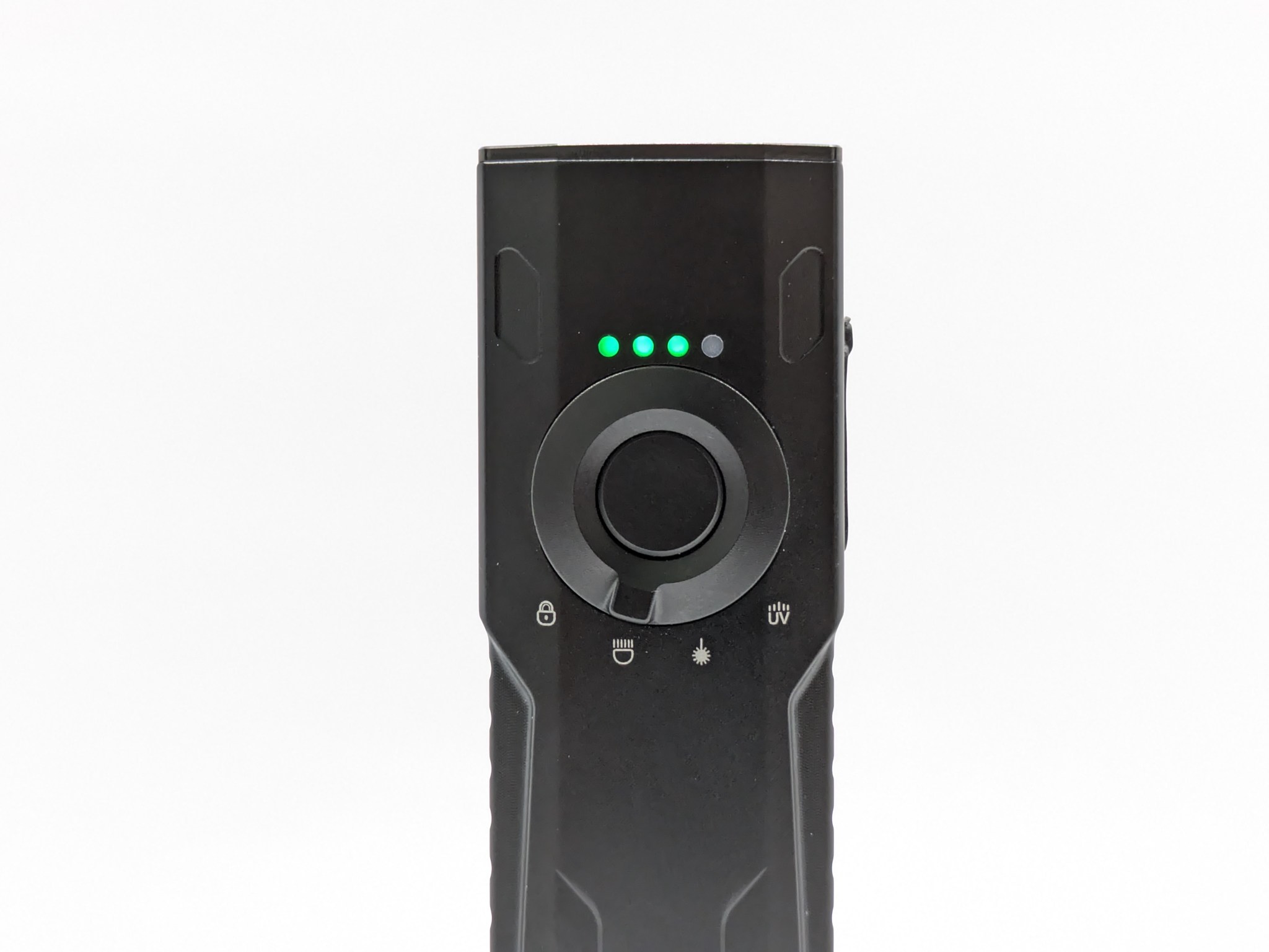
The battery indicator is located under the switch and glows for a few seconds after you turn the light on. I prefer four-diode indicators, but this four-color/pattern setup works ok. Here’s what the colors mean:
- Constant blue: >80% charge
- Blinking blue: 50-80% charge
- Constant red: 20-50% charge
- Blinking red: <20% charge
Carry & Ergonomics

Ergonomics are great. Single 21700 side-switch lights like this are just the right size and fit well in the hand. My thumb lands right on the button in a forward grip and the clip provides a nice index.

Clip score: 5/7 – serviceable for occasional use
- Attachment doesn’t pop off or rotate accidentally✅
- Can be removed and bent back into shape if needed✅
- Bezel-down carry is at a reasonable depth✅
- It’s not deep carry, but it’s good enough.
- Landing location is smooth, not on the charging port, and away from the bezel✅
- Mouth/ramp and loop(s) are wide enough for pants material❌
- The bezel-down entrance to the clip has no ramp, and it’s partially blocked by a larger-diameter section of the body tube. I have to lift the clip manually to pocket the light.
- Finish is durable✅
- No bidirectional clips without reason❌
- This light is too big and heavy to clip to a hat. There’s no reason to have a bidirectional clip, and it’s more likely to snag on something like a seatbelt.
Magnet: There’s a magnet in the tailcap that’s strong enough to hold the light up on a vertical surface. It can be removed or reversed by removing the two phillips screws inside the tailcap. It’s rather tricky to reinstall those screws right next to a large magnet. The magnet in the charging port can’t be removed.
Competition
Here are some lights in the same class and how they compare.
Acebeam E75: staple alternative
- more expensive
- similar brightness, wider beam, less throw
- similar layout (side e-switch, magnetic tailcap)
- similar UI
- slightly larger and heavier
- four individual LEDs instead of a quad-die
- better pocket clip
- USB-C charging instead of proprietary magnetic
Wurkkos TS22: budget alternative
- significantly less expensive
- similar layout, size, switch, magnetic tail, clip, and UI
- USB-C charging and powerbank function
- larger LED with more peak brightness
Skilhunt M200 V4: smaller alternative
- basically a smaller, lighter version of the same light
- slightly different UI (two moonlight modes)
- 18650 battery
This section is not comprehensive. If I didn’t include a particular light here, it doesn’t mean it’s bad or doesn’t deserve to be here. I simply cannot list every possible competitor.
Conclusion
This is a good general-purpose flashlight that can do a bit of everything. It’s ergonomic, well made, easy to use, with great performance and a nice LED. I’m glad they updated the UI, removed the blue accents, and let the proximity sensor be disabled. I hope to see USB-C charging and a better pocket clip in the next version.
Thanks to Skilhunt for sending me this light for review!