
Pricing & Availability
Sofirn sent me this light in exchange for an honest review. Here is the official product page and Amazon US page where you can see current pricing. At the time of writing, the purchase price varies from ~$47-$62 $USD depending on available coupons, store, and warehouse selection. It’d be nice if Sofirn listed the actual price instead of listing the inflated MSRP, a discounted price, and then making you apply 1-2 coupons on the product page to get the real purchase price.
What comes in the box?
SK31 comes in a retail-ready box with a few accessories. Inside is:
- The light itself
- Battery (inside the light)
- User manual
- USB A-to-C charging cable
- Wrist lanyard
- Belt holster

Design & Construction
The design is pretty typical of a duty light; big switch on the tail, flared head, and crenelated bezel with glass breakers.


Build quality is nice overall. My only gripes are the laser etching seems a bit low quality (particularly the tailcap battery direction icon) and my light came with a few very minor blemishes where the silver aluminum showed through (one on the tailcap corner and two on the charging port threads).
Size & Measurements
Surefire G2X Pro + Switchback | Streamlight Microstream | Sofirn SK31 | Olight Warrior 3S | Mini Maglite

| Measurement | Measured (mm) |
|---|---|
| Bezel Diameter | 36.0 |
| Length | 149.5 |
| Switch Diameter | 14.2 |
| Lens Thickness | 2.0 |
| Lens Diameter | 30.5 |
| Reflector Hole Diameter | 11.1 |
| Reflector Diameter | 30.7 |
| Reflector Height | 21.5 |
| MCPCB Size | ~25 |
| LED Footprint | 7070 |
| Body Tube Diameter | 27.0 |
| Pocket Clip Slot Width | 5.1 |
| Pocket Clip Slot Diameter | 25.3 |
| Tailcap Diameter | 29.3 |
| Tailcap Length | 29.1 |
| Included Battery Length | 72.0 |
| Weight with included battery (g) | 224 |
Switch & User Interface

Switches: SK31 has three switches:
- Tail switch: this is a two-stage e-switch that acts similar to a forward clicky and a reverse clicky mechanical switch. The first stage (half press) is soft. The second stage (full press) has a tactile actuation and audible click, similar to a mechanical switch.
- Lockout switch: this rocker on the tailcap just locks and unlocks the light. It’s easy to access one handed and tactile enough to flip without looking at it. Nicely done, Sofirn.
- Side switch: This one’s weird. It’s hidden under the charging cover and all it does is change the mode-group between tactical and outdoor.

User interface: Usable but sub-par.
Tactical mode group:
- Turbo: half-press the tail switch. If you release within 5 seconds, it will turn off (momentary-on). If you release the switch after more than 5 seconds, it will stay on (constant-on) and you must full-press to turn it off.
- Medium: Once constant-on Turbo is activated, you can half-press again to cycle down to Medium mode. Medium is not memorized in this mode group.
- Strobe: full-press the tail switch. If you release within 5 seconds, it will turn off (momentary-on). If you release the switch after more than 5 seconds, it will stay on (constant-on) and you must full-press to turn it off.
- SOS & Beacon: From constant-on Strobe, half-press the tailswitch to cycle to SOS. Half-press again to cycle to Beacon. These are not memorized.
- Switch to Outdoor mode group: Press the side switch 1-2x until it glows blue.
Outdoor mode group:
- On/off: Full-press the tail switch to turn on the last-used level. Full press to turn it off.
- Mode changes: half-press the tailswitch while on to cycle up through the 6 brightness levels
- No momentary: Half-press from off does nothing in the Outdoor mode group.
- No shortcuts: Whatsoever.
- Switch to Tactical mode group: press the side 1-2x until it glows blue.
Notes:
- The tactical mode group is not great. Having to hold the light on Turbo for 5 seconds before it will stay on is is backwards. It would have been much better for a short press-and-release (within 250 milliseconds, for example) to activate constant-on. Holding the switch longer than that should be momentary-on. Then maybe half-pressing and holding the switch once Turbo is constant-on could cycle down to Medium mode.
- The outdoor mode group isn’t great either. It works exactly like a reverse clicky mechanical switch. That’d be fine if it were a reverse clicky mechanical switch, but it’s a 2-stage electronic switch that should be able to do more. The big thing that’s missing is momentary-on. The user should be able to half-press from off for momentary-on.
- The whole UI & switch setup is sub-par. Some competitors offer an independent side switch with a standard e-switch UI for utility tasks and a dedicated Turbo/Strobe tailswitch. Others (including Sofirn themselves!) have models with dual switches on the tail to provide full utility and duty functionality all from the tailcap. I find both of those solutions to be preferable to SK31’s hidden side switch & UI.
Emitter & Beam
The emitter is an LHP73B. It’s a domeless 16-die LED with a 7070 footprint running at 3V (I measured ~2.45v across the solder blobs on the MCPCB at Moonlight level). It gets bright.


The beam has a medium-size hotspot and relatively narrow spill. There’s a bit of a ring at the edge of the beam but it’s not distracting in normal use. It’s a reasonably balanced beam for a duty-style light. It’s a little more narrow & throwy than you might expect from a utility light but not so narrow that it’s useless up close.
In the beamshots below, camera settings are fixed and the wall is ~2.5M away.


In the beamshots below, camera settings are as similar as possible, the basketball goal to the right of the hotspot is 39M away, and the power pole in the center is 185M away.


Mode Chart
Disclaimer: All of my measurements are taken at turn-on. Lumen measurements were taken on a Texas Ace 3.5″ Lumen Tube. A candela measurement was taken at 10 meters with an Opple Light Master III on the highest brightness, and other candela figures were calculated relative to that. CRI, CCT, & DUV data were taken for each mode from a few feet away at the center of the hotspot with the Opple Light Master and Waveform DUV Calculator. Runtime tests were performed with the Ceilingbounce app on my smartphone. These tests were performed with a fully charged included battery unless otherwise specified. I cannot measure moonlight directly, so moonlight readings are calculated based on the brightness relative to the next-lowest mode. None of this is professional equipment, so take these measurements with a grain of salt.
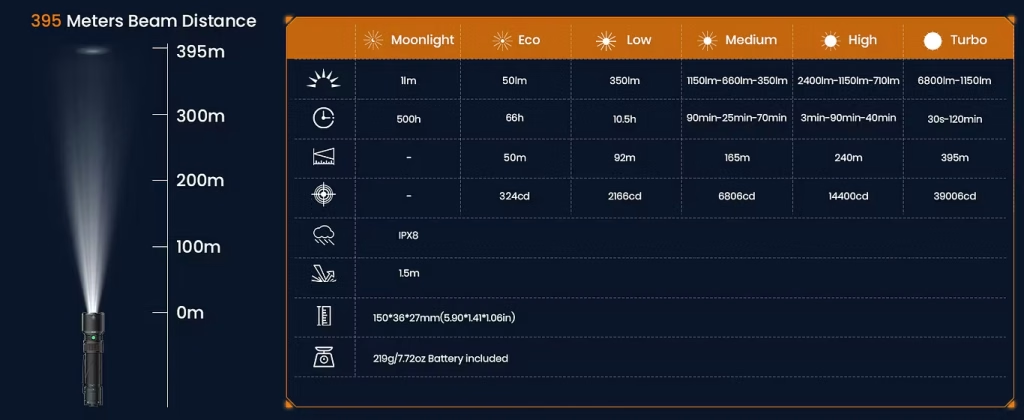
The official specs are above, followed by my own measurements below.
| Level | Lumens | Candela | Throw (Meters) | CRI (Ra) | Color Temp. (K) | DUV (Tint) |
| Turbo | 5500 | 36000 | 380 | 69 | 6710 | 0.0036 |
| High | 2500 | 16000 | 260 | 68 | 6460 | 0.0051 |
| Medium | 1250 | 8200 | 180 | 67 | 6280 | 0.0067 |
| Low | 380 | 2500 | 100 | 67 | 6250 | 0.0072 |
| Eco | 58 | 380 | 39 | 66 | 6280 | 0.0082 |
| Moonlight | 0.8 | 5 | 5 | 66 | 6010 | 0.0086 |
Runtime

Performance: Peak brightness is great, but it steps down quickly. Sustained brightness is also great at ~1200-1300lm. Surprisingly, the body of the light does not get too hot to hold when heat-saturated. Runtime is great too.
Thermal Management: My Turbo and Turbo Cooled tests are very close but not identical. If there is active thermal management here, it doesn’t seem to do much. It seems to be primarily timed stepdowns.
LVP (Low Voltage Protection) is present and works well. It doesn’t rely on the battery having a protection circuit. The light will shut off when the battery is practically empty, but it can be temporarily re-activated in an emergency. When the battery is low, the indicator LED in the mode group switch will start to breathe red but you can’t see it unless the port cover is open.
Driver
The driver is a Buck circuit according to my Sofirn contact. Buck drivers tend to be more efficient than the linear or FET drivers sometimes found in other budget hotrods.

Voltage immunity is a bit below average but not had. It’s about what I expected for such a hotrod. It would likely improve with a higher-discharge battery.
PWM: I can’t detect any PWM with my eyes, ears, nor Opple Light Master.
Parasitic Drain: I measured 9 microamps, which is suspiciously low. I don’t really believe that to be true but I’m leaving it here in case others get similar results and can corroborate. For context, that would take over 60 years to drain the battery from a full charge.
Batteries & Charging

The battery included is a Sofirn-branded 5000mAh unprotected flat top 21700 cell. A higher-discharge cell will probably provide better voltage immunity but this one is sufficient. I tried a protected cell but it was too long to fit.


Charging is facilitated by a USB-C port on the side of the light under a threaded cover. Charging takes about three hours. There’s no powerbank function, which is a shame. That’s a feature I normally expect on lights with 21700+ size batteries. It’s fully functional while plugged in.
The battery indicator is directly under the channel selector switch. It lights up for 5 seconds after the light is turned on to indicate battery status and any time it’s plugged in. You can’t see it at all unless the charging port cover is open. Here’s what it means:
| State | Indicator Color | Meaning |
| Unplugged | Solid Green | >75% |
| Unplugged | Flashing Green | 50-75% |
| Unplugged | Solid Red | 25-50% |
| Unplugged | Flashing Red | <25% |
| Plugged In | Solid Red | Charging |
| Plugged In | Solid Green | Full |
Carry & Ergonomics


Ergonomics are fine. It’s easy enough to teach the tail switches in a reverse grip. It may be difficult for people with small hands. The texturing on the body tube isn’t slippery but it’s less grippy than I’d like for a duty-style light.

Clip score: 5/7
- Attachment doesn’t pop off or rotate accidentally✅
- Can be removed and bent back into shape if needed✅
- Bezel-down carry is at a reasonable depth✅
- Landing location is smooth, not on the charging port, and away from the bezel✅/❌
- It lands on the body tube texturing, which isn’t smooth but it’s not rough either. Half point.
- Mouth/ramp and loop(s) are wide enough for pants material✅/❌
- The mouth of the clip doesn’t have a ramp to it, it’s just round. That’s not ideal, but I find I don’t usually have to lift the clip to pocket the light. Half point.
- Finish is durable✅
- No bidirectional clips without reason❌
- There’s no reason for this clip to be bidirectional. It’s far too large to clip to a hat, for example. The extra loop just makes it more likely to snag.


The holster is generic and rather bulky. It has a velcro closure and two loops in the back; one fixed and one that can be opened with a snap.
Competition
Here are some lights in the same class and how they compare.
Fenix TK20R V2.0: most-similar alternative
- 2-3x the price
- not quite as bright, more throw
- very similar design and layout
- dual tail switches instead of a dedicated lockout switch and hidden side switch
- USB-C charging and battery indicator similarly hidden under a threaded cover
- no embedded glass breakers
- better, but still suboptimal UI
Sofirn SK30: smaller, similar-budget alternative
- a bit less expensive, similar availability
- performance
- a bit smaller and lighter
- not quite as bright, similar throw
- dual tail switches with a better UI
- no dedicated lockout switch
- typical silicone-plug port cover with exposed indicator LED
Acebeam L16 2.0: best-UI alternative
- about 2x the price
- not as bright, much more throw
- exposed side switch with a normal e-switch UI
- dedicated independent Turbo tailswitch
- no dedicated lockout switch
- no threaded charging port & indicator cover
- no embedded glass breakers
This section is not comprehensive. If I didn’t include a particular light here, it doesn’t mean it’s bad or doesn’t deserve to be here. I simply cannot list every possible competitor.
Conclusion
I like the pricing, build quality, brightness, beam shape, runtime, dedicated lockout switch, and well-protected charging port. The pocket clip, ergonomics, and voltage immunity on the included battery are all ok. The one problem I have with this light is the sub-par UI.
Thanks to Sofirn for sending me this light for review!


